
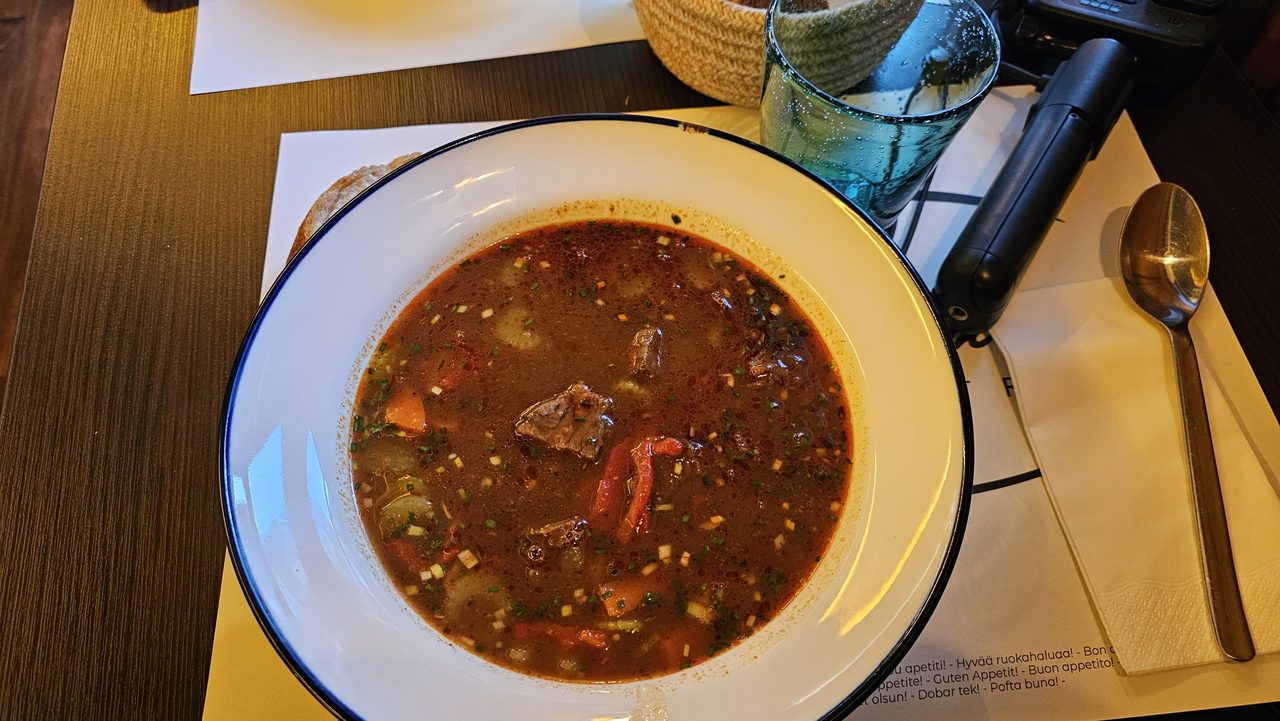
Photo: Hemant Bedekar · CC BY-SA 4.0
Chicken Paprikash
Chicken simmered with sautéed onions and paprika, then finished silky with sour cream — Hungary's beloved home dish. The red, creamy sauce coats the tender chicken, and spooned over nokedli egg dumplings it makes the perfect plate.
Ingredients
- Chicken · legs/thighs, cut up800 g
- Onions · finely chopped2
- Minced garlic2 cloves
- Paprika · sweet Hungarian3 tbsp
- Tomato · or 1 tbsp paste1
- Bell pepper · optional1
- Chicken stock · or water1.5 cups
- Oil · or lard2 tbsp
- Salt & pepper · to taste
- To finish
- Sour cream0.5 cup
- Flour1 tbsp
- To serve
- Nokedli · egg dumplings/spaetzle, or noodles/rice
Steps
- ⏲ 7 min
Season the chicken with salt and pepper. Brown it in oil in a pot, then remove.
- ⏲ 10 min
In the same pot, cook the onions low and slow until soft and golden, then add the garlic.
- ⏲ 30 sec
Off the heat, stir in the paprika quickly — burnt paprika turns bitter, so keep the heat off.
- ⏲ 35 min
Add the tomato, bell pepper, and stock, return the chicken, cover, and simmer gently 30-40 minutes.
- ⏲ 2 min
Mix the flour into the sour cream, temper with a little hot sauce, then stir into the pot to thicken — do not boil.
Adjust the seasoning and serve with nokedli, noodles, or rice.
Variations
- Mushroom paprikash: Use mushrooms for a vegetarian version.
- Spicier: Add hot paprika or chili.
- Beef or veal: Make it pörkölt-style.
- Gluten-free: Thicken with cornstarch instead of flour.
Tips
- Add the paprika off the heat — it turns bitter if it scorches.
- Cook the onions well so the sauce is deep and rich.
- Temper the sour cream and don't boil it, or it will split.
- Use plenty of good Hungarian sweet paprika — it's the heart of the dish.
More detail and the reasons why (4)
- Paprika is a dried fruit, not a spice seed. That is why it behaves the way it does: it carries real sugar, so it scorches and turns bitter far faster than a seed spice, and its colour is a fat-soluble carotenoid, so it needs fat to give that colour up at all. Off the heat but into the fat — and only for a moment, the same window ground spices get in blooming spices.
- Tempering is one of several answers to the same risk. Dairy and heat gives three ways cultured dairy splits — boiling, acid, and salt plus prolonged heat — and dishes answer it differently: Dovga stabilises yoghurt with egg and flour so it can be boiled outright, Šaltibarščiai never applies heat, Qurutob stops below the splitting temperature, and paprikash raises the cream to meet the pot instead of the other way round.
- The flour in the sour cream is doing two jobs. It thickens, and it physically gets between the casein so the proteins cannot find each other and clump — which is Dovga's whole mechanism, used at the end of the cooking rather than the start.
- "Cook the onions well" is most of the sauce. Stock and tomato go in only once the onion has broken down, and the cream only at the very end, so the body comes from onion broken down in fat. Doro Wat is the far end of that same idea.
The basics behind this dish
- Browning and the Maillard ReactionMeat fails to brown for one of three reasons: it is wet, the pan is cool, or you put too much in at once. Plus how the brown film stuck to the pan becomes your sauce.
- Cooking Meat: Temperature, Resting, and Cutting Against the GrainDoneness is a core temperature, not a number of minutes. What resting actually does, how to handle a thick cut, and why the direction you slice changes the texture.
- Knife Skills: Grip, Cuts, and Why Size MattersHow you hold the knife matters more than how fast you cut. The pinch grip, the claw hand, and why uniform size is a cooking decision rather than a cosmetic one.
More of the same kind


More from this country


Sign in to edit.
Written with AI · how we check it · Edit history
https://cookiki.com/en/r/chicken-paprikash · cookiki · User contributions are licensed under CC BY-SA 4.0.