
Photo: Wibowo Djatmiko (Wie146) · CC BY-SA 4.0
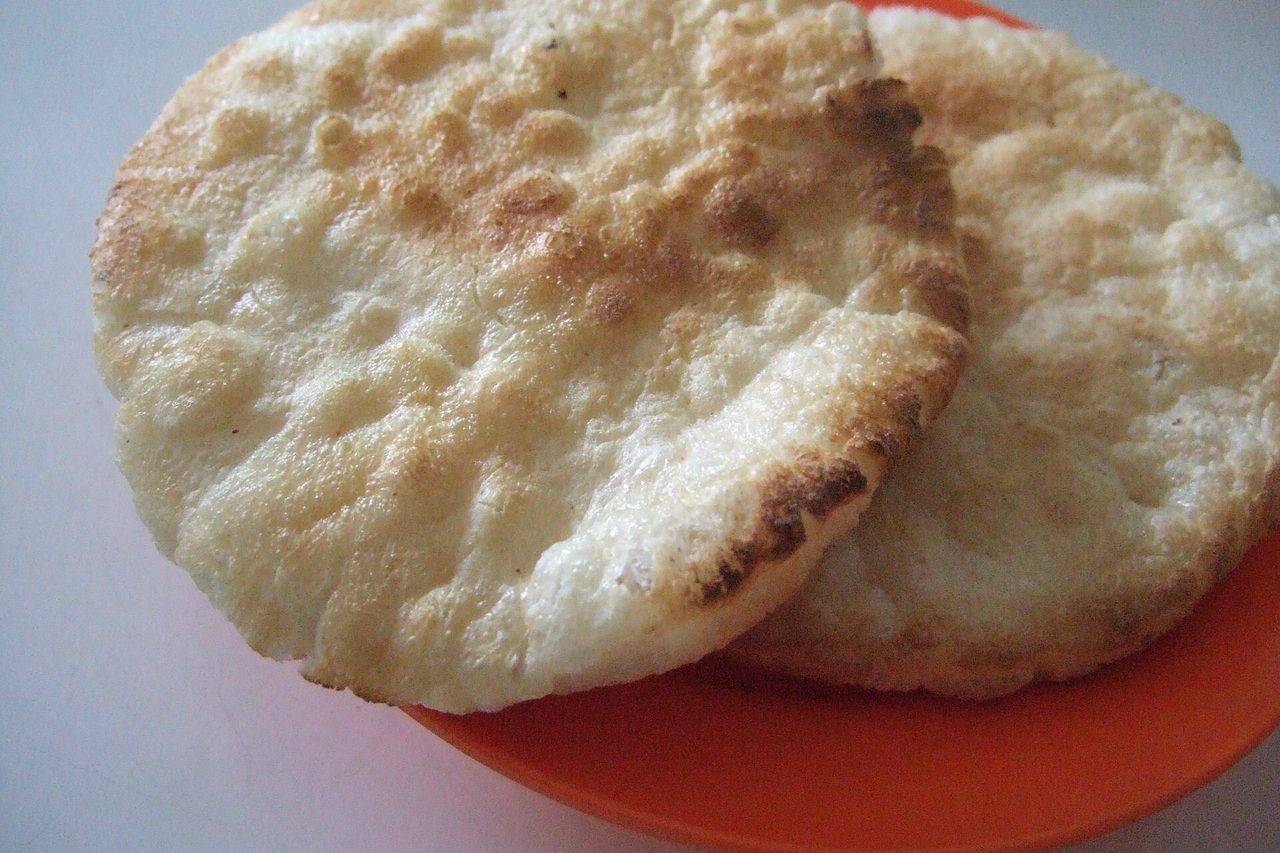
Kue Rangi (Coconut Sago Cakes Baked Without Oil)
A street snack of Jakarta's Betawi people: grated coconut and sago starch dampened with a few spoonfuls of water, pressed into a small mould and baked under a lid with no oil at all. There is no oil because the grated coconut, in the heat, gives up its own oil and a thick milk that bind the batter — the coconut is neither pressed nor reduced, kept whole in the cake, and still yields its fat in the mould. Spread with thickened palm-sugar syrup and eaten warm.
Ingredients
- Batter
- grated coconut flesh · from a mature coconut; or 150g unsweetened desiccated coconut soaked in 80ml warm water for 10 minutes200 g
- sago starch · or tapioca starch100 g
- tapioca starch50 g
- salt0.5 tsp
- water · more or less, depending on how moist the coconut is60 ml
- Palm-sugar syrup
- palm sugar · gula jawa or gula aren150 g
- water200 ml
- pandan leaf · knotted, optional1
- tapioca starch · mixed with 2 tbsp water1 tbsp
- jackfruit · finely chopped, optional50 g
Steps
- ⏲ 5 min
Break up the palm sugar and melt it with the water and pandan over low heat for 5 minutes. Strain it and return it to the pan.
- ⏲ 1 min
Stir in the starch slurry and boil for 1 minute more, until it is glossy and coats a spoon thinly. Take it off the heat and stir in the jackfruit, if using.
Put the coconut, sago starch, tapioca starch and salt in a bowl and rub them together with your hands. Add the water a spoonful at a time, still rubbing, and stop when it is like damp sand: it holds when you squeeze a handful and crumbles when you open your hand. If it flows like a batter it is too wet.
- ⏲ 5 min
Heat the kue rangi mould over medium-low heat for 5 minutes. Do not oil it. Without a mould, use a heavy cast-iron pan.
Fill each slot to the top and press it level with the back of a spoon. In a cast-iron pan, press rounds 6cm across and 1cm thick.
- ⏲ 5 min 30 sec
Cover and bake for 5-6 minutes, until the bottom is deep brown and the edges come away from the mould on their own. If they stick, give them another minute.
Lift them out with a small spatula and spread the tops with syrup. Heat the mould for a minute before the next batch.
Eat them warm. Keep any leftover batter in the fridge and bake it all the same day.
Tips & Variations
Variations
- Fruit in the syrup: Korean Wikipedia notes that chopped jackfruit, pineapple or durian is sometimes stirred into the syrup for flavour and aroma.
- Without a mould: some street sellers make it without the special mould. Pressed into rounds in a cast-iron pan it is the same cake in a different shape.
- Over charcoal: the name itself is about the fire. Kue rangi is short for digarang wangi, and garang means cooking over charcoal without oil. Street sellers bake it on a small charcoal stove.
Tips
- No oil in the mould. Korean Wikipedia gives the reason: no oil is added because the grated coconut becomes oil and a thick coconut milk that binds the batter by itself.
- The fat comes out without a press. Urap puts coconut milk like this: "Making milk means pulling the fat and water out of the flesh and discarding the flesh." And of its own way, keeping the flesh whole: "With nothing extracted there is no emulsion to break, and the oil and aroma stay inside the shreds and burst as you chew them." Rendang reduces the milk for two hours until the oil comes out: "The coconut milk splitting is the doneness sign, where elsewhere it is the failure to avoid." Kue rangi puts both in one mould. The flesh is not thrown away but stays in the cake, and the hot mould draws its oil and milk out of it.
- Which is why the coconut is mature. The main ingredients Korean Wikipedia lists are ripe coconut, tapioca starch, sago, a little salt and water. The flesh is what has to give up the oil and milk, so use grated flesh from a hard, mature coconut rather than a soft young one.
- Only a few spoonfuls of water. Papeda pours boiling water onto sago starch to make a glue, and as that page puts it, "Papeda uses the same move with four times the water, cooking all of it, so there is no dough left to knead, only glue." Here you stop when the mixture is damp sand. The starch cooks in the heat of the mould and the milk from the coconut, and the sago, per Korean Wikipedia, is what makes it chewy.
- Put the lid on. The article says the lid goes on so it cooks quickly. The bottom browns against dry iron while the top cooks in the trapped steam, and that browned bottom is where the toasty taste comes from, which the article credits to this way of cooking. It is the same side of coconut as the serundeng of kerak telor, the same grated coconut dry-fried in a pan.
- Thicken the syrup with starch. Palm-sugar syrup thickened with a little tapioca starch is the tradition. A thin syrup soaks in and wets the top; a thick one stays on it (thickening sauces).
- Use the batter the same day. Korean Wikipedia is clear that the batter spoils easily, cannot be kept, and must all be used within a day. Mix only as much as you need and keep the rest in the fridge.
The basics behind this dish
- Deep Frying: Temperature, Batter, and the Second FryFrying is not cooking in oil so much as trading the food's water for it. Two temperatures, what each kind of coating is for, and why the second fry exists.
- Heat Control: Preheating, Oil, and Reading the PanThe same ingredients become a different dish depending on pan temperature. When to add the oil, how to read heat by sound, and which dishes want low heat instead.
- Knife Skills: Grip, Cuts, and Why Size MattersHow you hold the knife matters more than how fast you cut. The pinch grip, the claw hand, and why uniform size is a cooking decision rather than a cosmetic one.
More of the same kind


More from this country


Sign in to edit.
AI-drafted, editor-reviewed · edits: 0 ·Edit history
https://cookiki.com/en/r/kue-rangi · cookiki · User contributions are licensed under CC BY-SA 4.0.