
Photo: RianHS · CC BY-SA 4.0
Dangke (Fresh Milk Curd Set with Papaya)
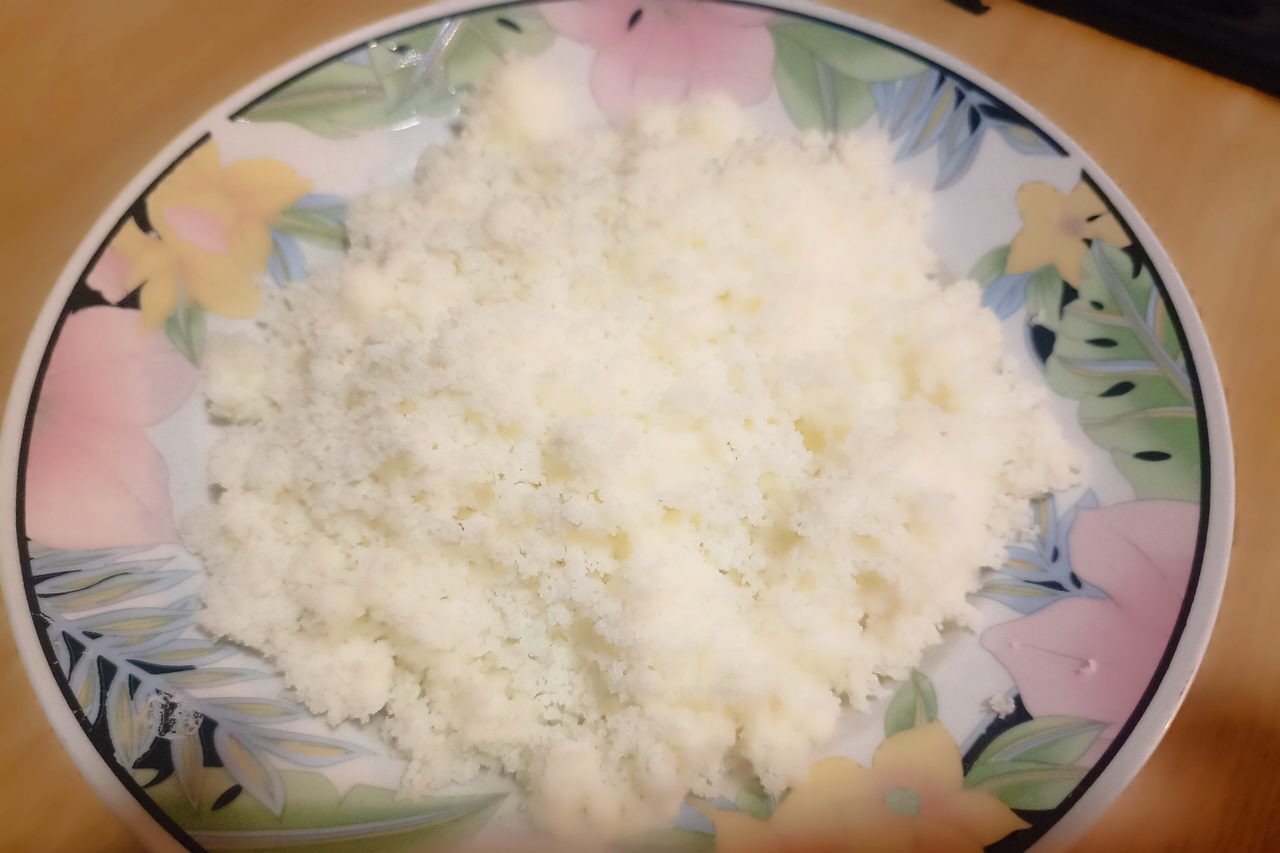
A fresh cheese from Enrekang in South Sulawesi. Milk from the same day, buffalo or cow, is heated with unripe papaya or its leaves, and the papaya's enzyme sets it. It is the same kind of enzyme that softens meat in a pear-based marinade, here made to curdle milk. The curd is shaped in half coconut shells and eaten as it is, tofu-like, or grilled and fried.
Ingredients
- Curd (4 people)
- whole milk (or buffalo milk) · not UHT; ordinary pasteurised or raw milk2 L
- unripe papaya · thinly sliced with the skin on, where most of the white sap is; or 2 papaya leaves, shredded60 g
- salt1 tsp
- To finish
- brine · 500ml water with 1 tbsp salt500 ml
- banana leaf · to wrap; optional
- neutral oil · for frying2 tbsp
Steps
Wear gloves for the unripe papaya: the white sap in the skin can sting. Slice it thin, skin on.
Put the milk and salt in a pan and warm slowly over medium heat, stirring now and then so the bottom does not catch.
- ⏲ 8 min
When a thermometer reads 70°C, add the papaya, give it one good stir, then stop stirring. As it nears 80°C, turn the heat down low so it does not go over, and within 5-10 minutes white curd gathers and a clear, faintly green whey separates between the pieces.
If the whey is still cloudy after ten minutes, add a little more papaya — a little at a time. Too much and it turns bitter.
- ⏲ 30 min
Lift out the papaya. Ladle the curd with a slotted spoon into half coconut shells or small moulds and press it in. Leave 30 minutes to drain.
Turn the curds out and leave them in the brine in the fridge overnight. If you used papaya leaf, this is where its bitterness is covered. Lift out and wrap in banana leaf.
- ⏲ 5 min
Eat it sliced as it is, or cut 1cm slices and fry in an oiled pan for 2-3 minutes a side until golden.
Tips & Variations
Variations
- Dangke bakar: grilled over charcoal. The photograph shows it pan-fried, browned on both faces.
- Dangke tumis: cubed and stir-fried with sambal.
- Dangke crackers: sliced thin, dried and fried.
- With buffalo milk: Enrekang's original. More fat and protein than cow's milk, so more curd, and firmer.
- Other plant enzymes: Guangdong's ginger milk curd also sets milk with a plant's enzyme.
Tips
- The enzyme that softens meat sets the milk. Galbi explains the pear in its marinade: "Protease from pear, onion and kiwi keeps working the whole time the meat sits, which puts a ceiling on the marinade." Unripe papaya carries the same kind of enzyme, one that cuts protein. Meeting meat, it loosens muscle; meeting milk, it cuts the casein and the milk curdles.
- As a way of setting milk, it belongs with rennet. Ricotta sorts the ways to set milk into acid, a calcium salt and rennet, and notes that "all three set the same protein, casein". Dangke is on the rennet branch: an enzyme cuts the casein. The difference is that the enzyme comes from papaya rather than a calf's stomach.
- And it does not stop at one place. Mozzarella says that "rennet cuts one spot on the casein surface and leaves the calcium inside". Papaya's enzyme is not that selective; it cuts protein wherever it finds it. That is why the dose has a ceiling. ko.wikipedia notes that too much enzyme makes the cheese strongly bitter — the same shape of ceiling as the pear that turns meat from tender to mealy.
- It sets in hot milk. Rennet works slowly in lukewarm milk; dangke meets its enzyme at 70°C and sets in minutes below 80°C. Add at 70°C, turn the heat down at 80°C: that is the order ko.wikipedia gives. Dairy and heat warns that boiling makes the proteins in cream clump and split; in dangke the enzyme makes them clump first, and on purpose.
- The overnight brine seasons and covers. According to ko.wikipedia it is there to cover the bitterness of papaya leaf. It also seasons the curd evenly and firms the outside a little, which makes it easier to slice.
- The texture is close to tofu, as ko.wikipedia says. Douhua, set with a calcium salt, starts from soy milk rather than milk, but pressed and drained the two end up as similar blocks.
The basics behind this dish
- Blanching: Keeping Vegetables GreenBlanched vegetables go dull because of acid and heat. Why the pot should be large, why the lid stays off, and what the ice bath is really for.
- Salt: When You Add It Matters More Than How MuchThe same amount of salt either draws water out or seasons all the way through, depending on when it goes in. Osmosis, seasoning in layers, and why salt types are not interchangeable by volume.
- Knife Skills: Grip, Cuts, and Why Size MattersHow you hold the knife matters more than how fast you cut. The pinch grip, the claw hand, and why uniform size is a cooking decision rather than a cosmetic one.
More of the same kind


More from this country


Sign in to edit.
AI-drafted, editor-reviewed · edits: 0 ·Edit history
https://cookiki.com/en/r/dangke · cookiki · User contributions are licensed under CC BY-SA 4.0.