
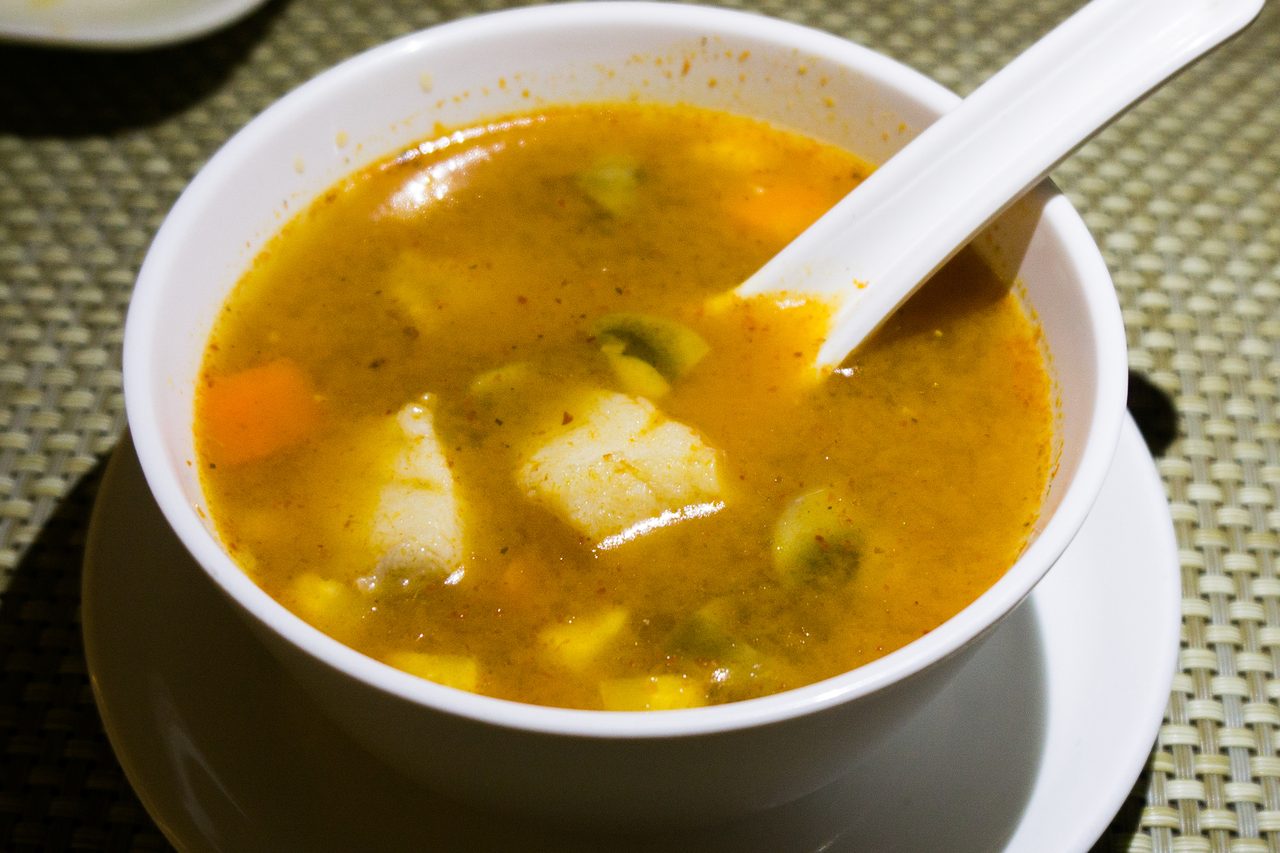
Photo: Vee Satayamas · CC BY 2.0
Tom Yum Goong (Hot & Sour Shrimp Soup)
Thailand's iconic hot-and-sour shrimp soup — broth perfumed with lemongrass, galangal, and kaffir lime leaf, brightened with lime at the end. Sour, spicy, savory; one of the world's most famous soups.
Ingredients
- Shrimp · heads & shells on (for stock)10
- Mushrooms · button or king oyster1 handful
- Cherry tomatoes6
- Water or stock4 cups
- Aromatics
- Lemongrass · bruised, cut in lengths2 stalks
- Galangal · not ginger4 slices
- Kaffir lime leaves · torn4
- Thai chilies · crushed3
- Seasoning
- Fish sauce3 tbsp
- Lime juice · added at the end3 tbsp
- Nam prik pao · chili jam, optional1 tbsp
- Sugar1 tsp
- Cilantro · garnish1 handful
- Coconut milk · for nam khon style, optional0.5 cup
Steps
- ⏲ 5 min
Peel the shrimp, keeping the meat aside and the heads/shells separate. Briefly fry the heads and simmer them in the stock for deeper umami.
- ⏲ 5 min
Add the lemongrass, galangal, kaffir lime leaves, and crushed chilies to the boiling stock to infuse the aromatics.
- ⏲ 3 min
Add the mushrooms and cherry tomatoes and simmer. (For nam khon style, add the coconut milk and nam prik pao here.)
- ⏲ 2 min
Add the shrimp and cook only until they turn pink — overcooking toughens them.
- ⏲ 1 min
Off the heat, season with fish sauce and sugar, then stir in the lime juice last. (Boiling the lime turns it bitter.)
Top with cilantro and serve right away, with rice or on its own.
Tips & Variations
Variations
- Nam khon (creamy): With coconut milk and nam prik pao for a rich, smooth soup.
- Nam sai (clear): No coconut — clear and sour, the classic version.
- Tom yum noodles: Serve the broth over rice noodles.
- Chicken/mixed seafood: Use chicken, or squid and mussels, instead of shrimp.
Tips
- The shrimp is bought once and used twice, and the recipe's first line is the second use. Heads and shells are fried and simmered into the stock before anything else happens, which is a step no other part of the page mentions. Poo pad pong curry states the principle from the other side — "the shells give the sauce, so fry a handful of prawn shells in the oil first to make some of it back" — and that pairing is the whole idea: the same shells go into water here and into oil there.
- Which medium you choose decides which half of the shell you get. The orange that bleeds out of a fried shell is a carotenoid and dissolves in fat; the savour is water-soluble and comes out into a simmer. Blooming spices sets that split up as the premise of the whole guide and names the exceptions that run the other way. A crab curry wants a coloured, perfumed oil to build a sauce on; a clear sour soup wants none of that oil and all of the savour, which is why the heads are fried only briefly and then go into the pot rather than staying in the pan.
- The lime last is not the same instruction as the fish sauce last. Fish sauce is held back because heat drives its aroma off; lime juice is held back because its acidity is largely citric, which does not evaporate but does turn dull and faintly bitter when boiled, taking the fresh top note with it. Rasam makes the general rule explicit — which acid it is decides where in the recipe it goes — and tamarind, its opposite case, is safe at either end.
- Sinigang is the neighbour that shows the difference. Both are sour soups built on a souring agent rather than on a stock, but that one sours with tamarind and can do it forty minutes before serving, while this one cannot sour until the heat is off. Same shape of dish, and the acid decides the whole order of both.
- The trio of lemongrass, galangal, and kaffir lime leaves is the heart of the aroma — without them it isn't tom yum (use an Asian market or tom yum paste).
- The aromatics are there to infuse, not to eat — fish them out or set them aside.
- Add the lime juice off the heat, at the very end — boiling it makes it bitter.
- Cook the shrimp just until pink so they stay plump.
- Balance the sour (lime), salty (fish sauce), spicy, and sweet to taste.
The basics behind this dish
- Blooming Spices: Why Aromatics Go into Fat FirstStir ground spice into liquid and half the aroma never arrives, because most aroma compounds are fat-soluble. The thirty-second window, and the order things go in.
- Balancing Flavour: Salt, Acid, Sweet, Fat, HeatWhen something tastes like it is missing something, it is usually salt or acid. Five dials, the order to turn them, and how to taste properly.
- Fresh Herbs: Hardy, Delicate, and When to Add ThemAroma is volatile, so timing is the whole game. What separates a hardy herb from a delicate one, why the stems are worth more than you think, and why basil should never meet a knife.
More of the same kind


More from this country


Sign in to edit.
AI-drafted, editor-reviewed · edits: 0 ·Edit history
https://cookiki.com/en/r/tom-yum · cookiki · User contributions are licensed under CC BY-SA 4.0.