
Photo: elingunnur · CC BY 3.0
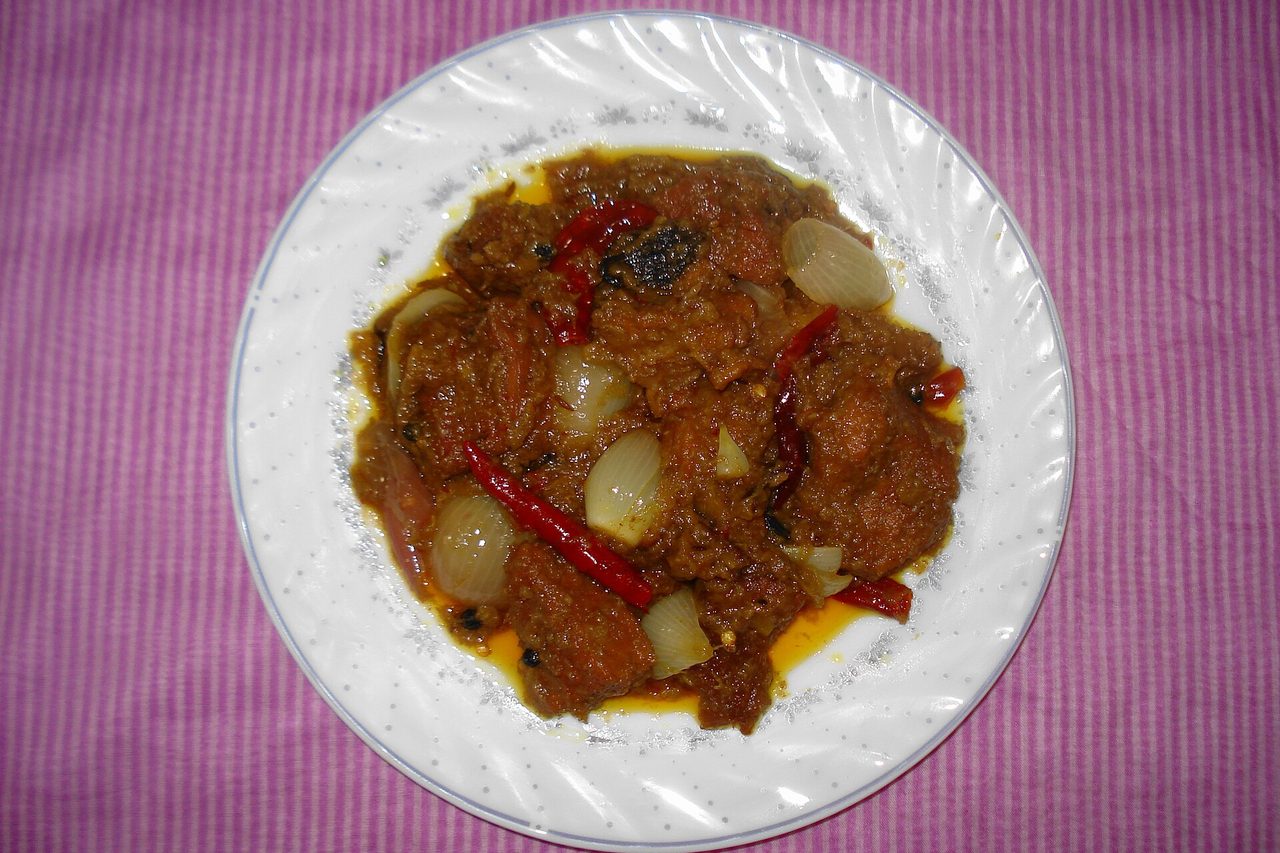
Calulu (Fish Stew with Greens and Okra)
Angola's signature fish stew: dried smoked fish, fresh fish, greens, okra and aubergine layered in the pot and simmered without stirring. The savoury backbone is the dried fish rather than the fresh, and not stirring is the only way the fish stays in pieces.
Ingredients
- The fish
- Dried smoked fish · The savoury backbone; leave it out and it is a different dish150 g
- Firm white fish · Cod, grouper, hake — thick steaks or chunks600 g
- Lime juice · To season the fresh fish; lemon works2 tbsp
- Salt · For the fresh fish1 tsp
- The vegetables
- Sweet potato leaves · Spinach, kale or chard if you cannot find them300 g
- Okra · Left whole, not sliced — see the tips200 g
- Aubergine · In large chunks1
- Tomatoes · Ripe, roughly chopped3
- Onions · Thickly sliced2
- Garlic · Minced4 cloves
- Red chilli · To taste; can go in whole1
- Fat and liquid
- Red palm oil (dendê) · The colour and the characteristic aroma — substitutes below4 tbsp
- Dried shrimp · Optional; another layer of savouriness2 tbsp
- Water · Use the strained fish soaking liquid as part of it400 ml
- Salt · Seasoned at the very end
- To serve
- Funge · Thick cassava-flour porridge; calulu's partner
- Rice · If there is no funge
Steps
- ⏲ 30 min
Soak the dried smoked fish in warm water for 30 minutes. Lift it out, pick out the big bones, tear it into large pieces, and strain and keep the soaking liquid — the savouriness is in that water.
- ⏲ 20 min
Season the fresh fish with the lime juice and salt and leave it 20 minutes. The flesh firms up and loses any muddy note.
- ⏲ 15 min
Thickly slice the onions; cut the tomatoes and aubergine into large pieces. Wash and roughly chop the greens. Trim the okra stems but do not cut the pods.
- ⏲ 10 min
Layer the pot. Palm oil on the base, then onion, garlic and chilli → tomato → aubergine → dried fish (and dried shrimp) → the fresh fish → okra → the greens piled over the top. This order is the recipe.
- ⏲ 2 min
Add the strained soaking liquid and water to come only halfway up the ingredients. The greens release a lot of liquid, so a full pot of stock leaves you with something watery.
- ⏲ 40 min
Cover and simmer on low for 35–45 minutes. Do not stir at any point. The greens on top collapse and their juices run down through the layers, which cook in each other's steam.
- ⏲ 3 min
When the fish is cooked through and the okra is tender, take it off the heat and rock the pot gently from side to side instead of stirring. A spoon breaks the fish apart.
- ⏲ 3 min
Now taste it for the first time. The dried fish and shrimp have already salted it, so add salt sparingly and late — see Salt and seasoning. A little more lime juice sets the sourness.
- ⏲ 2 min
Serve with funge or plain rice. There is plenty of liquid, and it is meant to be spooned over the starch.
Tips & Variations
Variations
- Meat calulu: calulu de carne, made with beef or dried meat, is just as common. Simmer the meat 40–50 minutes until tender before it goes into the layers — the reasoning is in Braising: collagen and time.
- Without palm oil: red palm oil (dendê) supplies colour and aroma at once. Four tablespoons of neutral oil with a teaspoon of paprika gets the colour but not the aroma — it is more honest to treat that as a different dish. Brazilian grocers sell the same thing as 'dendê oil'.
- The greens: sweet potato leaves are standard in Angola. Spinach is the easiest but collapses fast, so add it for the last 15 minutes; kale and chard can go in from the start.
- São Tomé and Príncipe: calulu is a signature dish of both Angola and São Tomé and Príncipe. It is filed here under Angola, but claiming it for either alone would be wrong. The São Tomé version uses a wider range of leaves.
- Related dishes: Congolese moambe chicken uses palm fruit and Cameroonian ndolé uses peanut and bitterleaf, but all three build their depth on dried fish in the same way. So does Senegalese thieboudienne.
- Without okra: the okra thickens the liquid gently. Left out you get a much thinner stew, so add a little more aubergine to compensate.
Tips
- Do not skip the dried fish. Adding fish to a fish dish sounds redundant, and it is nevertheless where all the depth comes from. Smoking and drying concentrate a savouriness fresh fillets cannot produce — the same structure is set out in Building umami.
- Keep the soaking liquid. Strain it, since dried fish often carries grit, and use it as part of the cooking liquid.
- Do not stir. This is what the layering is for. Stirred, the fish shreds and you end up with a mush. If you want it combined, rock the pot.
- Leave the okra whole. Cut pods weep their mucilage and the liquid turns ropy. Whole, they thicken it smoothly instead.
- Liquid only halfway up. It is easy to underestimate how much water 300g of greens gives off. You can always add more later; you cannot take it out.
- Season at the end. Dried fish, dried shrimp and palm oil are all bringing salt and savour, and the liquid concentrates as it simmers. Salted at the start it is almost always too salty.
- Finish with lime. Acidity cuts through the richness of the palm oil and dried fish. Adding it last is the method described in Balancing flavour.
- It is better the next day. The layers need time to come together properly. Reheat gently over low heat, again without stirring.
The basics behind this dish
- Reviving Leftovers: Reheating by Texture, Not by DefaultThe microwave is not the right tool for everything. What you do depends on what degraded — moisture, crispness, or starch — and the three want opposite treatments.
- Thickening a Sauce: Starch, Roux, and ReductionSlurry, roux, reduction — three methods that do not give the same result. Why a starch-thickened sauce thins on reheating, and why the slurry has to be mixed cold.
- Browning and the Maillard ReactionMeat fails to brown for one of three reasons: it is wet, the pan is cool, or you put too much in at once. Plus how the brown film stuck to the pan becomes your sauce.
More of the same kind


Sign in to edit.
AI-drafted, editor-reviewed · edits: 0 ·Edit history
https://cookiki.com/en/r/calulu · cookiki · User contributions are licensed under CC BY-SA 4.0.