
Photo: Rosser1954 · CC BY-SA 4.0
Laverbread (Laver Seaweed Boiled Down to a Purée)
Laver gathered on the Welsh coast and boiled for hours until every frond has come apart into a glossy black purée. Despite the name it is not a bread: it is spread on toast, or mixed with fine oatmeal and fried in bacon fat for breakfast. Laver is the seaweed Korea and Japan press into thin sheets and dry, and gimbap counts a softened sheet as a failure. Laverbread goes to the other end — cooked in water until the seaweed is no longer a sheet at all.
Ingredients
- Laverbread (about 400g)
- fresh laver · raw, as sold in season; with 400g tinned laverbread skip steps 1-3600 g
- water · to cover, topped up as it reduces
- salt · to taste, at the end
- black pepper · a little
- lemon juice1 tsp
- Breakfast (4 people)
- fine oatmeal · or rolled oats blitzed fine40 g
- bacon8 rashers
- bread · for toast4 slices
Steps
Swish the laver in a large bowl of cold water, lift the seaweed out and pour the water away — the sand stays on the bottom, so do not tip the bowl out with the laver in it. Repeat four or five times, until no sand is left in the bowl.
Put the laver in a pan, cover with water, bring to the boil and turn the heat down low. Simmer, lid ajar, for several hours: wild laver from the Welsh coast can take five or six. How long it takes varies a great deal from one batch to the next, so go by its state, not the clock. Stir now and then so it does not catch, and top up the water as it reduces.
It is done when stirring leaves no strands and the whole pot collapses into one sticky black purée. Pour off any water left, and if the texture is still coarse, mash it with a fork or give it a moment in a blender.
Season with salt, pepper and lemon juice. That is laverbread. Cooled and chilled, it keeps three or four days.
- ⏲ 10 min
Mix 200g of the laverbread with the oatmeal and leave 10 minutes. Once the oatmeal has taken up the moisture and it can be handled, shape it into four flat cakes 1.5cm thick.
- ⏲ 6 min
Fry the bacon and lift it out, then fry the cakes in the bacon fat for 3 minutes a side, until the outside has set and they turn without breaking.
Serve with the bacon. Spread any laverbread left over thickly on hot toast.
Tips & Variations
Variations
- On toast: the photograph. Cold laverbread spread on hot toast, sometimes with scrambled egg on top.
- With cockles: a South Wales breakfast, Swansea's especially, puts bacon, laverbread cakes and boiled cockles on one plate.
- Tinned: what most people outside Wales use. It is already cooked to a purée, so start at step 4 (season to taste).
- The name: in Welsh, bara lawr. "Welsh Laverbread" was registered as an EU protected designation of origin in 2017. The same seaweed is eaten on the Irish and Scottish coasts too, under names of its own (sloke, slake).
Tips
- Gim, taken to the other end. Laver is the English for gim. The laver on the Welsh coast (Porphyra umbilicalis) is a red seaweed of the same group as the one Korea and Japan press into sheets. Gimbap cools its rice before rolling because "Too hot and the steam softens the gim", and bugak makes "two sheets of laver glued together with the paste" and dries them hard. Laverbread never dries the seaweed at all: it boils it in water until the fronds that would have become a sheet have come apart entirely.
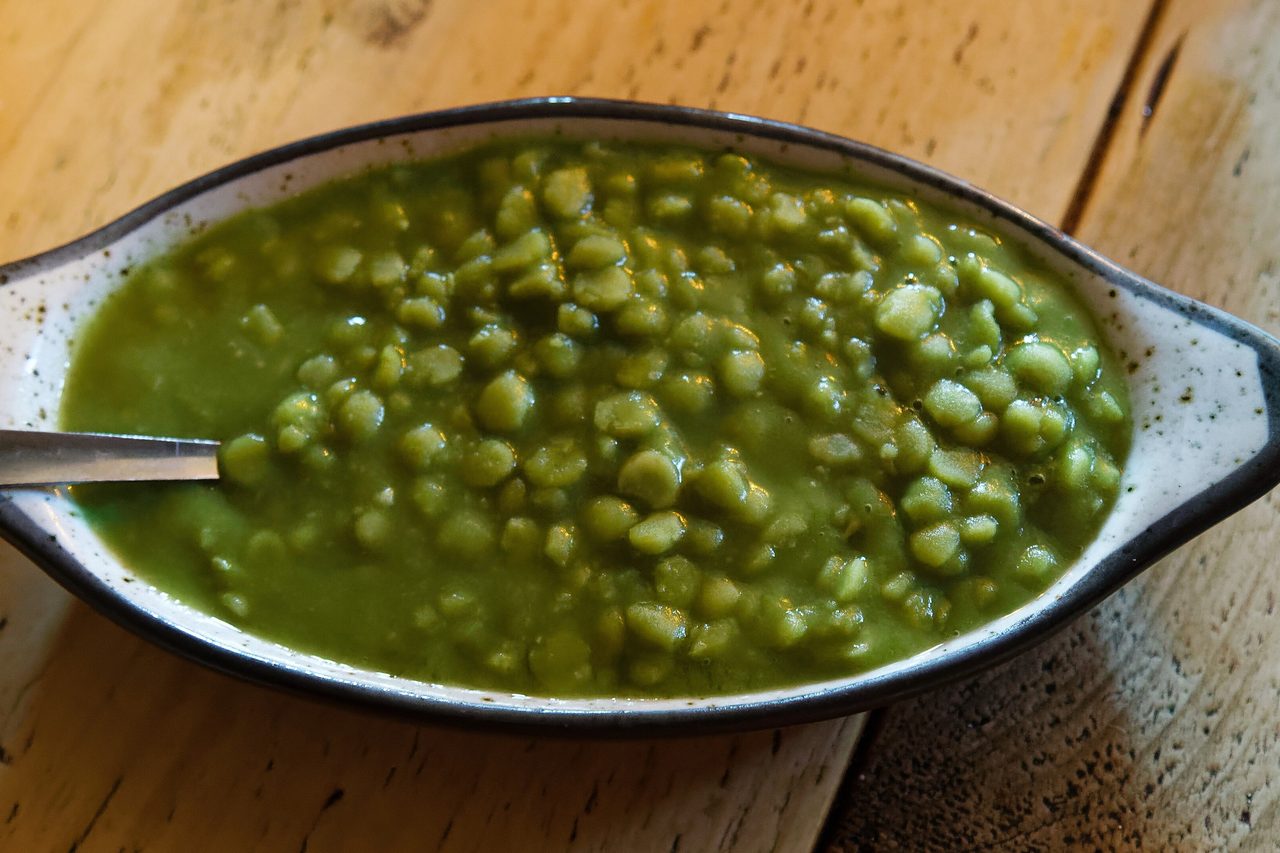
- Another British side cooked until it collapses. Mushy peas also boils until the food gives way, but there bicarbonate does the work: "The soda is not dissolving the skin — it dissolves the pectin gluing the cells of the pea together", so the pea gives way from the inside. Laverbread has no such help, only time, which is why it takes hours.
- Go by the state, not the clock. Wild or farmed, which coast and which month — the thickness of the laver varies, and the time with it. Strands still showing mean it is not there yet; when stirring folds it into one glossy mass, it is done.
- Leave the sand in the bowl. Pour the bowl through a sieve and the sand that had settled goes straight back over the laver. Lift the seaweed out and throw the water away, again and again. Once it is cooked there is no way to pick the sand out.
- Salt at the end. It comes from the sea, so some salt stays after washing, and hours of reducing concentrate it. Salt it before and you cannot take that back. The lemon juice tidies up the seaweed's marine edge.
- The oatmeal is there to drink the water. A purée cannot hold a shape by itself, so it needs an oat that takes up water fast. Haggis has the sentence that sorts the two oats: "Rolled oats have already been steamed and flattened, so they take up water fast and spread into paste." Haggis chooses pinhead for that reason, so its grains stay whole; here the choice is the one that spreads. The ten minutes is the time it needs to drink.
- Why bacon fat. The purée is deep in flavour but has no fat in it. Frying in bacon fat sets the outside and adds salt and fat at the same time, which is what makes it sit on one plate with the rest of breakfast. Put it beside cawl, also Welsh, and the two describe one kitchen: root vegetables given two hours, seaweed given half a day.
The basics behind this dish
- Blanching: Keeping Vegetables GreenBlanched vegetables go dull because of acid and heat. Why the pot should be large, why the lid stays off, and what the ice bath is really for.
- Salt: When You Add It Matters More Than How MuchThe same amount of salt either draws water out or seasons all the way through, depending on when it goes in. Osmosis, seasoning in layers, and why salt types are not interchangeable by volume.
- Knife Skills: Grip, Cuts, and Why Size MattersHow you hold the knife matters more than how fast you cut. The pinch grip, the claw hand, and why uniform size is a cooking decision rather than a cosmetic one.
More of the same kind


More from this country



Sign in to edit.
AI-drafted, editor-reviewed · edits: 0 ·Edit history
https://cookiki.com/en/r/laverbread · cookiki · User contributions are licensed under CC BY-SA 4.0.