
Dorayaki (Red Bean Pancake Sandwich)
Two small castella-like pancakes sandwiching sweet red bean paste. The honey and mirin in the batter are what make it this and not a pancake — the moisture, the sheen and the few days of keeping all come from there. The one real technical hurdle is an evenly browned face with no speckles.
Ingredients
- Makes 6
- Batter
- eggs · room temperature2
- sugar60 g
- honey · do not leave it out — it is the source of the moisture and the sheen20 g
- mirin · gives the surface its colour and gloss10 ml
- plain flour · sifted100 g
- baking powder3 g
- water · adjusted by how the batter runs30 ml
- Red bean paste
- adzuki beans · soaked overnight; 300g of shop-bought tsubuan works instead200 g
- sugar · about 80% of the weight of the beans, added in two stages160 g
- salt · gives the sweetness an edge1 pinch
- For the pan
- neutral oil · brushed on, then wiped almost entirely away with kitchen paper a little
Steps
Soak the adzuki beans in water overnight. With shop-bought paste, skip this and the next two steps.
- ⏲ 60 min
Bring the soaked beans to the boil in fresh water and throw the first water away — that takes out the astringency. Cover generously with water again and simmer gently 50-60 minutes, until a bean crushes under your finger.
Cook the water down, then add the sugar in two lots, stirring as it reduces. When a spatula drawn across the base leaves a trail that holds for a moment, add the salt and take it off. It thickens further as it cools, so stop while it is still a little loose.
Beat the eggs in a bowl and add the sugar, honey and mirin, mixing until the sugar has completely dissolved. You are dissolving, not whisking air in.
Add the sifted flour and baking powder and mix only until no dry flour shows. Stirred longer it develops gluten, which toughens it and puckers the surface.
- ⏲ 30 min
Cover and rest it in the fridge 30 minutes. The flour hydrates and the bubbles settle, which is what gives a smooth face. Batter that skipped these 30 minutes bakes with pinholes and speckles.
Check the consistency. It should fall off the spatula in an unbroken ribbon. If it is stiff, add water a tablespoon at a time.
Heat the pan on low and let it come up properly, then brush it with oil and wipe almost all of it off with kitchen paper. Oil left in the pan fries that spot and gives you a blotchy face — the secret to an unspeckled surface is the pan, not the batter.
Pour from a height, in one go, onto one spot and let it spread into a circle by itself. Do not push it out with a spatula. About 8cm across is right.
- ⏲ 2 min
Cook 2 minutes, until holes open on the surface and the gloss goes, then flip and give it 1 minute more. The side cooked first becomes the outside of the finished cake.
- ⏲ 10 min
Stack the cooked pancakes on a plate and let them cool 10 minutes under a damp cloth. Left to dry, the skin stiffens and cracks when folded.
Pair them browned-side-out and spoon the paste on domed high in the middle before closing. Spread flat, it squeezes out of the sides when pressed.
Cup them in your hand to seal the rim. Wrapped individually in cling film they are arguably better the next day.
Tips & Variations
Variations
- Change the filling: custard, cream and strawberry, candied chestnut, or red bean with butter. An-butter is common in Japan for a reason — the salt and fat cut across the sweetness. Anything cream-based, though, throws away the keeping quality: eat it the same day.
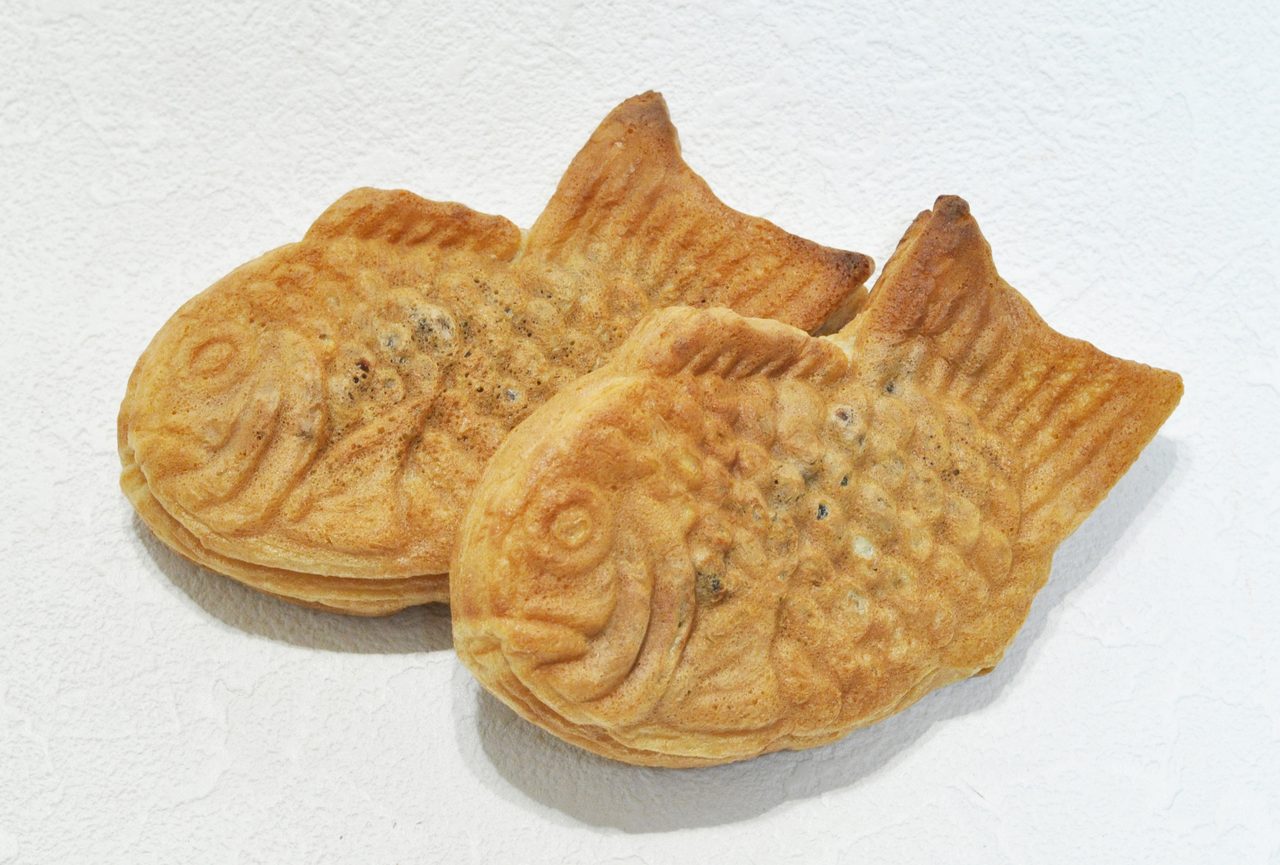
- How it differs from taiyaki and monaka: taiyaki pours a thin batter into a mould, so its shell is crisp, while dorayaki is a soft castella-textured cake. Monaka is not baked batter at all but a dry wafer shell.
- Nure dorayaki: syrup brushed over the filled cake to keep it moist — a version made for eating a day or more later.
- One pancake, folded: bake one large round and fold it into a half-moon. Harder to get wrong, and it takes more filling.
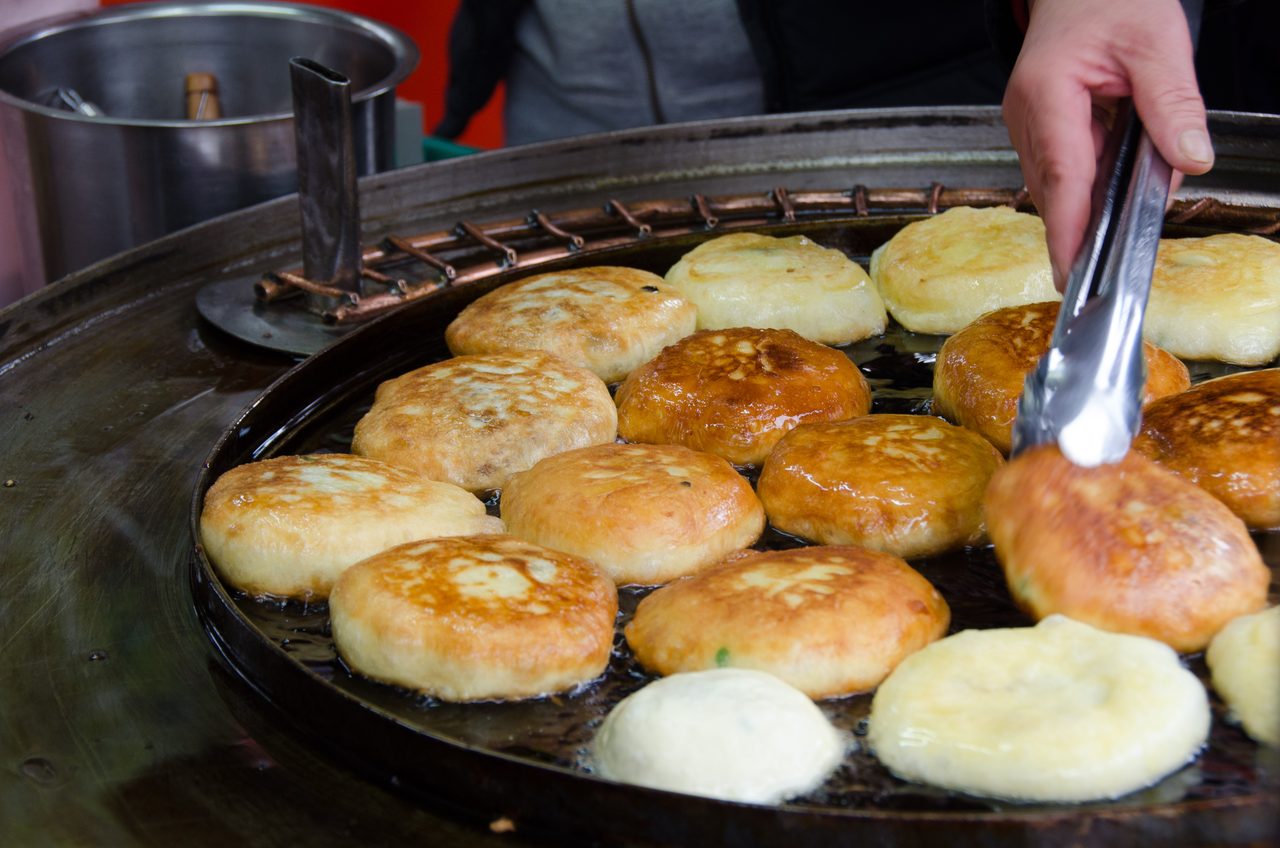
- Against pancakes and hotteok: pancakes go the milk-and-butter route and dorayaki goes the honey-and-mirin route — they are not the same batter. Hotteok is the other approach entirely: a yeasted dough, filled and pressed flat as it fries.
- The name, and Doraemon: dora means gong (銅鑼), and the usual explanation is the shape of two rounds stacked. Most people outside Japan know the cake through the cartoon, but the cake is very much older than Doraemon.
Tips
- Honey and mirin are what define this. Honey is hygroscopic and holds moisture in for days; the sugar and alcohol in mirin build the surface colour and gloss. Drop both and use sugar alone and you have made a small pancake (what sugar does).
- The unspeckled face comes from wiping the pan. This is the step most often got wrong. Where oil pools, that spot fries and goes dark; on a dry pan you get even colour. Oil is something you brush on and then remove — and re-wipe between every pancake (browning).
- Low heat, thoroughly preheated. On high heat the outside colours before the middle sets. One trick is to touch the hot pan to a damp cloth once to even the temperature out (heat control).
- The 30-minute rest is a step for appearance. The flour takes up water and the large bubbles from mixing disappear. Skip it and the surface keeps pinholes — it tastes the same and does not look like dorayaki (choosing flour, dough and gluten).
- One spot, from a height, in one pour. The batter has to spread by itself for the circle to be clean. Pushed out with a spatula it ends up uneven in thickness and cooks unevenly.
- The cue to flip is the surface, not the clock. Holes rising and the gloss going means the underside is done. Two minutes is the target; your pan and your hob will differ.
- Write off the first one. Anything cooked before the pan settles comes out patchy. That is calibration, not failure.
- The damp cloth is not optional. A freshly cooked dorayaki skin dries fast, and a dried skin splits when you fold it around the filling. Stacking them under a cloth solves it.
- Dome the paste in the middle. Spread flat, it escapes at the sides and the rim will not seal. Leave the outer centimetre bare (wrapping and sealing).
- Throw away the beans' first boiling water. The astringency (saponins) leaves with it. With shop-bought paste this is already done for you (soaking).
- Sugar only once the beans are fully soft. Sugar added early tightens the skins by osmosis and the beans stop softening. That order applies to pulses generally.
- Better the next day, and keep it out of the fridge. With the honey holding water it keeps two or three days at room temperature. Refrigerated, the starch retrogrades and it goes dry and crumbly — to keep it longer, wrap individually and freeze, then thaw at room temperature (freezing and thawing, serving temperature).
The basics behind this dish
- Deep Frying: Temperature, Batter, and the Second FryFrying is not cooking in oil so much as trading the food's water for it. Two temperatures, three kinds of coating, and why the second fry exists.
- Heat Control: Preheating, Oil, and Reading the PanThe same ingredients become a different dish depending on pan temperature. When to add the oil, how to read heat by sound, and which dishes want low heat instead.
- Knife Skills: Grip, Cuts, and Why Size MattersHow you hold the knife matters more than how fast you cut. The pinch grip, the claw hand, and why uniform size is a cooking decision rather than a cosmetic one.
More of the same kind


More from this country


Sign in to edit.
AI-drafted, editor-reviewed · edits: 0 ·Edit history
https://cookiki.com/en/r/dorayaki · cookiki · User contributions are licensed under CC BY-SA 4.0.