
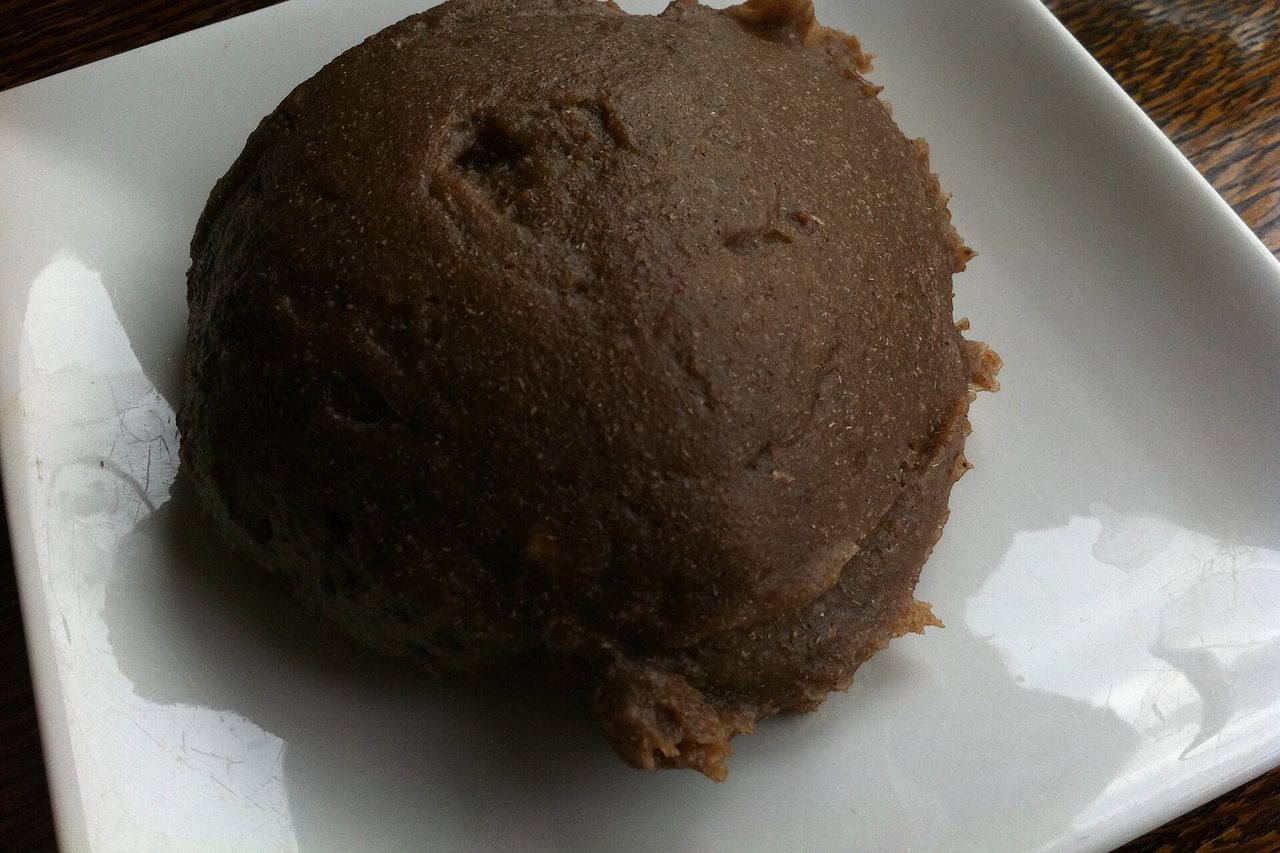
Photo: 江戸村のとくぞう · CC BY-SA 4.0
Tsukudani (Kombu Simmered Down in Soy and Mirin)
A Japanese relish of kombu, small fish, shellfish or vegetables simmered in soy, mirin and sugar until the liquid is gone. The name comes from Tsukudajima in Edo, where fishermen boiled their catch down salty to eat on bad-weather days and at sea. This recipe uses the kombu left over from making dashi. A spoonful does a bowl of rice.
Ingredients
- kombu left over from making dashi · saved from two or three batches in the freezer100 g
- water200 ml
- soy sauce4 tbsp
- mirin3 tbsp
- sugar1 tbsp
- sake2 tbsp
- white sesame seeds · optional1 tsp
- sansho berries · optional, pickled in soy1 tsp
Steps
Cut the kombu into 2cm squares. Kombu left from making dashi goes in as it is (stocks and broth).
- ⏲ 15 min
Put the kombu, water and sake in a small pan and simmer over low heat until the kombu tears when pressed between your fingers.
- ⏲ 20 min
Add the soy, mirin, sugar and sansho. Simmer uncovered over low heat until the liquid is almost gone.
- ⏲ 5 min
When only a little liquid is left in the bottom, turn the heat down further and keep stirring until it is glossy and the last of the liquid has clung on. This is when it catches most easily.
Take it off the heat and stir in the sesame. Cool completely, pack into a sealed container and refrigerate (salt and seasoning).
Put a spoonful on top of rice, or use it as a filling for onigiri.
Variations
- Chilli-leaf tsukudani. Chilli leaves simmered down in the same seasoning. The photograph on this page is this kind.
- Butterbur stalks (kyarabuki). Simmered until a deep brown.
- Shigureni. Clams simmered down with ginger. Small fish, as on Tsukudajima, are done the same way.
- Inago. Inland, in the Ina valley in Nagano and in Gunma, far from the sea, grasshoppers were simmered down instead.
Tips
- Leave the lid off. The point is to boil the liquid away.
- Turn the heat down and stir for the last few minutes. The sugar catches on the bottom.
- It turns jelly-like when cold. Serve it straight from the fridge.
- One to two weeks in the fridge. Today's milder tsukudani does not keep as long as the old salty kind.
More detail and the reasons why (2)
- The kombu lifted out of the stock becomes the dish. Stocks and broth has you take the kombu out before the water boils. That kombu still has body to chew, and tsukudani turns what would be thrown away into a side dish. Japanese even has a phrase, "enough to make tsukudani of", for having more of something than you can use: it began as a way to keep what was left over.
- Salty and dry. On Tsukudajima it was made salty enough not to spoil, so it would keep. Boiling the liquid all the way off is part of the same idea, and it is why it is eaten a little at a time, with rice.
The basics behind this dish
- Blanching: Keeping Vegetables GreenBlanched vegetables go dull because of acid and heat. Why the pot should be large, why the lid stays off, and what the ice bath is really for.
- Salt: When You Add It Matters More Than How MuchThe same amount of salt either draws water out or seasons all the way through, depending on when it goes in. Osmosis, seasoning in layers, and why salt types are not interchangeable by volume.
- Knife Skills: Grip, Cuts, and Why Size MattersHow you hold the knife matters more than how fast you cut. The pinch grip, the claw hand, and why uniform size is a cooking decision rather than a cosmetic one.
More of the same kind



More from this country


Sign in to edit.
Written with AI · how we check it · Edit history
https://cookiki.com/en/r/tsukudani · cookiki · User contributions are licensed under CC BY-SA 4.0.