
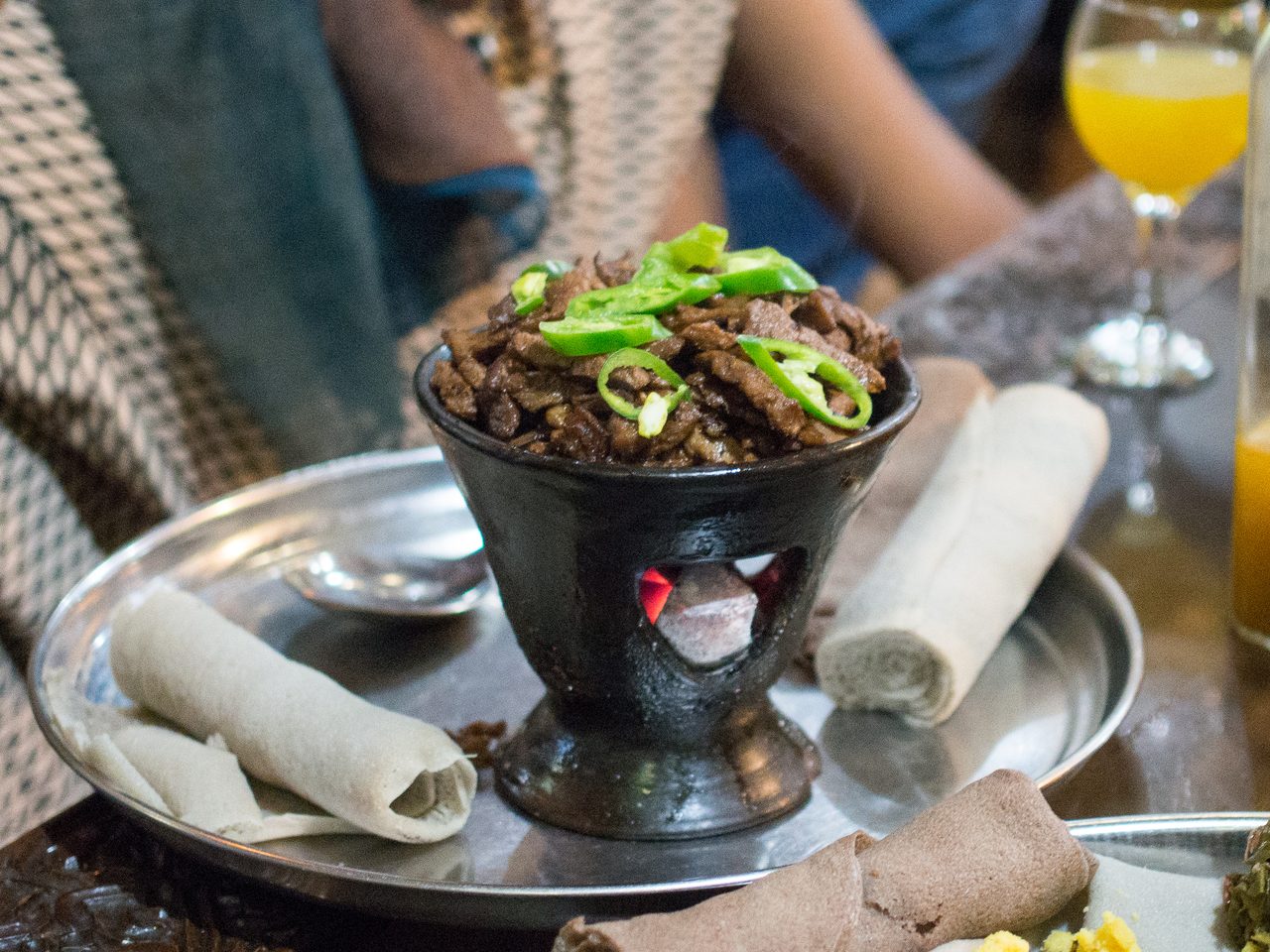
Photo: Lelaw Wondimu · CC BY-SA 4.0
Kitfo (Raw Minced Beef in Warm Spiced Butter)
Ethiopian raw beef, chopped fine and turned through warm spiced clarified butter (niter kibbeh) with mitmita. Yukhoe and steak tartare pick a lean cut and serve it cold, because cold fat reads as wax. Kitfo picks the same lean cut and then puts the fat back as butter, which sets on a cold plate — so this raw beef is served warm, mixed in a pan off the heat and eaten at once.
Ingredients
- Beef
- beef top round or eye of round · bought for eating raw, used the same day400 g
- mitmita · or 1 tsp fine chilli powder plus a pinch of cardamom and clove1.5 tsp
- korarima (Ethiopian cardamom), ground · or green cardamom0.25 tsp
- salt0.5 tsp
- Niter kibbeh (spiced clarified butter)
- unsalted butter · 70g of it is used here; keep the rest225 g
- onion · chopped0.25
- garlic · chopped2 cloves
- ginger · grated1 tsp
- fenugreek seeds0.5 tsp
- cumin seeds0.5 tsp
- cardamom pods · lightly crushed4
- turmeric0.25 tsp
- dried oregano · in place of besobela1 tsp
- To serve
- ayib (fresh curd cheese) · or drained ricotta or cottage cheese150 g
- gomen (braised collard greens) · optional
- injera3
Steps
- ⏲ 35 min
Niter kibbeh: melt the butter over low heat. When the foaming subsides, add the onion, garlic, ginger and spices and leave it on the lowest heat for 35 minutes. It is ready when the milk solids on the base are pale brown; stop before they darken. Strain through muslin and keep only the clear fat.
- ⏲ 10 min
Trim every trace of fat and sinew from the beef and keep it in the fridge. Chop it very fine with a knife — finer than tartare, almost to a paste. Keep the chopped beef in the fridge until the moment you mix it.
- ⏲ 1 min 30 sec
Warm 70g of the niter kibbeh in a small pan only until it has just melted — you should be able to touch it. Turn off the heat and stir in the mitmita, korarima and salt.
- ⏲ 30 sec
Add the beef to the pan off the heat and turn it quickly for 30 seconds, until the butter coats all of it and the fridge chill has just gone. If the colour starts to change it has already gone too far.
Plate it at once with ayib, gomen and injera. Do not let it sit — this is a dish served warm, not one kept warm.
Tips & Variations
Variations
- Tere (raw): this recipe. The beef coated in butter with the fridge chill just gone.
- Leb leb (lightly warmed): at step 4, put the pan back on the lowest heat for 30 seconds to a minute and stir until the edges just begin to change colour. The version usually offered to anyone wary of raw beef.
- Yebesele (cooked): cooked through. The niter kibbeh and mitmita stay; every constraint of raw meat goes.
- With kocho: in southern Ethiopia it is often eaten with kocho, a fermented bread made from enset, instead of injera.
- Injera: the spoon it is eaten with. It shares a table and the same niter kibbeh with doro wat.
Tips
- It is served warm because of the fat you chose. Yukhoe tells you to pick a lean cut and gives the reason: "cold, its fat is solid and reads as wax". So yukhoe is served cold, dressed in sesame oil that stays liquid in the fridge. Kitfo picks the same lean cut and puts the fat back as butter, and butter sets on a cold plate. Serving temperature puts it plainly: "Fat that will not melt in your mouth does not read as rich; it reads as wax." So the cold rule turns round — the butter is warmed just to melting and the beef is turned through it in a pan off the heat.
- The lukewarm warning still stands. Yukhoe says "Yukhoe gone lukewarm pushes the smell of the beef forward", and steak tartare says the same: "With almost no fat in the meat, lukewarm pushes the smell of the beef forward." Kitfo goes out at exactly that temperature, carrying far more spice than either — the chilli and clove of the mitmita, the korarima, and whatever was steeped into the butter. That spice is dissolved in the butter, which is why it comes through best while it is warm.
- Served warm is not the same as kept warm. The beef goes from the fridge into the butter and onto the table in a few minutes, and it should never wait warm. Buy it as you would for yukhoe — say it is for eating raw, use it the same day — and the same advice applies: "The standard advice everywhere is that pregnant people, young children and anyone immunocompromised should not eat raw beef." If in doubt, serve it leb leb or yebesele.
- By knife, and very fine. Steak tartare warns that "A mincer makes something else entirely". Kitfo is chopped much finer than tartare, but with the same tool, a knife. The finer the chop, the more surface there is for the butter, which is why thirty seconds coats all of it.
- Here the butter is not clarified for heat. Dairy and heat says "Indian cooking uses ghee for a temperature reason, not a traditional one." That is ghee's use at 250C; here the niter kibbeh is warmed only as far as you can touch it. What the clarifying does in this dish is simply take the water and milk solids out, so a batch of butter can be spiced once and kept. Cover the rest and use it for doro wat.
- Keep the ayib beside it. Mitmita is hot. Chilli and heat explains that "Casein in milk binds capsaicin and carries it off." and ayib is a fresh cheese made of exactly that casein. Take them in alternate mouthfuls.
The basics behind this dish
- Browning and the Maillard ReactionMeat fails to brown for one of three reasons: it is wet, the pan is cool, or you put too much in at once. Plus how the brown film stuck to the pan becomes your sauce.
- Cooking Meat: Temperature, Resting, and Cutting Against the GrainDoneness is a core temperature, not a number of minutes. What resting actually does, how to handle a thick cut, and why the direction you slice changes the texture.
- Knife Skills: Grip, Cuts, and Why Size MattersHow you hold the knife matters more than how fast you cut. The pinch grip, the claw hand, and why uniform size is a cooking decision rather than a cosmetic one.
More of the same kind


More from this country


Sign in to edit.
AI-drafted, editor-reviewed · edits: 0 ·Edit history
https://cookiki.com/en/r/kitfo · cookiki · User contributions are licensed under CC BY-SA 4.0.