
Photo: Gerda Arendt · CC0
Steak Tartare (Hand-Chopped, Not Minced)
Lean beef chopped by knife, seasoned with capers, cornichons, shallot and mustard, topped with a raw yolk and served cold. A mincer makes something else entirely, and the clock starts the moment salt and acid touch the meat.
Ingredients
- Serves 2
- beef top round · or the tail of a fillet. Buy it as a whole piece and chop it yourself, sold for raw eating, same day300 g
- shallot · or a quarter onion; minced and rinsed in cold water1
- cornichons · finely diced and patted dry6
- capers · rinsed and roughly chopped1 tbsp
- flat-leaf parsley · finely chopped, added at the end2 tbsp
- egg yolks · one into the dressing, one on top2
- Dressing — mixed at the last moment
- Dijon mustard · it works as the emulsifier1 tsp
- Worcestershire sauce · anchovy savour1 tsp
- extra-virgin olive oil1 tbsp
- Tabasco · to taste3 drops
- salt · not in advance0.5 tsp
- black pepper · coarsely ground to taste
- To serve
- baguette · thin and toasted. Fries are equally canonical6 slices
Steps
- ⏲ 30 min
Trim every trace of fat and sinew, wrap the beef and put it in the freezer for 20-30 minutes. Firm at the surface is all you need.
Chop it with a knife. Aim for a 3-4mm dice: spread it out, cut across the grain, cut again the other way, then finish by tapping through it with the blade. Do not use a mincer — the blades crush and smear rather than cut, which kills the texture and squeezes the juice out.
Put the chopped beef in a cold bowl in the fridge, ideally with the bowl sitting on ice. Nothing goes in yet.
- ⏲ 5 min
Mince the shallot finely and soak it in cold water for 5 minutes, then squeeze it dry. That takes the raw bite out so it does not bury the beef.
Chop the cornichons and capers and pat them dry. Any brine left on them thins the dressing by exactly that much.
In a small bowl mix one yolk with the Dijon, Worcestershire and Tabasco, then trickle in the olive oil while stirring to emulsify it thick. The mustard and yolk are the emulsifiers, and this sauce is what holds the water the beef gives up.
Chill the plates. Toast the baguette now — once the beef is dressed there is no time to spare.
With service ready, add the shallot, cornichons, capers and dressing to the beef and fold it about twenty times. Salt and pepper go in here and you taste immediately. The parsley goes in last, two folds.
Press it into a ring mould or a cup and turn it out onto the plate. Do not pack it tight. Make a hollow in the middle for the remaining yolk.
Serve immediately, with the toast or fries. Left standing on the plate, the salt and acid discolour the surface and it starts to weep.
Tips & Variations
Variations
- Non préparé: one of the two standard French services — the chopped beef and the garnishes come separately and you mix it at the table. The other is préparé, seasoned in the kitchen. Same dish; the only difference is when salt and acid reach the meat, which is why non préparé is in principle the fresher of the two.
- Carne cruda all'albese: the Piedmontese version, dressed with olive oil, lemon and salt alone — no capers, no mustard. Minimal, so the beef itself is fully exposed.
- Filet américain: the Belgian and Dutch form, bound with mayonnaise into a spread for bread.
- Tartare de cheval: horse, still common in Lyon and Switzerland. Sweeter and leaner than beef.
- Tuna or salmon tartare: the same structure with fish — more acid, fewer capers, often avocado or soy. Unlike ceviche the acid is not there to cure it; it goes in at the end.
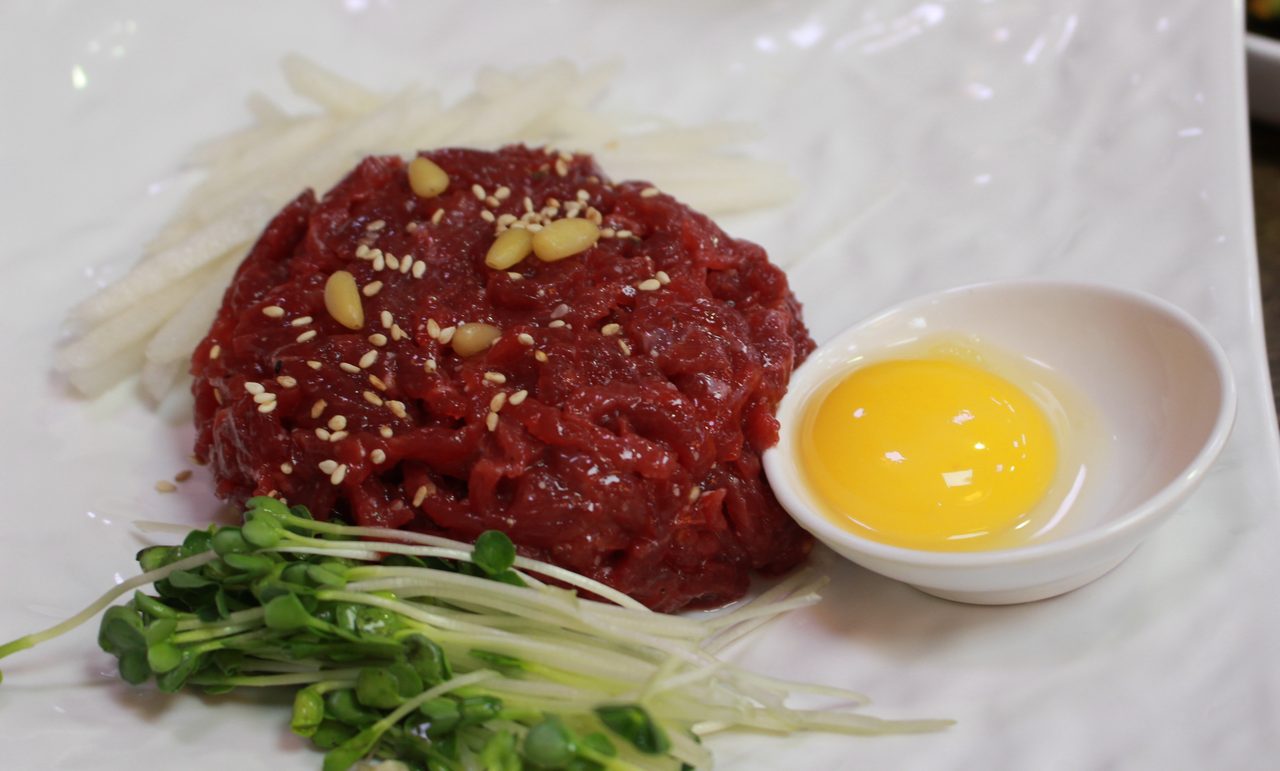
- Yukhoe: the same raw beef pointing the opposite way. Sesame oil and pear build nuttiness and sweetness, with no acid, mustard or capers anywhere. Make the two side by side and you can see how far apart one ingredient can be taken.
- German Mett: raw pork. The name looks adjacent and the food-safety picture is not, so do not transfer the method here to it.
Tips
- Knife-chopped and machine-minced are different foods. This is the single decision that matters most. A mincer's blades push and crush, rupturing cells, so the juice leaves and the texture goes mealy. A knife cuts (knife skills).
- Buy a whole piece and chop it yourself — and not only for texture. Pre-ground beef has tens of times the surface area, with whatever was on the outside distributed through all of it. Meat to be eaten raw is bought whole, trimmed, and cut at home. Tell the butcher it is for raw eating and use it the same day.
- Half-freezing decides the chop. Twenty to thirty minutes firms the surface so it dices cleanly; lean beef at room temperature sticks to the blade and tears. Same preparation as yukhoe.
- Salt and acid start a clock. Salt draws water out by osmosis, and acid — the brine on the cornichons and capers, the Worcestershire — denatures surface protein and takes the colour with it. Tartare that has stood thirty minutes is grey and sitting in liquid. Hence dressing at the last moment (salt and seasoning).
- The mustard and yolk hold the dressing together. Both are emulsifiers, so the olive oil, the acid and the water coming out of the beef stay as one thing. Leave the mustard out and the sauce slides off with oil pooling on the plate (emulsions).
- Rinse the shallot. The harsh bite of raw onion and shallot is water-soluble; five minutes in cold water and a squeeze removes it and leaves the aroma. Skip it and the tartare tastes of onion.
- Pat the brine off. Cornichons and capers added wet thin the dressing. Acid belongs in this dish under control, through the sauce, not arriving by accident (balancing flavour).
- Parsley last. Its aroma is volatile and folding releases water (fresh herbs).
- Cold, including the plate. With almost no fat in the meat, lukewarm pushes the smell of the beef forward. Chill the plates and do not dawdle (serving temperature).
- Press the mould gently. Packed hard, the chopped beef compacts back into a paste and the knife work was for nothing.
- Do not use beef that was frozen and thawed. Thawed lean beef has ruptured cells, weeps, and will not dice (freezing and thawing).
- Serve it with something crisp. Toasted baguette or fries. Alongside soft bread the whole texture collapses into one thing.
The basics behind this dish
- Knife Skills: Grip, Cuts, and Why Size MattersHow you hold the knife matters more than how fast you cut. The pinch grip, the claw hand, and why uniform size is a cooking decision rather than a cosmetic one.
- Salt: When You Add It Matters More Than How MuchThe same amount of salt either draws water out or seasons all the way through, depending on when it goes in. Osmosis, seasoning in layers, and why salt types are not interchangeable by volume.
- Heat Control: Preheating, Oil, and Reading the PanThe same ingredients become a different dish depending on pan temperature. When to add the oil, how to read heat by sound, and which dishes want low heat instead.
More of the same kind


More from this country


Sign in to edit.
AI-drafted, editor-reviewed · edits: 0 ·Edit history
https://cookiki.com/en/r/steak-tartare · cookiki · User contributions are licensed under CC BY-SA 4.0.