
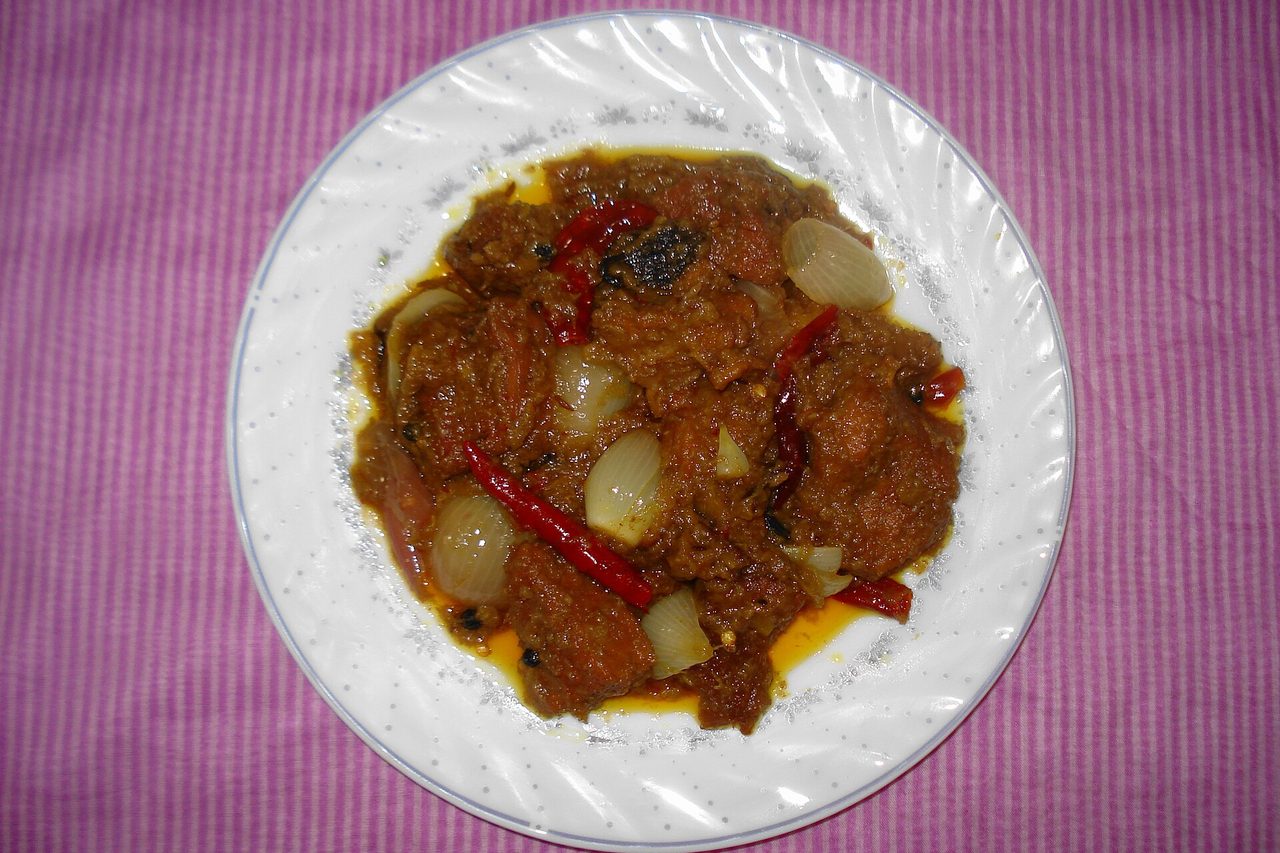
Photo: stu_spivack · CC BY-SA 2.0
Doro Wat (Chicken Stew with Berbere and Whole Eggs)
One of Ethiopia's national dishes, and the first thing this site's injera page lists under what goes on it. The aromatics guide sets its order out in numbered steps: heat the fat, whole spices, then the onion. Doro wat deletes step one. A kilo of finely chopped red onion goes into a dry pot with no fat at all and cooks for close to an hour until its water is gone and it has collapsed, and only then do the butter and the berbere arrive. The onion here is not an aromatic being bloomed, it is the body of the sauce. There is no flour, no tomato and no cream in it.
Ingredients
- The chicken (serves 4-6)
- chicken · jointed, skin removed1.2 kg
- lemon juice · to steep it3 tbsp
- salt1 tsp
- The sauce
- red onions · very finely chopped; cut this and there is no sauce1 kg
- niter kibbeh · spiced clarified butter; siga tibs has the method100 g
- berbere · about 6 tbsp of the Ethiopian spice blend60 g
- garlic · minced6 cloves
- ginger · minced30 g
- water or chicken stock400 ml
- salt1.5 tsp
- To finish
- eggs · hard-boiled and peeled6
- mekelesha · or ground cardamom, stirred in off the heat1 tsp
- To serve
- injera · or ayib, the fresh Ethiopian cheese4
Steps
- ⏲ 20 min
Steep the chicken in water with the lemon juice and salt for 20 minutes — ko.wikipedia records this step — then rinse it well and pat it dry.
- ⏲ 50 min
Put the chopped red onion into a dry pot with no fat in it at all over low heat. For the first ten minutes nothing seems to happen, and then the onion starts giving up its own water. Stir often and cook 50 minutes, until the water has gone and the onion has collapsed into a brown purée.
- ⏲ 5 min
Blooming spices sets the order out in numbers: 1. heat the fat, 2. whole spices, 3. onion. There is no step 1 here — the fat goes in now. Melt the niter kibbeh into the onion and cook 5 minutes more. The onion is not an aromatic being bloomed, it is the body of the sauce: there is no flour, no tomato, no cream and no nuts in this dish (thickening a sauce).
- ⏲ 4 min
Add the garlic and ginger for 2 minutes, then the berbere for 3-4 minutes. As that guide says, aroma dissolves in fat rather than water, so the late fat is there for the spice. Its thirty-second limit on ground spice has an exception here: the pot still holds the onion's moisture, so it is running far cooler.
- ⏲ 5 min
Add the water or stock a little at a time to a thick sauce and season with salt. Do not pour it all in at once — this is a sauce you spread, not a broth.
- ⏲ 40 min
Put the chicken in, turn it until it is coated, cover and simmer 40 minutes. Red oil rising to the surface means it is done.
- ⏲ 10 min
Peel the boiled eggs and score them a few times, shallowly, all over. They go in whole, so those cuts are the only way anything gets inside. Add them and cook 10 minutes more.
- ⏲ 5 min
Off the heat, stir in the mekelesha and leave it covered 5 minutes. It is a finishing spice and is not boiled.
- ⏲ 3 min
Spoon it onto injera, or serve it with injera beside it. You tear injera and wrap a mouthful in your hand.
Tips & Variations
Variations
- Zigni is the Eritrean name for it — strictly, the same red stew (key wat / keyih tsebhi) made with beef or lamb, and ko.wikipedia records that "zigni and taita" is one of Eritrea's national dishes. That is the same structure this site's injera page describes for the bread, where taita is "the Eritrean name for the same bread". Both the bread and the stew have their own name in each country.
- If you cannot get berbere: siga tibs gives an approximation. Bear in mind this dish uses 60g of it, so a substitute changes the result considerably.
- Alicha doro: the mild version, turmeric and ginger and no berbere, so yellow rather than red. During Lent the fasting stews — shiro, misir wat — leave out the meat and dairy entirely.
- Beyainatu: several wats arranged around one injera, the spread the injera page describes.
- It is celebration food: ko.wikipedia notes it is never missing from weddings and family gatherings, which is another way of saying an hour of onion is not a weeknight dish.
- Against fesenjan: there ground walnuts hold the sauce together, here collapsed onion does. Neither uses flour or starch, and in both the body is an ingredient.
Tips
- Do not cut the onion down. A kilo of onion to 1.2kg of chicken looks like a typo, but the onion here is volume rather than aroma. Halve it and you have seasoned chicken instead of a sauce.
- Do not leave the pot during the dry cook. The last fifteen minutes, as the water goes, is when it starts to catch. If the base dries, add a tablespoon of water and scrape.
- Skin the chicken. Coated in sauce for forty minutes, skin does not crisp; it only goes soft.
- Score the eggs. A whole egg has nowhere for flavour to get in except the surface.
- Dial the heat with the berbere. Blends vary a great deal, so start at 4 tablespoons the first time (chilli and heat).
The basics behind this dish
- Blooming Spices: Why Aromatics Go into Fat FirstStir ground spice into liquid and half the aroma never arrives, because most aroma compounds are fat-soluble. The thirty-second window, and the order things go in.
- Building Umami: Glutamate, Synergy, and LayersUmami is built in layers, not added from one bottle. The key is synergy: glutamate plus nucleotides multiply each other rather than adding up.
- Browning and the Maillard ReactionMeat fails to brown for one of three reasons: it is wet, the pan is cool, or you put too much in at once. Plus how the brown film stuck to the pan becomes your sauce.
More of the same kind


More from this country
Ethiopian →

Sign in to edit.
AI-drafted, editor-reviewed · edits: 0 ·Edit history
https://cookiki.com/en/r/doro-wat · cookiki · User contributions are licensed under CC BY-SA 4.0.