
Photo: Haha169 · CC BY-SA 4.0
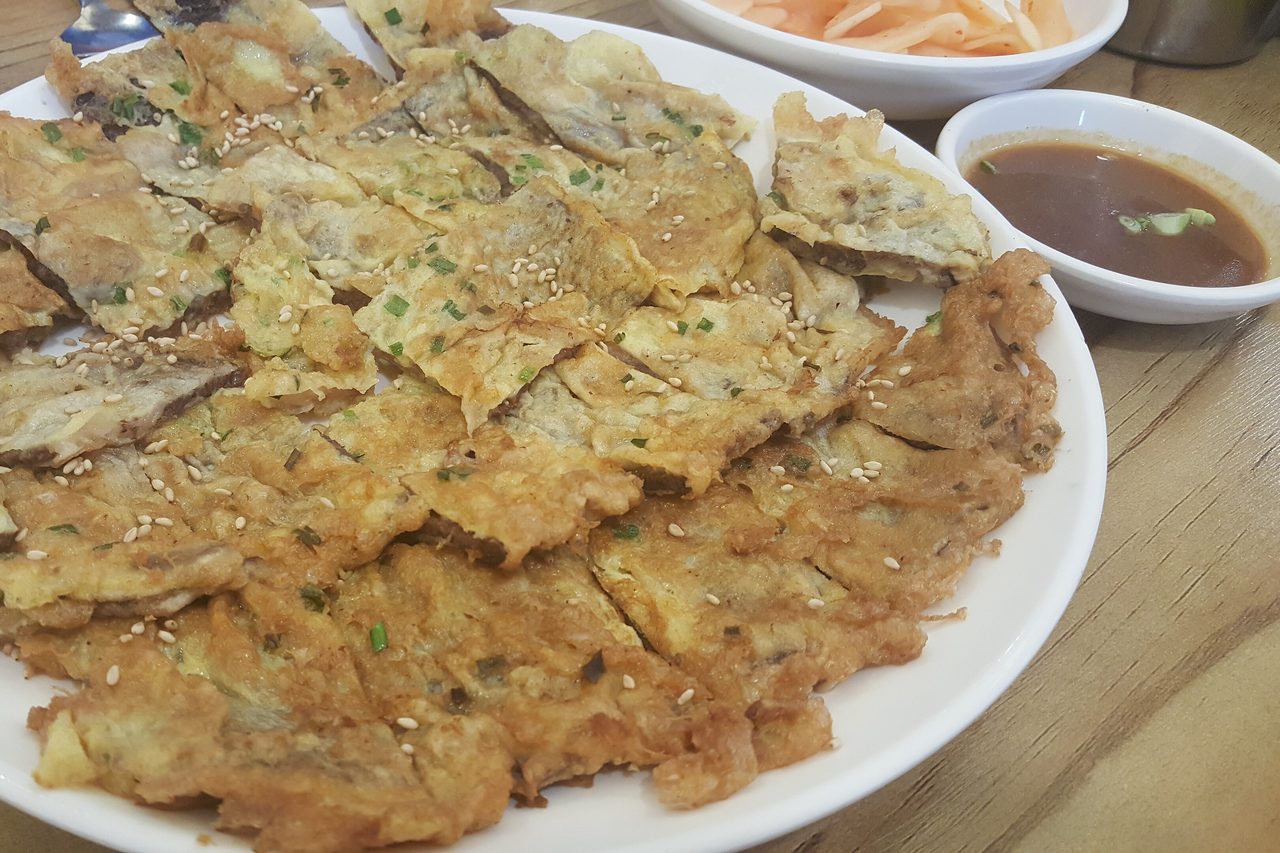
Wu Gok (Fried Taro Dumplings with a Lace Crust)
A Cantonese dim sum: steamed taro mashed into a dough with wheat starch and lard, wrapped round pork and prawn, and fried until the surface stands up in a honeycomb lace. Bugak has to dry its starch hard before it will foam in oil; this paste is wet. What it has instead is lard worked all the way through, so the steam leaving the surface pushes apart a paste the fat has already loosened.
Ingredients
- Taro dough (12 dumplings)
- taro · peeled and cut into thick slices500 g
- wheat starch · the gluten-free starch sold for dim sum60 g
- boiling water60 ml
- lard · soft, at room temperature; vegetable shortening will do60 g
- sugar1 tsp
- salt0.5 tsp
- five-spice powder1 pinch
- Filling
- minced pork150 g
- prawns · coarsely chopped80 g
- dried shiitake, soaked · finely chopped2
- soy sauce1 tbsp
- oyster sauce1 tbsp
- Shaoxing wine1 tbsp
- sugar0.5 tsp
- sesame oil1 tsp
- cornflour · slaked in 1 tbsp water1 tsp
- oil for deep-frying1.5 L
Steps
- ⏲ 25 min
Steam the taro over boiling water for 25 minutes, until a chopstick slides straight in.
Mash it fine while it is hot. Any lump left in will fry as a bald patch in the lace.
Pour the boiling water over the wheat starch all at once, stir with chopsticks, then knead it into one piece while still hot.
- ⏲ 30 min
Mix the mashed taro with the wheat-starch dough, sugar, salt and five-spice, then work in the lard until smooth. It should be soft and a little tacky. Cover and chill for 30 minutes so it can be handled.
- ⏲ 5 min
Fry the pork, add the prawns and shiitake, and season with the soy, oyster sauce, wine and sugar. Bind with the slaked cornflour, add the sesame oil and cool completely.
- ⏲ 20 min
Divide the dough into 12, flatten each in your palm, add a spoonful of filling, close it round and pinch the seam firmly into a rugby-ball shape. Chill for 20 minutes.
- ⏲ 2 min 30 sec
Heat the oil to 180°C. Lower three at a time on a spider and leave them alone for the first 30 seconds. Fry 2 minutes 30 seconds in all, until the surface has stood up into lace and turned golden.
Drain and serve at once. Let the oil climb back to 180°C before the next three go in.
Tips & Variations
Variations
- Shortening: the usual stand-in for lard. What the dough needs is a solid fat that spreads all through it, not the taste of pork.
- Vegetarian filling: shiitake, bamboo shoot and carrot, fried and bound with mushroom soy instead of soy and oyster sauce.
- Its steamed cousin: the taro cake (芋頭糕) among lo bak go's variations is "the same method with taro instead of radish, and richer for it." Wu gok takes the same taro into a dough of lard and wheat starch and fries it instead.
- To freeze: shape them, freeze them unfried, and fry from frozen at 170°C for 3 minutes 30 seconds.
Tips
- Why a wet paste foams in oil at all. Bugak explains its own: "The starch was cooked and then dried, so the moment it meets oil the little water left inside it turns to steam all at once and blows the film into a foam." The condition for a starch foam there is dryness. Wu gok's dough is steamed taro and full of water, and it foams anyway. The difference is the lard. With the fat worked right through, the water leaving the surface as steam pushes apart a paste the fat has already loosened, and the strands it pulls up set where they stand. Cantonese cooks say that without lard the lace does not form.
- Which makes the temperature narrow in both directions. Deep-frying warns: "Run the oil too cool and the steam is feeble, so oil seeps into its place." Here it is worse than greasy — steam too weak to open the paste leaves it wet, and it falls apart in the oil. Too hot, and the surface sets before it can open, giving a smooth shell. Hold 180°C, and fry three at a time so the oil stays there.
- Leave them alone for the first thirty seconds. The lace is at its weakest while it is standing up. Roll them with the spider and the strands snap and leave a bald patch.
- The wheat starch is there to bind, not to be clear. Har gow says "only wheat starch, with the gluten washed out, turns clear as it steams." — there the clarity is the point. Here, once fried, nobody sees it. What the scalded wheat starch does is tie taro, which has no stretch at all, into a dough that can be wrapped and pinched shut.
- Shape it cold. Soft lard makes the dough stick to your hands and the seams gape, and a gaping seam leaks filling juices into the oil, which spits.
The basics behind this dish
- Knife Skills: Grip, Cuts, and Why Size MattersHow you hold the knife matters more than how fast you cut. The pinch grip, the claw hand, and why uniform size is a cooking decision rather than a cosmetic one.
- Salt: When You Add It Matters More Than How MuchThe same amount of salt either draws water out or seasons all the way through, depending on when it goes in. Osmosis, seasoning in layers, and why salt types are not interchangeable by volume.
- Heat Control: Preheating, Oil, and Reading the PanThe same ingredients become a different dish depending on pan temperature. When to add the oil, how to read heat by sound, and which dishes want low heat instead.
More of the same kind


More from this country


Sign in to edit.
AI-drafted, editor-reviewed · edits: 0 ·Edit history
https://cookiki.com/en/r/wu-gok · cookiki · User contributions are licensed under CC BY-SA 4.0.