
Photo: Ceeseven · CC BY-SA 4.0
Lau Sa Bao (Steamed Buns with a Molten Salted Egg Yolk Filling)
A Cantonese dim sum bun filled with salted egg yolk beaten into butter. Break it open and the orange filling runs out like sand, which is what the name means. It looks like a custard, but there is no egg in it for the heat to set: the salt set the yolks long before, and what flows is the butter. So the filling is wrapped cold and solid, and the steamer melts it again.
Ingredients
- Filling (for 8)
- salted duck egg yolks · vacuum-packed cooked yolks work too6
- unsalted butter · softened at room temperature60 g
- icing sugar50 g
- milk powder25 g
- custard powder · or 10g more milk powder10 g
- Dough
- plain low-protein flour · cake flour, or part all-purpose250 g
- sugar30 g
- instant dried yeast3 g
- milk · lukewarm130 ml
- neutral oil10 g
Steps
- ⏲ 10 min
Rinse any white and salt off the yolks and steam them over boiling water for 10 minutes, right through. A soft centre will not go through a sieve.
While they are hot, press the yolks through a fine sieve. Cold, they clump again and the grains come out coarse.
- ⏲ 30 min
Beat the soft butter with the icing sugar, then add the sieved yolk, milk powder and custard powder and stir until smooth. Freeze for 30 minutes.
- ⏲ 30 min
Divide the firm filling into 8, roll into balls and freeze again for 30 minutes. If the butter starts melting in your palm, the filling cannot be wrapped.
- ⏲ 10 min
Mix all the dough ingredients and knead for 10 minutes until smooth. No baking powder — this bun must not split at the top.
Divide the dough into 8, roll each so the edge is thinner than the middle, set a frozen ball on it, pleat and seal. Stand them seam-down on squares of paper.
- ⏲ 35 min
Prove somewhere warm until 1.5 times the size, 30-40 minutes. The filling may soften meanwhile; that is fine, it is already sealed in.
- ⏲ 10 min
Put them in the steamer over cold water, and once it is steaming steam over medium heat for 10 minutes. Fierce heat cracks the surface and the filling leaks.
- ⏲ 3 min
Turn off the heat and leave the lid on for 3 minutes before opening, or the buns wrinkle. Eat them warm — once cold the butter sets again and nothing runs.
Tips & Variations
Variations
- Nai wong bao (奶黃包): the same bun with a real custard in it — egg, milk and starch cooked thick over heat. Lau sa bao sometimes borrows "nai wong" for its name, but its filling is not a custard. A custard is egg that heat sets, and it is cooked to hit the window eggs describes, with yolk starting to set around 68°C. This filling never uses that window.
- The yolk left whole: mooncake and lo mai gai press one salted yolk into the middle unbroken. As the lo mai gai page puts it, "It concentrates the salt and the fat into one spot". Lau sa bao takes the same yolk, sieves it and beats it into butter so it runs through the whole filling instead.
- Baked: the same filling wrapped in a bread dough and baked, or in a cookie dough and pressed in a mould. Baked versions flow less than steamed ones, so warm them briefly before eating.
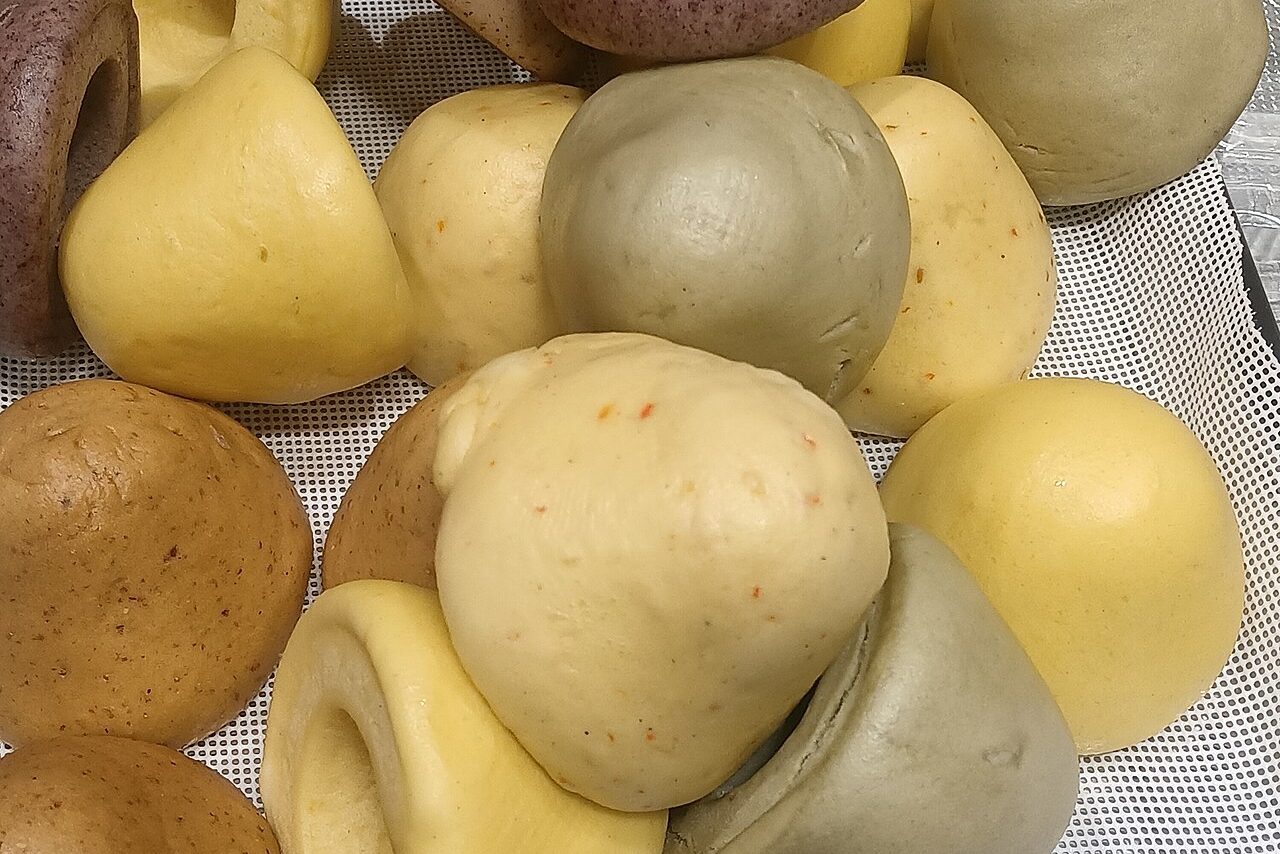
- Piglets and goldfish: dim sum houses colour and shape the dough. The filling works the same way.
Tips
- The salt has already set the yolk. Century egg says of the salt-cured duck egg: "Instead of going dark and creamy the yolk turns orange and hard." A yolk set like that never goes creamy again. So this filling does not try to melt the yolk. It cooks it right through into a powder and adds something that melts instead: the butter.
- What a mooncake avoids, this does on purpose. Mooncake only pre-bakes its salted yolks lightly: "Cooked through now, plus the main bake, and they crumble." In a mooncake the crumbling is a fault. Lau sa bao wants exactly that crumbled yolk. The sieved grains stay suspended in the butter without dissolving, and that is the "sand" you feel in your mouth.
- Wrap it cold, eat it hot. Xiaolongbao seals in a set stock jelly that melts into hot broth as they steam. Lau sa bao runs the same sequence with butter in place of gelatine: from the freezer the filling is a solid you can wrap, and in the steamer it becomes a liquid. Try to wrap it half-set and it melts in your hand, butter gets on the seal, and the seal opens as it steams.
- The same dough, minus the baking powder. Char siu bao says the rest of the bun family comes from its dough with only the filling changed, and "The rule about setting the filling first holds for all of them." That rule holds here. But char siu bao is meant to burst open in three at the top, and "that split is not luck — it comes from using yeast and baking powder together and steaming over very hard heat." In this bun that split is the way the filling escapes. So this recipe leaves out the baking powder and steams at medium heat.
- Re-steam them cold. Once cool the butter sets and nothing flows. Five minutes in a steamer keeps the dough softer than a microwave does.
- If it tastes too salty, add milk powder, not sugar. More sugar makes it both sweeter and just as salty. Milk powder adds bulk, which dilutes the yolk.
The basics behind this dish
- Eggs: Coagulation Temperatures and What They DecideWhite sets at 62°C, yolk at 68°C. Those two numbers explain scrambled eggs, boiled eggs, steamed custard and crème anglaise all at once.
- Why Sauces Split: Emulsions and Pan SaucesA cream sauce breaking and a carbonara scrambling are the same failure. Temperature and emulsifiers — plus how to bring a split sauce back.
- Knife Skills: Grip, Cuts, and Why Size MattersHow you hold the knife matters more than how fast you cut. The pinch grip, the claw hand, and why uniform size is a cooking decision rather than a cosmetic one.
More of the same kind


More from this country


Sign in to edit.
AI-drafted, editor-reviewed · edits: 0 ·Edit history
https://cookiki.com/en/r/lau-sa-bao · cookiki · User contributions are licensed under CC BY-SA 4.0.