
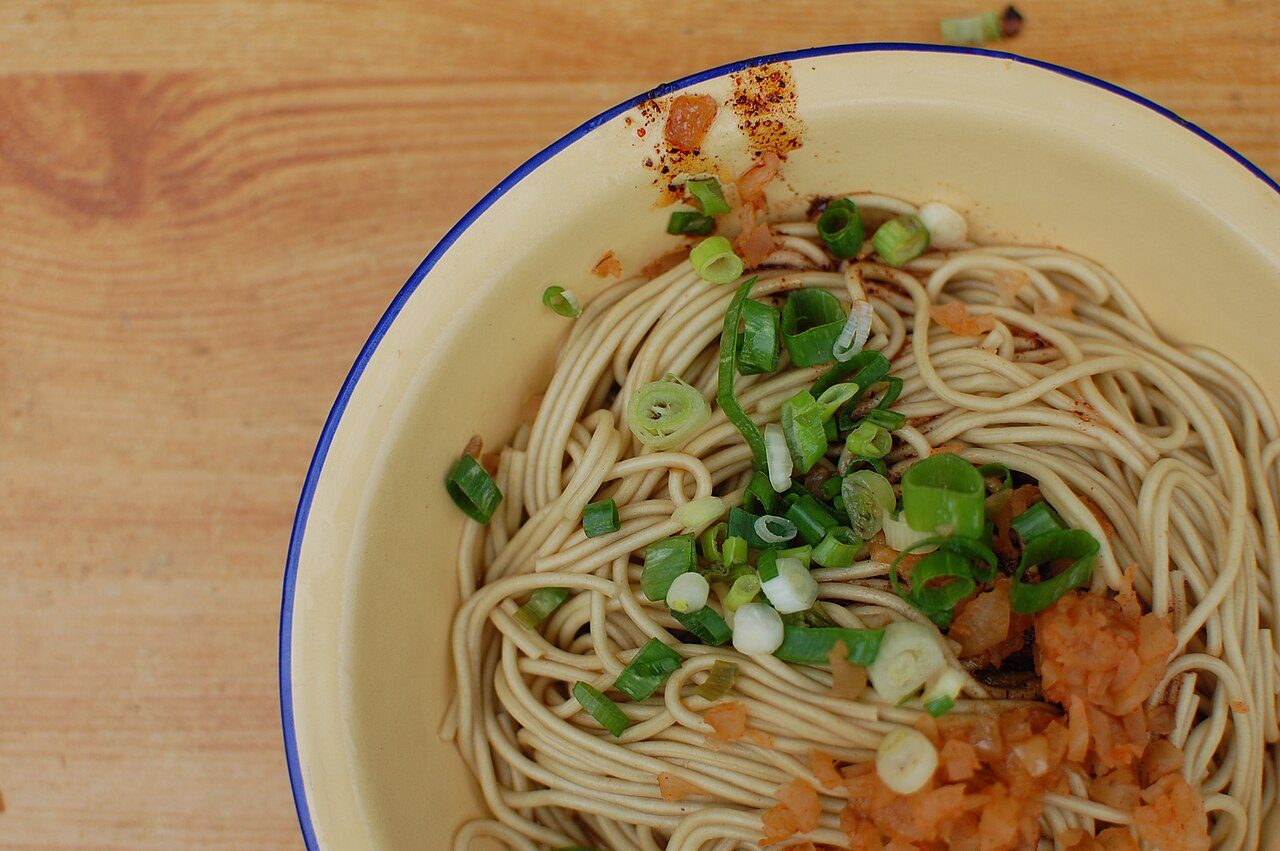
Photo: N509FZ · CC BY-SA 4.0
Luosifen (River Snail Rice Noodles)
Rice noodles from Liuzhou in Guangxi. It is named after river snails and there are no snails in the bowl — they are simmered with pork bones for hours and then lifted out. What makes the bowl what it is instead is suan sun, bamboo shoot fermented in water. Every other strong ferment on this site has a handling rule: rinse the salt out of it, or cook the volatiles off. Luosifen does neither. The smell is not a by-product the cooking removes; it is the state the bowl is served in.
Ingredients
- Thick dried rice noodles · the round Liuzhou kind; soak them first300 g
- Broth
- Freshwater river snails · purged; see Variations500 g
- Pork spine bones500 g
- Ginger · sliced30 g
- Star anise2
- Cassia bark1 piece
- Cloves3
- Sand ginger (galangal root) · or more ginger10 g
- White pepper1 tsp
- Salt2 tsp
- To finish
- Suan sun (fermented bamboo shoot) · squeezed, not rinsed — see the Tips150 g
- Chilli oil4 tbsp
- Fried tofu skin60 g
- Fried peanuts4 tbsp
- Wood ear mushroom · soaked and shredded30 g
- Boiled eggs4
- Coriander1 handful
- Young cabbage or pak choi200 g
Steps
Purge the snails in clean water overnight, changing the water two or three times. Skip this and the broth carries grit.
- ⏲ 10 min
Bring the pork bones up from cold water, blanch once, throw the scum away and rinse. This is what keeps the broth from going cloudy (stocks and broths).
- ⏲ 8 min
Dry-fry the snails hard with the ginger until the shells dry out and the smell comes up. This frying is half the flavour of the broth.
- ⏲ 150 min
Add 3 litres of water, the star anise, cassia, cloves, sand ginger and white pepper to the snails and blanched bones and simmer gently for two and a half hours or more. Never at a rolling boil.
- ⏲ 5 min
Strain, and throw the snails and the bones away. What goes in the bowl is the broth alone. Season with salt.
- ⏲ 1 min
Squeeze the suan sun lightly — do not rinse it — and chop it. Fry it in a tablespoon of oil for thirty seconds only; longer and the aroma you want is gone.
- ⏲ 7 min
Cook the rice noodles as the packet says, soaking the thick ones for half an hour first, and drain. Do not hold them in the broth.
- ⏲ 2 min
Blanch the cabbage one minute and the wood ear briefly in the same water.
- ⏲ 2 min
Put the noodles in the bowl and pour over very hot broth. Top with the suan sun, chilli oil, tofu skin, peanuts, wood ear, egg, cabbage and coriander.
Tips & Variations
Variations
- Without snails: freshwater river snails are hard to buy outside Liuzhou. Build the broth on pork spine and chicken feet and add 30g of dried shrimp and three dried shiitake, and the savour lands close. The ingredient the name points at drops out — and it never reached the bowl anyway.
- When there is no suan sun: jarred fermented bamboo shoot from a Thai or Vietnamese grocer is the nearest thing. Zhacai and suan cai are not substitutes — those are mustard stem and cabbage, and they are used as acid, the way beef noodle soup uses them. See the Tips.
- Heat: Liuzhou's default is properly hot. Leaving the chilli oil to each person at the table lets one pot suit everybody (chilli and heat).
- Toppings: duck feet, pig trotter, sausage, fried tofu puffs, fish cake. Liuzhou shops let you pick. Keep the fried tofu skin and the peanuts, though — they are the only crunch in the bowl.
- The packet version: vacuum-packed luosifen took off after 2014 and is now a major Liuzhou industry. Even in the packet the suan sun comes in a sachet of its own.
- Against beef noodle soup: two Chinese noodle broths topped with a fermented vegetable, handling it in opposite ways. The first Tip is that story.
- Against reganmian: its pair, and the opposite position on broth. That one is hot with none at all; here the broth is the whole bowl.
Tips
- Not rinsing the ferment is the axis of this dish. Beef noodle soup uses suan cai in the same country, in the same kind of bowl, and states the rule: "It is the acid that cuts a rich broth, and without it the second half of the bowl becomes hard work" Its step is explicit: "Rinse the suan cai, squeeze it dry and chop it. Getting the salt out is what stops it shifting the seasoning of the bowl" There the fermented vegetable is admitted as acid, and everything else it carries — salt, smell — is washed out. Luosifen is the inverse. Rinse the suan sun and you no longer have the dish, because what rinses away is the whole of what the name is worth.
- It refuses the move stinky tofu makes. That page sets out the standard answer for a strong-smelling ferment: "So the raw smell is not a fair warning about the eating: the fried result is far milder, and what stays behind is savour" Frying carries the volatiles away, so what you eat is much milder than what you smelled. Luosifen has no such step. The suan sun gets thirty seconds, and the hot broth then keeps sending those compounds up into the air. Here the smell before and the taste after do not part company.
- Suan sun and that brine are the same family. Stinky tofu's page describes its brine as "that brine is itself a living culture built from long-fermented vegetables, shrimp and bamboo shoots" — and the bamboo shoot in that list is this ingredient. One dish uses it as a culture to move a smell into tofu; the other lifts it out and puts it on top.
- The snails never reach the bowl. This is a dish named for an ingredient you never see. Frying them dry in their shells is half the broth, and skipping that leaves it muddy-tasting (browning).
- Purge them overnight. River snails hold grit, and grit survives a strainer. Change the water two or three times.
- Do not hold the noodles in the broth. Thick rice noodles keep drinking, which swells them and concentrates what is left (cooking noodles covers why rice noodles are soaked rather than boiled). Drain, bowl, pour.
- Never let the broth boil hard. Fat from the bones breaks up into it and it goes cloudy, and once suspended it cannot be skimmed back out (stocks and broths).
- Ventilation is equipment. The thirty seconds the suan sun spends in the pan is the strongest the kitchen gets. Open a window first.
- Crisp toppings last. The tofu skin and peanuts start softening the moment they touch the broth. Add them and serve (serving temperature).
The basics behind this dish
- Dough and Gluten: When to Build It and When to Avoid ItThe same flour and water becomes a dumpling wrapper or a tender pancake. The difference is whether you built gluten or avoided it — and kneading and resting do different jobs.
- Why Sauces Split: Emulsions and Pan SaucesA cream sauce breaking and a carbonara scrambling are the same failure. Temperature and emulsifiers — plus how to bring a split sauce back.
- Knife Skills: Grip, Cuts, and Why Size MattersHow you hold the knife matters more than how fast you cut. The pinch grip, the claw hand, and why uniform size is a cooking decision rather than a cosmetic one.
More of the same kind


More from this country


Sign in to edit.
AI-drafted, editor-reviewed · edits: 0 ·Edit history
https://cookiki.com/en/r/luosifen · cookiki · User contributions are licensed under CC BY-SA 4.0.