
Emping (Melinjo Nut Crackers)
Indonesian chips made by roasting melinjo seeds, peeling them and hammering each one flat, then drying them in the sun. There is no dough and no paste: the seed itself becomes the sheet, and it puffs and crisps within seconds in hot oil. A faint bitterness is part of the taste.
Ingredients
- raw emping · dried, unfried; from Indonesian grocers100 g
- oil · for frying600 ml
- salt a pinch
- Sweet or spicy coating (optional)
- palm sugar · or dark brown sugar60 g
- water2 tbsp
- chilli powder · for the spicy kind0.5 tsp
Steps
- ⏲ 60 min
Spread the raw emping in one layer on a tray and dry it for about another hour in the sun or a warm, airy place. Taking out moisture before frying is the recommended order.
- ⏲ 10 min
Heat the oil in a deep pan until properly hot, 180°C.
- ⏲ 10 sec
Fry a handful at a time. Within seconds they puff and turn pale gold; lift them out at once. They are thin enough that a moment more takes them brown and sharpens the bitterness.
- ⏲ 1 min
Drain in one layer on a rack and salt lightly while hot.
- ⏲ 5 min
(Optional) Simmer the palm sugar and water in a small pan until thick, take it off the heat, add the chilli powder and the fried emping and toss quickly. Spread on baking paper to cool.
Variations
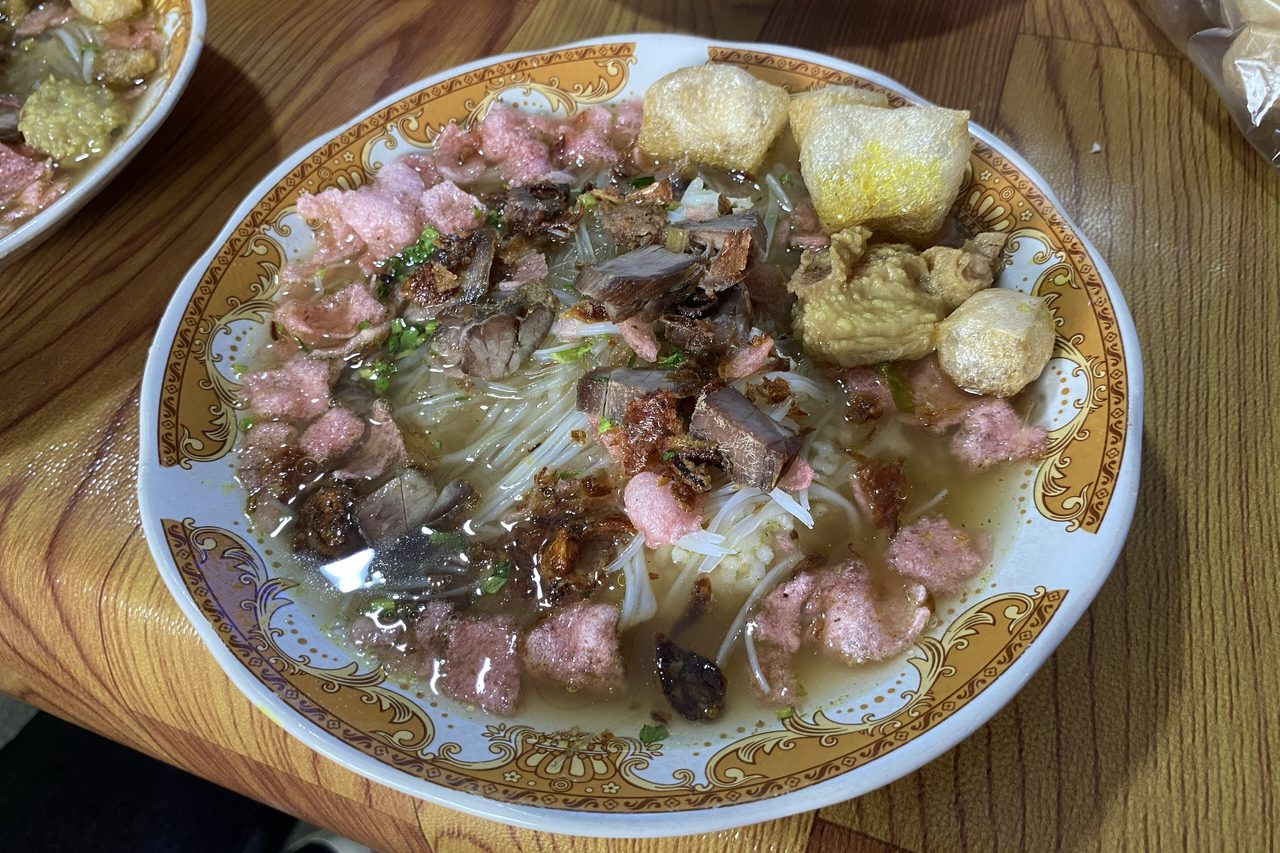
- As a garnish. Scattered over soto, nasi uduk, gado-gado, nasi goreng, laksa and bubur ayam for crunch.
More detail and the reasons why (3)
- From the seed. Roast melinjo seeds over a medium flame with no oil (some makers roast them in sand); some boil them first so they peel more easily. Peel off the soft outer skin and the hard inner one by hand, then strike each seed with a wooden mallet or press it under a stone cylinder into a flat round. Spread on woven bamboo trays and sun-dry for a whole day, and that is raw emping.
- Large emping. Several seeds can be pressed together into a chip as large as krupuk, and those are usually mixed with another starch such as cornstarch or tuber starch. One seed alone will not make a chip that size.
- Thin and thick. Thin emping is usually fried plain or just salted; thick emping is coated in caramelised sugar or spiced with chilli. The coating step above is the thick kind's method.
Tips
- Dry it again before frying. Raw emping takes up moisture in storage. Dry it first, then put it into properly hot oil.
- It takes seconds. Puffed and pale gold is the moment to lift it out. The sheet is so thin that it keeps colouring for a moment after it leaves the oil.
- The bitterness is not a fault. A slight bitter edge is what emping tastes like. Burn it and that bitterness comes to the front.
- Storage. Fried emping softens quickly in humid air; cool it completely and keep it airtight.
More detail and the reasons why (3)
- A cracker with no dough. Deep frying gives "A starch film cooked and then dried" a line of its own — bugak, vegetables painted with glutinous rice paste and dried, which puffs because the water is trapped inside the gelatinised film and expands all at once: "Which is why the fry is three to five seconds." Emping belongs to that class without the paste. The roasted seed, hammered flat, is the film.
- One seed, one chip. Because the chip is a flattened seed, the seed sets its size. Going bigger means adding another starch, which is the large emping above. A cracker built from a starch dough from the start, such as kemplang, begins at the opposite end.
- Melinjo is a seed. It looks like a fruit, but melinjo (Gnetum gnemon) is a gymnosperm and the part you eat is, strictly, a seed. In Indonesia the seeds and young leaves are also cooked as vegetables.
The basics behind this dish
- Deep Frying: Temperature, Batter, and the Second FryFrying is not cooking in oil so much as trading the food's water for it. Two temperatures, what each kind of coating is for, and why the second fry exists.
- Heat Control: Preheating, Oil, and Reading the PanThe same ingredients become a different dish depending on pan temperature. When to add the oil, how to read heat by sound, and which dishes want low heat instead.
- Knife Skills: Grip, Cuts, and Why Size MattersHow you hold the knife matters more than how fast you cut. The pinch grip, the claw hand, and why uniform size is a cooking decision rather than a cosmetic one.
More of the same kind


More from this country


Sign in to edit.
Written with AI · how we check it · Edit history
https://cookiki.com/en/r/emping · cookiki · User contributions are licensed under CC BY-SA 4.0.