
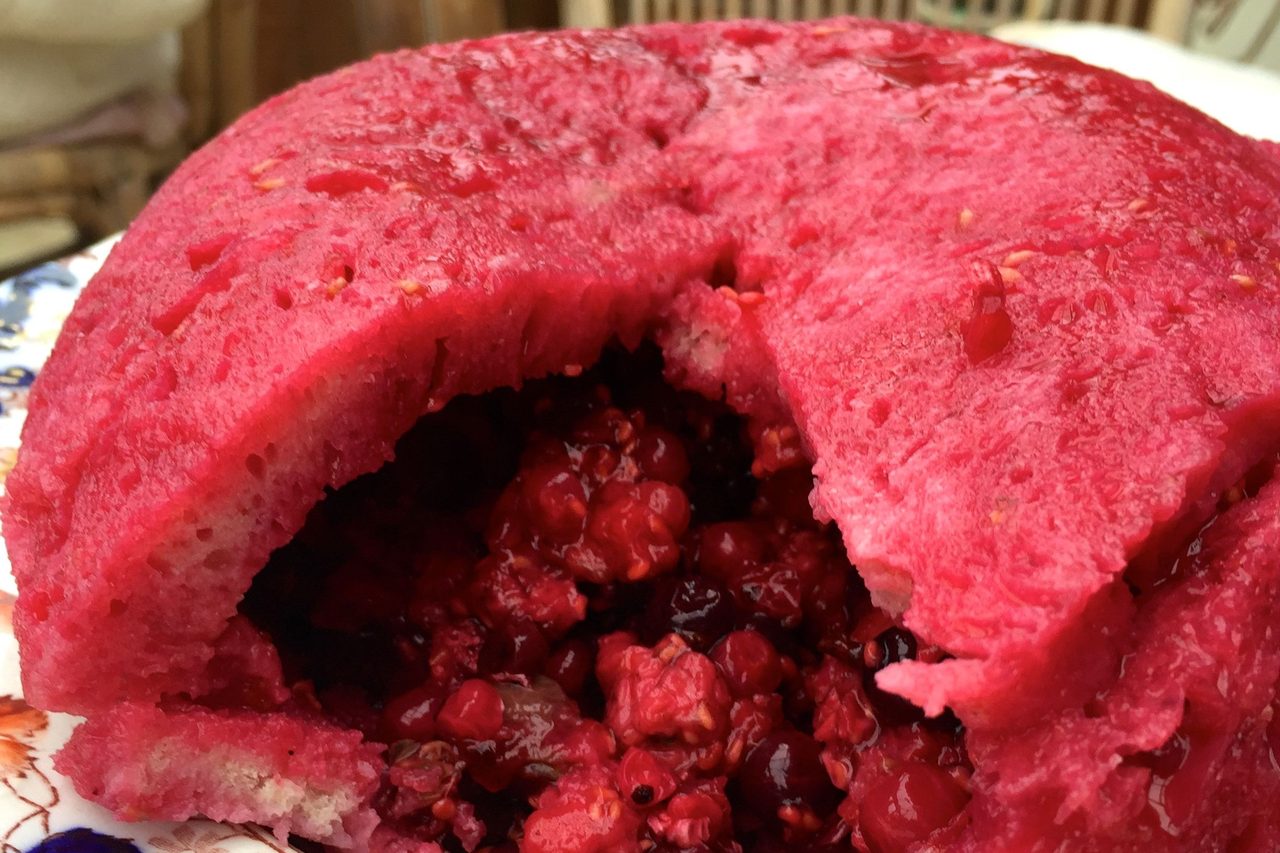
Photo: plambertuk · CC BY 2.0
Spotted Dick (Suet Pudding Steamed in a Basin)
The British steamed pudding, and the only dish on this site built on the highest-melting fat in the kitchen. A croissant needs its butter kept cold so it never melts in, and shortbread is held together by butter that has set hard again. Suet is the fat from around a bullock's kidneys and it does not start to melt until 45-50°C, more than fifteen degrees above butter — so through two hours in a steamer that never passes 100°C, the batter sets first and only then does the fat run out of it. The holes it leaves behind are the light open crumb. Swap in butter and it melts in the first few minutes, and the pudding comes out dense.
Ingredients
- The pudding (one 1.2L basin, serves 6)
- plain flour250 g
- baking powder2 tsp
- suet · shredded beef suet, from a butcher or the packet kind125 g
- caster sugar75 g
- currants or raisins · these are the spots175 g
- lemon zest1 lemon
- milk · adjust to the consistency175 ml
- salt1 pinch
- For the basin
- butter · to grease the inside20 g
- To serve
- custard · crème anglaise; the method is on the île flottante page400 ml
Steps
- ⏲ 5 min
Butter the inside of the basin thoroughly. A disc of baking paper in the bottom makes turning it out certain.
- ⏲ 4 min
Put the flour, baking powder and salt in a bowl and break the suet through it with your fingers. Do not rub it in as you would for pastry — the suet has to stay as separate shreds, because the holes they leave when they finally melt are the crumb.
- ⏲ 3 min
Stir in the sugar, currants and lemon zest, then add the milk and bring it together to a soft dropping consistency. Do not work it.
- ⏲ 3 min
Spoon it into the basin and level the top. Leave 2-3cm of headroom — that is the room to rise.
- ⏲ 5 min
Cover with baking paper and foil together and fold a pleat down the middle. That pleat is the slack it needs as it rises, and string tied tightly under the rim is what keeps water out. The steaming guide names drips off the lid as the commonest failure, and this double cover exists for exactly that — over two hours rather than ten minutes, which is a different order of magnitude from every other steamed dish here.
- ⏲ 120 min
Stand the basin on a plate or trivet in a deep pan and pour in boiling water to come halfway up the basin. Cover and steam 2 hours, keeping a steady gentle boil. Top up with boiling water as it goes; cold water drops the temperature.
- ⏲ 5 min
Take the cover off and push a skewer in. No wet batter on it means it is done. Wait 5 minutes, then put a plate over and turn it out. Turned out at once it slumps; left too long it sticks.
- ⏲ 3 min
Pour hot custard over. That is the crème anglaise from île flottante; the British version usually takes a little cornflour with it.
Tips & Variations
Variations
- Swap butter for the suet and it works, but it becomes a different pudding — much closer, much heavier, nearer a cake. ko.wikipedia says the same, describing non-traditional versions that use another fat or add eggs as "resembling a sponge pudding or a cake". Vegetarian suet is formulated to melt at a similar temperature and comes far closer.
- Haggis uses suet too, but there it is fat distributed through oatmeal, and because it boils inside a casing the order of when the batter sets and when the fat melts does not matter the way it does here. Where suet turns up outside a pudding it usually carries no structure at all — sukiyaki rubs a piece round the pan and that is the whole of its job.
- Against Christmas pudding: steamed the same way, but that one is far heavier in dried fruit, takes brandy, and is matured for weeks or months. Spotted dick is made and eaten the same day.
- Jam roly-poly and syrup sponge: the same suet dough rolled round jam, or steamed over golden syrup in the bottom of the basin. The dough does not change.
- Not to be confused with spotted dog. That is Irish soda bread with raisins in it — the same naming logic and nothing else in common, since it is baked and has no suet in it.
- The name: the origin of "dick" is not settled — dialect dough becoming dick, or a shortening of puddick, are the usual suggestions. The currants are the spots.
- To plump the fruit soak it overnight in tea or rum. That dried fruit takes water out of a batter is explained on bara brith; this batter is wet enough that it is optional.
Tips
- Do not rub the suet in. The pastry reflex — working it between your palms — melts it and spreads it, and the moment it does the whole principle of the pudding is gone. Break it through with your fingertips and stop.
- The pleat in the cover is not optional. Covered tight there is nowhere to rise, and it either splits at the side or comes out compressed on top.
- Top up with boiling water. The steam must not stop for two hours, and a cup of cold water costs you twenty minutes.
- Keep the boil gentle. A hard boil throws water onto the cover, it pools there, and eventually it gets in.
- Five minutes before you turn it out. This is where most of them fail.
- Leftovers get cut thick and fried in butter. That is the standard way to eat it the next day.
The basics behind this dish
- Cooking Oils: Smoke Point and What Each One Is ForWhat a smoke point actually marks, how much headroom deep frying needs, and why sesame oil and extra-virgin olive oil are finishing oils rather than cooking oils.
- Eggs: Coagulation Temperatures and What They DecideWhite sets at 62°C, yolk at 68°C. Those two numbers explain scrambled eggs, boiled eggs, steamed custard and crème anglaise all at once.
- Why Sauces Split: Emulsions and Pan SaucesA cream sauce breaking and a carbonara scrambling are the same failure. Temperature and emulsifiers — plus how to bring a split sauce back.
More of the same kind



More from this country




Sign in to edit.
AI-drafted, editor-reviewed · edits: 0 ·Edit history
https://cookiki.com/en/r/spotted-dick · cookiki · User contributions are licensed under CC BY-SA 4.0.