
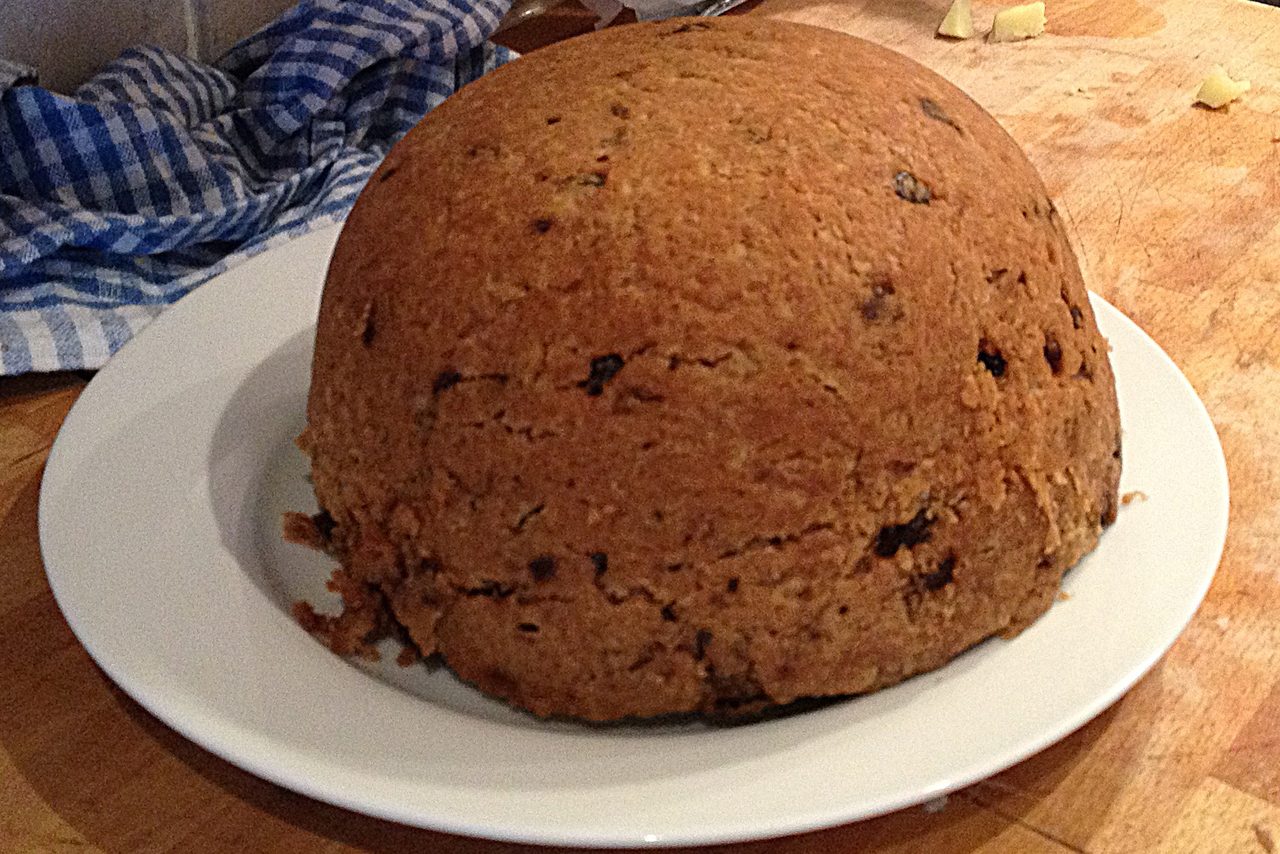
Photo: sam.romilly · CC BY 2.0
Summer Pudding (Bread-Lined Mould of Soft Fruit)
An English dessert: a basin lined with stale white bread, filled with barely-heated soft fruit and its juice, weighted, and turned out the next day. There is no gelatine, no egg and no starch in it, and the bread is never baked. It stands up on the plate because bread swollen with juice, held under a weight, loses the seams between the slices. Nothing is added to set it, and the overnight wait is not resting -- it is the cooking.
Ingredients
- Fruit
- raspberries300 g
- blackcurrants · blueberries if you have none200 g
- redcurrants150 g
- blackberries150 g
- caster sugar · taste the fruit and adjust120 g
- lemon juice1 tbsp
- creme de cassis · optional1 tbsp
- The lining
- white sliced bread · a day or two old, cut thin, crusts off. Not fresh bread and not wholemeal8 slices
- To serve
- double cream · lightly whipped, or just poured200 ml
Steps
- ⏲ 5 min
Line a 1L pudding basin generously with cling film. That one step is the whole of turning it out later.
- ⏲ 5 min
Cut the crusts off and cut the bread into one disc for the base, six to eight tapered pieces for the walls, and one disc for the lid. No butter -- fat repels the juice.
- ⏲ 3 min
Put the fruit, sugar and lemon juice in a pan over a low heat for 2-3 minutes only, until the juice runs and the sugar dissolves. Do not let it boil -- you are not cooking the fruit, only bursting the cells so the juice comes out.
Strain, keeping fruit and juice apart, and hold back 150ml of the juice. It is for patching at the end.
- ⏲ 10 min
Dip each piece of bread in the hot juice on one side only and lay it dipped-side against the basin. Overlap the pieces slightly and press the seams together with a finger.
Fill with the fruit and some juice, lay on the bread lid and press the edges inward to close it. Fold the cling film over.
Set a plate on top, weight it with a couple of tins, and leave it in the fridge overnight, eight hours at the very least. This is the cooking: the bread swells as it takes up juice, and under the weight the swollen pieces bond to each other.
- ⏲ 5 min
Turn it out onto a plate and peel off the film. If any patch is still pale, pour the reserved juice over it. A pale patch is not a cosmetic problem -- it is that slice reporting that it never got wet enough. Serve with cream.
Tips & Variations
Variations
- Autumn pudding: blackberries with cooked apple. The winter one is made with dried fruit and orange.
- Hydropathic pudding and Malvern pudding: the same recipe appears under both names from 1868, as a dessert for patients at hydropathic spas who were not allowed pastry. The name "summer pudding" first appears in print in 1904. A pudding defined by what it leaves out.
- With frozen fruit: out of season, use 800g of frozen mixed berries straight from the freezer at step 3 without thawing. Freezing has already burst the cells, so the juice runs more freely, not less (freezing and thawing).
- Individual moulds: six ramekins work, but a small mould gets less even pressure, so do not cut the weight or the time.
- In brioche or panettone: better not. A rich bread repels the juice, so the outside wets and the middle stays dry.
Tips
- Nothing in it sets it. Panna cotta sets with gelatine, creme caramel with egg and heat, yokan with agar. This has none of them. It stands for two reasons only: bread starch swollen with juice, and a night under a weight.
- Stale is not the same as dry, and this needs stale. Umm Ali bakes its pastry brittle and says that only something dry takes up hot milk and still holds its layers. What this needs is bread that has staled -- its starch has recrystallised as it cooled and gone firm, which is the story daifuku tells -- so it takes up juice without turning to paste before you have finished lining the basin. Fresh bread collapses; oven-dried bread crumbles.
- It wants exactly what umm ali forbids. That page says that given time the layers collapse into one mass, and that the dish depends on them surviving. Summer pudding depends on the opposite: the slices have to lose their identity and become one thing, or it will not stand when you turn it out.
- Pressed cold, and that is the difference from pyeonyuk. That one has to be pressed hot, because only while the dissolved gelatine is still liquid can it spread between the fibres -- its page says that pressed cold you squeeze out liquid without making a block. There is no gelatine here, so there is no such deadline. Cold, slow, and bonded by swelling instead.
- Keep some juice back. The reserved 150ml is what rescues almost every summer pudding. Poured over a pale patch after turning out, it colours through in five minutes.
- Boil it and you have jam. Past three minutes the pectin comes out, the fruit breaks down, and the filling turns into a sweet mass with nothing to bite. What goes inside is raw fruit that has been made to give up its juice, not cooked fruit.
- When there is no summer fruit. The name is a season but the dish is not tied to a date -- frozen berries give the same thing all year.
The basics behind this dish
- Eggs: Coagulation Temperatures and What They DecideWhite sets at 62°C, yolk at 68°C. Those two numbers explain scrambled eggs, boiled eggs, steamed custard and crème anglaise all at once.
- Why Sauces Split: Emulsions and Pan SaucesA cream sauce breaking and a carbonara scrambling are the same failure. Temperature and emulsifiers — plus how to bring a split sauce back.
- Knife Skills: Grip, Cuts, and Why Size MattersHow you hold the knife matters more than how fast you cut. The pinch grip, the claw hand, and why uniform size is a cooking decision rather than a cosmetic one.
More of the same kind


More from this country



Sign in to edit.
AI-drafted, editor-reviewed · edits: 0 ·Edit history
https://cookiki.com/en/r/summer-pudding · cookiki · User contributions are licensed under CC BY-SA 4.0.