
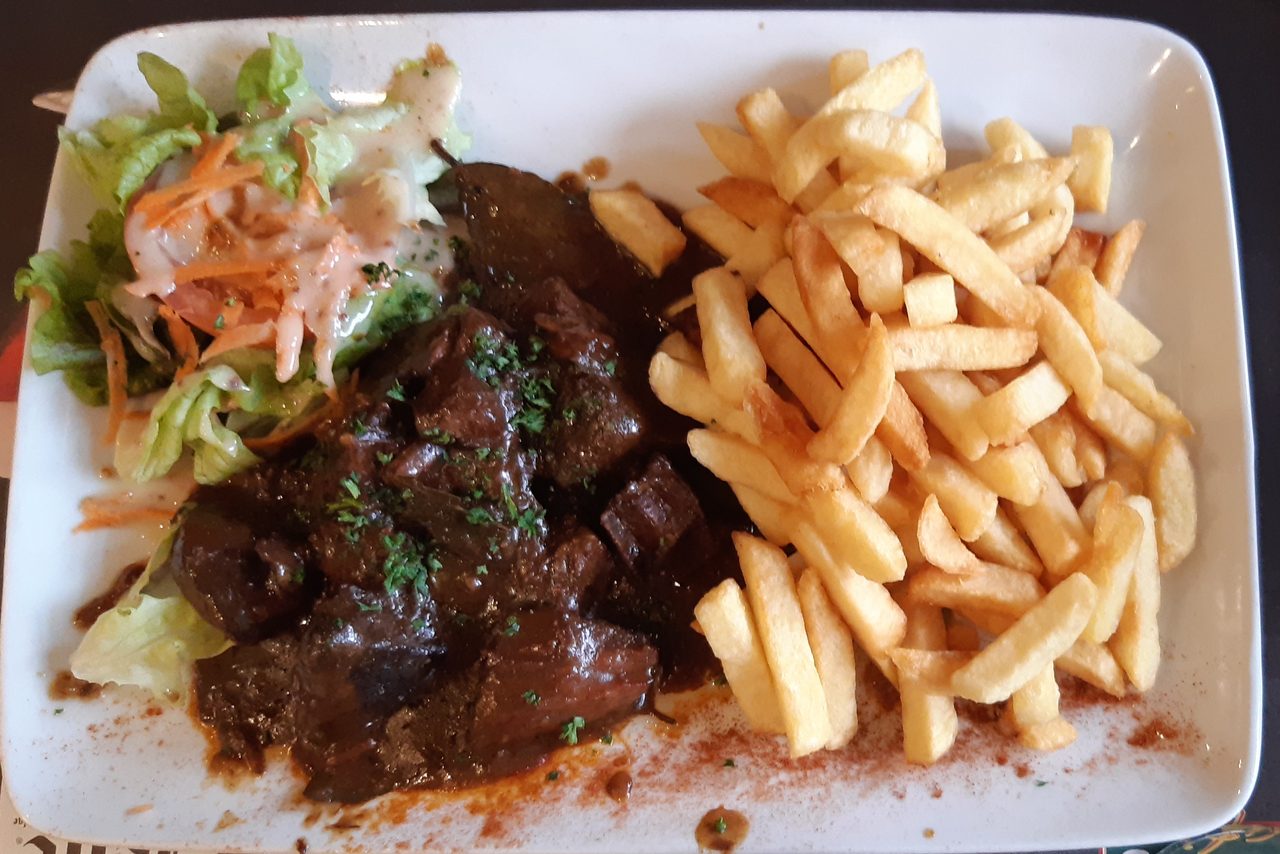
Photo: UnorthodoxY · CC BY-SA 2.0
Moules-Frites (Mussels and Chips)
Belgium's national dish: mussels steamed open in a covered pot and served with chips. Almost no liquid goes in. As the shells open they pour out the seawater they were holding, and that becomes the broth — so the best thing in the pot is not something you made but something the mussels brought with them. Five minutes on the heat is the whole of it, and everything past that is a loss.
Ingredients
- Mussels (serves 2)
- live mussels · a kilo per person is the benchmark2 kg
- butter40 g
- shallots · finely chopped, or one onion3
- celery · finely sliced2 sticks
- garlic · chopped3 cloves
- flat-leaf parsley · chopped, stalks included4 tbsp
- dry white wine · this is all the liquid that goes in150 ml
- black pepper · coarsely ground0.5 tsp
- bay leaf1
- Frites
- potatoes · floury; cut into thick 1cm batons800 g
- frying oil · beef dripping is the Belgian choice1.5 L
- salt · the moment they come out1 tsp
- To serve
- mayonnaise · mayonnaise, not ketchup4 tbsp
- baguette · for the broth; optional0.5
Steps
Clean the mussels. Scrub them in cold water and pull the beard sharply towards the hinge to remove it. Throw away any with cracked shells, and any gaping ones that do not close when you tap them — those are dead. One already shut tight is alive and fine.
- ⏲ 6 min
Cut the potatoes into 1cm batons, rinse off the surface starch and dry them completely in a cloth. Fry them 6 minutes at 150°C — this pass cooks the inside without colouring it. Lift them out and rest at least 10 minutes, which lets steam escape and the surface dry.
- ⏲ 3 min
In a pot big enough to be half empty with all the mussels in it, melt the butter and soften the shallots, celery and garlic for 3 minutes without colouring them.
Add the wine, the coarse pepper, the bay and half the parsley and bring it to a hard boil. That is all the liquid there is. The urge is to add water; do not. The broth arrives inside the mussels.
- ⏲ 4 min
Tip in all the mussels at once, cover, and give them 4-5 minutes over high heat. Once, halfway, take the pot in both hands and toss it to swap top for bottom. Do not stir with a spoon — the shells chip and the pieces end up in the broth.
Lift the lid, and the moment most of them are open, take it off the heat. Do not wait for every last one — while you wait on the stragglers, everything already open shrinks and turns rubbery. Discard any that stayed shut.
- ⏲ 3 min
Fry the rested potatoes a second time, 3 minutes at 190°C, until deep gold and firm to the touch. Salt them the moment they come out; salt will not stick once they cool.
Scatter the rest of the parsley and bring the whole pot to the table. There is a correct way to eat them: use one empty shell as tongs to pick the meat out of the rest. Chips go in the mayonnaise, and the broth gets wiped up with bread.
Tips & Variations
Variations
- Marinière: what the recipe above is. White wine, shallots and parsley, nothing else, and the first line on every Belgian brasserie's list.
- À la crème: lift the mussels out, then reduce 100ml of cream into the remaining broth. Softer, at the cost of covering some of the sea flavour (dairy and heat).
- À la bière: Belgian wheat beer instead of the wine — the country's other export doing the same job, which is exactly the logic carbonnade flamande is built on (cooking with alcohol).
- Provençale: plenty of tomato and garlic, in the southern French manner. Go far enough down that road and you are heading towards bouillabaisse.
- The frying fat: beef dripping is the Belgian original — a higher smoke point than vegetable oil, and a savoury smell of its own. It stops being vegetarian, and it sets solid white in the pan, which is a nuisance (choosing oils).
- The sauce: mayonnaise is the default, with andalouse (mayonnaise, tomato and pepper), tartare and samouraï (mayonnaise and harissa) close behind. Ketchup is regarded in Belgium as something for children.
- Season: the Belgian rule is months with an R in them — September to April — which lines up with mussels being plump again after spawning.
- How it differs from clam chowder and paella: in both of those the shellfish is one ingredient among many and the liquid is made separately. Here the shellfish brings the broth, which is why the only liquid added is one glass of wine.
- Against fish and chips: two countries that both made fried potato a national food, differently. The Belgian cut is thicker, fried twice, and dipped in mayonnaise rather than doused in vinegar.
Tips
- Do not add water. This is the common mistake. Two kilos of mussels release cups of seawater as they open; anything you add only dilutes it, and a deep pool in the base means the bottom layer boils rather than steams. 150ml of wine is the ceiling.
- Four to five minutes, and do not wait for the last one. The window is narrow — two minutes past open and the meat has shrunk by half and gone rubbery. Do not sacrifice the majority to the stragglers.
- Sort them while cleaning. A gaping mussel that will not close when tapped is dead, and so is a cracked one. Conversely, ones still shut after cooking may just have a stubborn muscle, but there is no way to tell, so throw them out.
- Debeard just before cooking. Pulling the beard starts the mussel dying, so do it when you can go straight to the pot. Pull it towards the wide end of the shell, not the point.
- Big pot; toss it, do not stir it. More than half full and steam cannot circulate, so only the bottom cooks. A spoon chips the shells and puts fragments in the broth (steaming).
- A kilo per person. Most of that weight is shell — the actual meat is 200-250g. First-timers almost always buy too few.
- Fry the potatoes twice. 150°C cooks the inside, then, after they cool, 190°C sets the outside. In one pass the outside burns before the middle is done. The cooling in between is the point — that is when steam leaves the interior, which is what lets the second fry crisp (deep frying).
- Dry the potatoes completely. Wet ones spit instead of frying and come out soggy. Rinse, then press them dry in a cloth.
- Salt them the second they leave the oil. Salt only sticks while the surface fat is hot; sprinkle it over a plated pile and it falls straight through (salt and seasoning).
- Leave the last spoonful of broth in the pot. Grit from the mussels settles there. Ladle the broth out rather than pouring it.
- Pick leftovers out of the shells. Reheated in the shell they toughen; picked and stirred into pasta or fried rice at the last moment they are fine (reviving leftovers).
The basics behind this dish
- Dry Heat and Moist Heat: Choosing the MethodRoasting and simmering are not hotter and cooler versions of one thing — they are different families. One builds aroma, the other builds tenderness, and most good cooking uses them in sequence.
- Alcohol in Cooking: What It Actually DoesAlcohol is a solvent for aroma, it does not all cook off, mirin and sake and shaoxing and wine each do a different job, and there is a real substitution ratio when you have none.
- Browning and the Maillard ReactionMeat fails to brown for one of three reasons: it is wet, the pan is cool, or you put too much in at once. Plus how the brown film stuck to the pan becomes your sauce.
More of the same kind


More from this country


Sign in to edit.
AI-drafted, editor-reviewed · edits: 0 ·Edit history
https://cookiki.com/en/r/moules-frites · cookiki · User contributions are licensed under CC BY-SA 4.0.