
Photo: Simon Abrams · CC BY 2.0
Pepperpot (Cassareep Beef Stew)
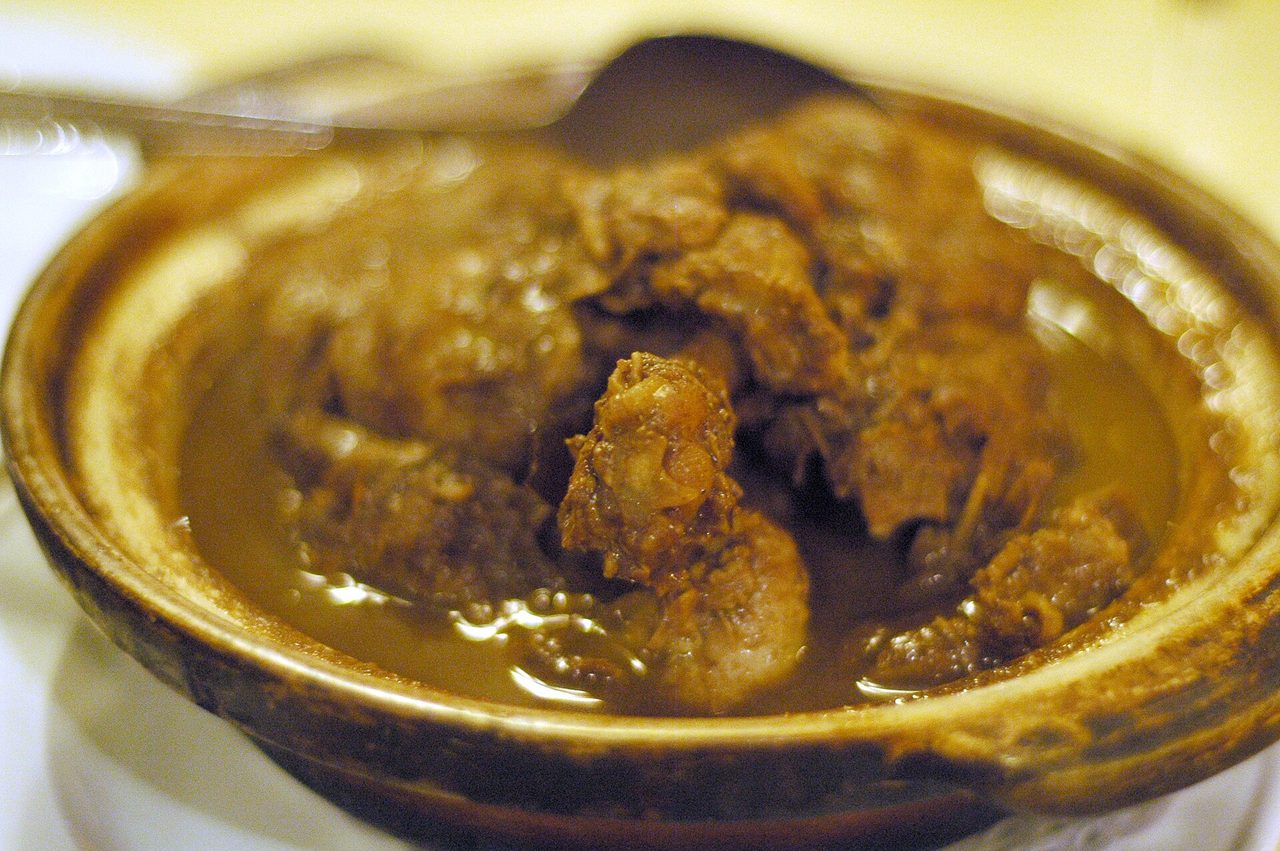
The stew Guyana counts as a national dish: collagen-rich cuts such as oxtail and cow heel, simmered for hours with cinnamon, cloves, thyme, orange peel and whole hot peppers in a seasoning of cassareep, until the liquid is nearly black. Cassareep is the juice of bitter cassava boiled down to a syrup like molasses, and both the colour and the savour of the stew come from it. It is eaten on Christmas morning with fresh bread.
Ingredients
- Meat
- oxtail · cut at the joints800 g
- beef shin · in large chunks600 g
- cow heel · cut in pieces; or more oxtail500 g
- Seasoning
- cassareep · bottled120 ml
- brown sugar2 tbsp
- salt2 tsp
- onion · roughly chopped1
- garlic · crushed6 cloves
- cinnamon sticks2
- cloves6
- thyme4 sprigs
- orange peel · finger-length, white pith removed1 strip
- wiri wiri peppers · or 1-2 Scotch bonnets; whole4
- water · enough to just cover the meat1.5 L
- To serve
- bread · fresh white bread1 loaf
Steps
- ⏲ 5 min
Put the cow heel and oxtail in cold water, bring to the boil and blanch 5 minutes, then drain and rinse under running water.
Put all the meat in a large pot with the onion, garlic, cinnamon, cloves, thyme and orange peel. Do not brown the meat. Add the cassareep, brown sugar and salt, and pour in water to just cover.
Bring to the boil over high heat, skim, and drop in the peppers whole. For more heat, slit just one of them.
- ⏲ 165 min
Cover and simmer over low heat for 2 hours 30 minutes to 3 hours, until the cow heel tendons part with a chopstick and the liquid has reduced to something dark and glossy. Fish the peppers out partway through to set the heat.
- ⏲ 10 min
Taste and add a little salt or cassareep. If you add cassareep, simmer 10 minutes more.
If you can, cool it and leave it in the fridge overnight. Lift off the set fat, bring it back to a full boil before eating, and serve with bread.
Variations
- Pork or mutton: pig's trotters or mutton are often used alongside or instead of beef. Either way, choose cuts that only turn tender after long cooking.
More detail and the reasons why (3)
- A pot kept going for days: made for Christmas and reheated through the holidays, topped up with more meat and cassareep as it goes down. That only works if the storage rule in the tips is kept.
- Same name, other dishes: Jamaican pepperpot soup is a green soup built on callaloo leaves, and the Philadelphia pepper pot is a thick tripe soup. The one made with cassareep is Guyana's.
- Without cassareep: there is no real stand-in. Soy sauce and molasses can imitate the colour, but not the bitter edge of cassava juice. Bottled cassareep is sold in Guyanese and Caribbean grocers.
Tips
- The poison leaves in the boiling, which is why you buy it. Bitter cassava juice carries a compound that turns into hydrogen cyanide in contact with water, and hydrogen cyanide is volatile and goes off with heat. Bottled cassareep has already been through that boiling. Do not make it from raw cassava juice at home; use a reliable commercial bottle.
More detail and the reasons why (6)
- The colour is not made in the pot, it comes out of a bottle. That is why the meat is not browned: meat under water cannot get its surface above 100°C, so it does not brown (browning), and the stew's near black is cassareep's colour from the start. Where hong shao rou melts sugar in the pan for its colour, pepperpot buys a syrup that has already been cooked down.
- Cassareep is cassava juice taken all the way. The juice pressed from grated bitter cassava is boiled until it has lost half its volume and is as thick as molasses, then spiced. The same juice, fermented and used as a thin broth, is the base of Brazil's pato no tucupi. One is a broth and the other a syrup.
- Use cuts that can take hours. Oxtail, cow heel and shin are full of sinew and collagen and only soften after hours of simmering, and the gelatine they release is what gives the liquid its gloss (braising). Lean meat alone gives a thin liquid and dry meat.
- It is better the next day. As with any braise, the meat takes the liquid back in as it cools overnight (reviving leftovers), which is why it is made on Christmas Eve and reheated in the morning.
- Do not trust the preservative story enough to leave it out. Cassareep has long been said to preserve the meat, but laboratory testing has not shown it. If the pot is to last several days, cool it and refrigerate it each time, and bring it to a full boil every time it is served.
- Whole peppers, and let time set the heat. An unbroken pepper gives aroma and some heat and can be fished out; once it splits there is no going back (chilli and heat). Wiri wiri is a small round pepper native to Guyana; Scotch bonnet is the usual substitute.
The basics behind this dish
- Browning and the Maillard ReactionMeat fails to brown for one of three reasons: it is wet, the pan is cool, or you put too much in at once. Plus how the brown film stuck to the pan becomes your sauce.
- Cooking Meat: Temperature, Resting, and Cutting Against the GrainDoneness is a core temperature, not a number of minutes. What resting actually does, how to handle a thick cut, and why the direction you slice changes the texture.
- Knife Skills: Grip, Cuts, and Why Size MattersHow you hold the knife matters more than how fast you cut. The pinch grip, the claw hand, and why uniform size is a cooking decision rather than a cosmetic one.
More of the same kind


Sign in to edit.
Written with AI · how we check it · Edit history
https://cookiki.com/en/r/pepperpot · cookiki · User contributions are licensed under CC BY-SA 4.0.