
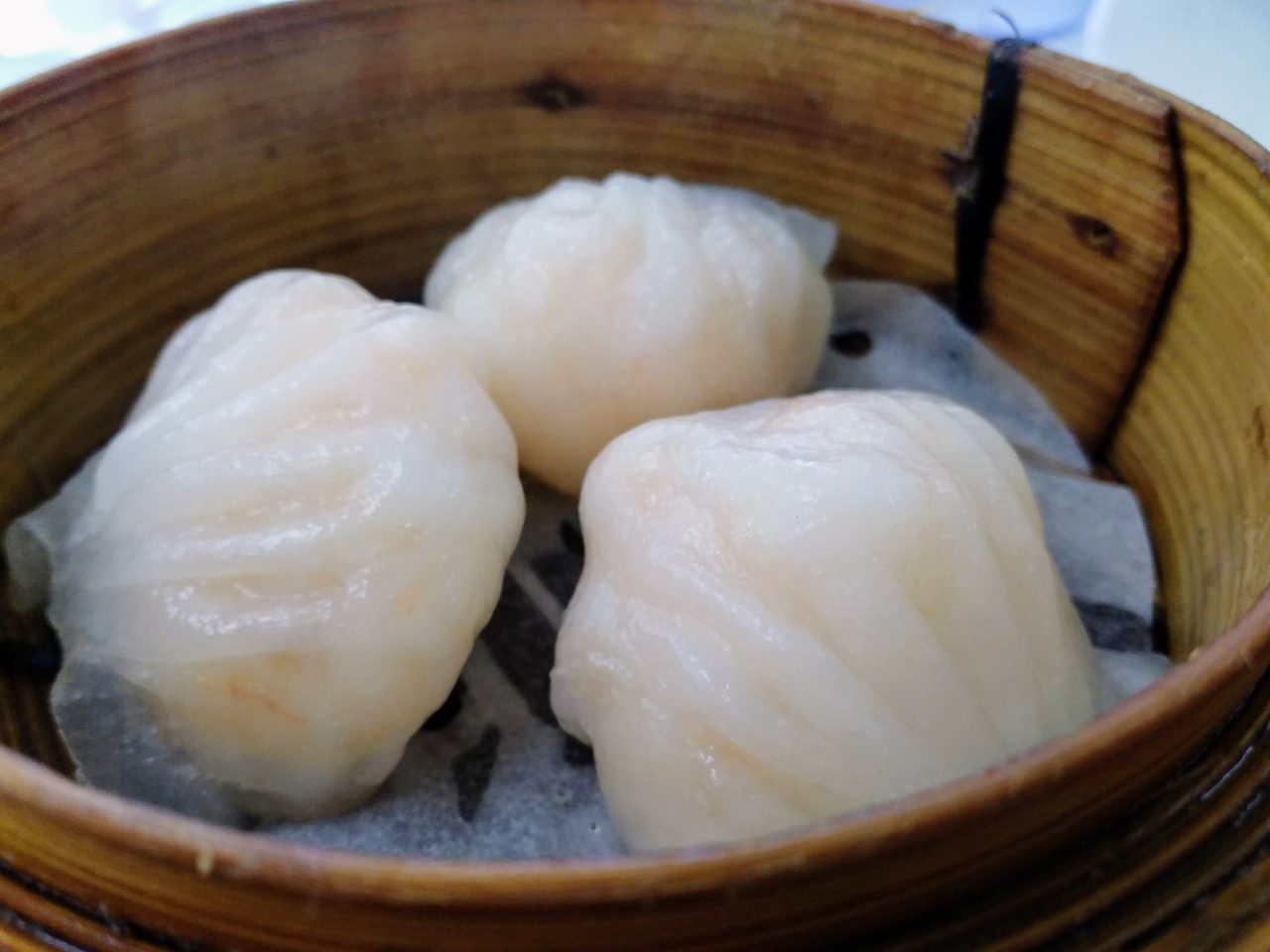
Photo: Edsel Little · CC BY-SA 2.0
Siu Mai (Open-Topped Pork and Prawn Dumpling)
The dim sum that is not closed at the top. Instead of sealing it like a dumpling, you push the wonton wrapper down through a ring of your fingers to make a cup and pack the filling in. So the skill is not in the pleating but in the springiness of the filling, and that comes from salting it first and then slapping it against the bowl.
Ingredients
- Filling (makes about 24)
- minced pork · shoulder, 25–30% fat; all-lean turns dry400 g
- raw prawns · half roughly chopped, half fine — the pieces are the texture200 g
- dried shiitake · soaked 30 minutes in warm water and diced; keep the water4
- bamboo shoot or water chestnut · finely diced, for the crunch50 g
- salt · goes in first1 tsp
- sugar1 tsp
- white pepper0.5 tsp
- Shaoxing wine1 tbsp
- oyster sauce1 tbsp
- sesame oil1 tbsp
- potato starch1 tbsp
- shiitake soaking water · cooled; the only liquid in the filling2 tbsp
- Wrappers
- wonton wrappers · the thin yellow kind, or round siu mai wrappers24
- To top
- crab roe or carrot · very finely diced; carrot is the usual stand-in2 tbsp
- peas · optional24
- To dip
- soy sauce3 tbsp
- chilli oil1 tbsp
- black vinegar1 tbsp
Steps
- ⏲ 30 min
Soak the dried shiitake in warm water for 30 minutes, then dice them. Keep 2 tablespoons of the soaking water and let it cool — it is the only liquid that goes into the filling, and all the mushroom savouriness is in it.
- ⏲ 3 min
Add the salt, sugar and white pepper to the pork first and stir in one direction for 3 minutes. The salt dissolves muscle protein into a tacky network, and that network is what makes siu mai springy. Add the salt after everything else and it never develops.
Take the mixture in your hand and slap it against the side of the bowl 20 to 30 times. It tightens, pulls into one mass and goes smooth on the surface. Skip this and the filling crumbles apart as you bite it.
Mix in the wine, oyster sauce, sesame oil, potato starch and the cooled mushroom water, then fold in the shiitake, bamboo shoot and prawns lightly only. The prawn pieces need to stay whole, so they go in last and get a few turns, no more.
- ⏲ 30 min
Cover and chill 30 minutes. A cold filling has firm fat, which makes it easier to shape and less likely to slump in the steamer.
Lay a wrapper on your palm, put a tablespoon of filling on it, and push it down through a ring made with your thumb and forefinger so the wrapper gathers upwards. Flatten the top with the back of a spoon. Do not close the top — a siu mai is a cup, not a sealed dumpling.
Top each one with crab roe or finely diced carrot and press it in gently; a single pea if you are using them. It has to go on before steaming to stick.
- ⏲ 9 min
Bring the steamer to a hard boil. Line it with paper or cabbage leaves, stand the siu mai so they do not touch, and steam 8–10 minutes. Check the water has not boiled dry, and do not overdo it: the wrapper toughens and the filling loses its juice.
Tilt the lid to let the steam out once, then serve straight away, with soy sauce mixed with chilli oil and black vinegar.
Tips & Variations
Variations
- Japanese shūmai: pork only, no prawn, with a single pea pressed into the top. It became a Yokohama speciality and then a lunchbox staple — smaller and softer than the Cantonese kind.
- Shanghai siu mai: filled with glutinous rice instead of meat. The same name for what is effectively a different dish, and a surprise if you order it expecting this one.
- Northern shao mai (稍麥): around Hohhot it is lamb and spring onion in a thicker wrapper, opening into a wide flower at the top. It does not even look like the yellow-wrapped Cantonese version.
- Salt and pepper siu mai: steamed, then deep fried and dusted with salt and white pepper — a Hong Kong snack-shop item.
- Instead of crab roe: carrot, peas, sweetcorn. The topping is there for colour, so it changes very little.
- Freezing: shape them and freeze unsteamed, spread on a tray before bagging, then steam from frozen for 12 minutes. Steamed first and then frozen, the wrapper toughens on reheating.
Tips
- Do not close the top. This is the most common misunderstanding the first time. A siu mai is a cup made of wrapper, not a sealed dumpling, and the filling showing at the top is correct. Har gow is pleated shut, xiaolongbao is twisted shut to hold soup in, and gyoza is pressed shut to be pan-fried. Dumplings that arrive on the same table are solving different problems.
- Its wrapper works on the opposite principle to har gow's. A har gow wrapper is wheat starch scalded with boiling water so the starch gelatinises — translucent, and with no gluten at all. Siu mai uses an ordinary gluten wheat-and-egg wonton wrapper as it comes. Side by side on a trolley, they are completely different doughs (dough and gluten).
- Salt first, then slap it. Same mechanism as menchi katsu with a different goal: there it is to stop the patty falling apart, here it is to build a filling that springs back when you bite it. The difference is how far the same principle is pushed (salt and seasoning).
- 25–30% fat is not negotiable. Siu mai made with lean pork is dry, and no amount of extra seasoning fixes it. The easy route is asking the butcher to mince shoulder.
- Use the mushroom soaking water. It gives more depth than plain water or stock, and two tablespoons is all you need. Pour it off the grit that settles at the bottom (soaking).
- Prawns last, and coarse. Minced with everything from the start they disappear into the pork. Keeping half of them in rough pieces is the trick.
- Keep the steamer at a hard boil. Weak steam leaves the wrapper slack and undercooked (dry heat and moist heat).
- Stop at 8–10 minutes. This is not a thing that improves with longer steaming: the wrapper toughens and the filling gives up its juice into the basket.
- Origin: an early trace is usually placed in the teahouses of Hohhot, recorded as 稍麥, spreading south into the Cantonese dim sum form. Fillings and wrappers differ so much by region (see the variations above) that a single lineage is hard to pin down — but the Cantonese version is what most people now mean by siu mai.
The basics behind this dish
- Knife Skills: Grip, Cuts, and Why Size MattersHow you hold the knife matters more than how fast you cut. The pinch grip, the claw hand, and why uniform size is a cooking decision rather than a cosmetic one.
- Salt: When You Add It Matters More Than How MuchThe same amount of salt either draws water out or seasons all the way through, depending on when it goes in. Osmosis, seasoning in layers, and why salt types are not interchangeable by volume.
- Heat Control: Preheating, Oil, and Reading the PanThe same ingredients become a different dish depending on pan temperature. When to add the oil, how to read heat by sound, and which dishes want low heat instead.
More of the same kind


More from this country


Sign in to edit.
AI-drafted, editor-reviewed · edits: 0 ·Edit history
https://cookiki.com/en/r/siu-mai · cookiki · User contributions are licensed under CC BY-SA 4.0.