
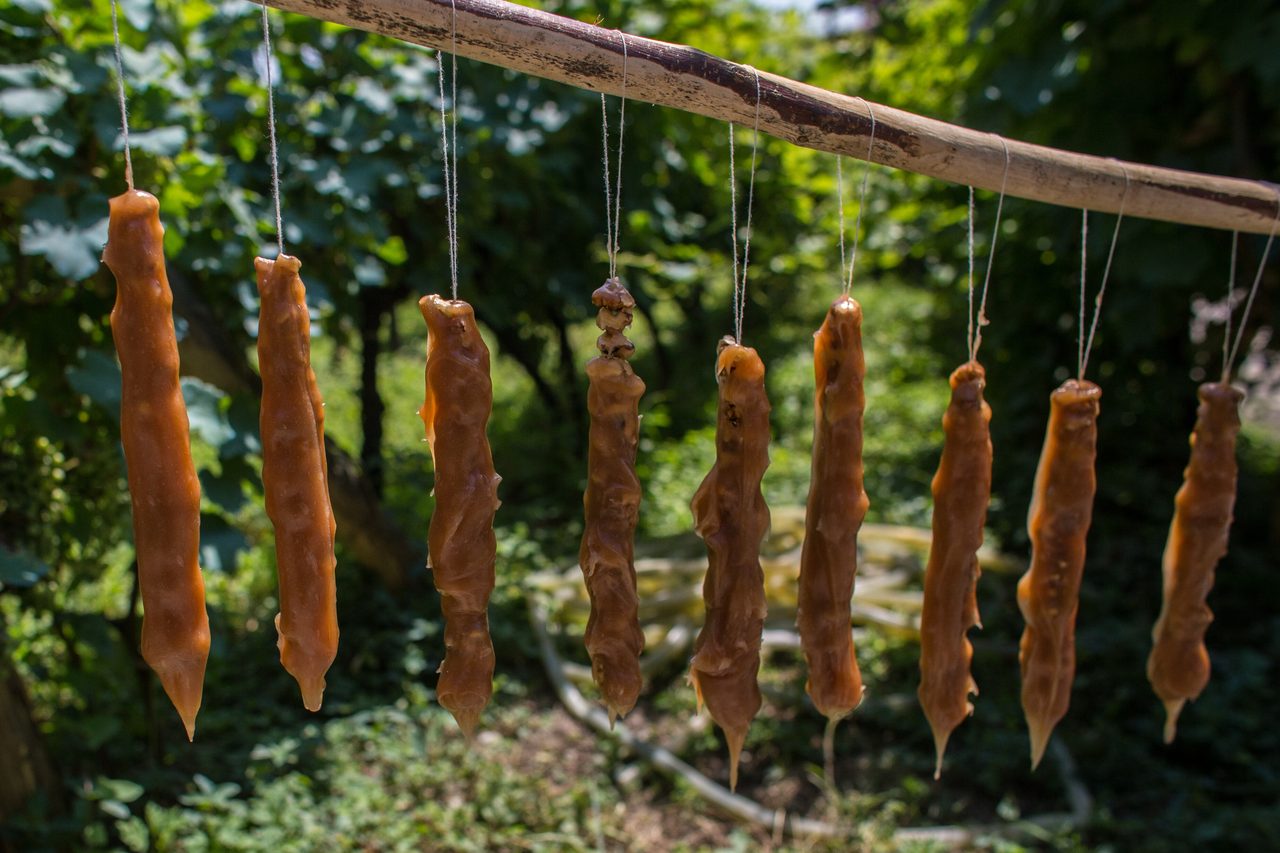
Photo: Xuthoria · CC BY-SA 4.0
Tklapi (Sun-Dried Fruit Leather)
Georgia's fruit leather: cooked, sieved fruit spread 2-3mm thin and dried in the sun. Sweet sheets of apricot or peach are eaten as they are; sour ones of cherry plum (tkemali) are torn off a piece at a time and dissolved into soups such as kharcho to sour them. Dry a whole fruit and the outside dries first and traps the water inside; spread it as a thin puree and there is no inside to trap it, so it dries in days.
Ingredients
- cherry plums (tkemali) or apricots · plums for sour, apricots or peaches for sweet; fully ripe1 kg
- water50 ml
- sugar (optional, sweet tklapi only) · leave out if the fruit is sweet enough; never in the sour kind50 g
- neutral oil · to film the tray1 tsp
Steps
- ⏲ 18 min
Wash the fruit, put it in a pan with the 50ml of water, cover and cook over low heat for 15-20 minutes, until the flesh collapses. Halve and stone apricots first; small plums can go in whole.
- ⏲ 10 min
While it is hot, press it through a sieve to leave the skins and stones behind. Keep only the smooth puree. For sweet tklapi, stir in the sugar now.
- ⏲ 10 min
Return the puree to the pan and cook it uncovered over medium-low heat for 10 minutes, stirring, to thicken it a little — until a line drawn with a spoon holds for a moment. Every bit of water taken off here is drying time saved.
- ⏲ 5 min
Film a large tray or board with the oil, very thinly, or line it with baking paper. Pour on the puree and spread it 2-3mm thick and even. Thin at the edges and thick in the middle, the edges crack while the middle stays wet.
Dry it in strong sun and moving air, under a mesh cover, for 2-3 days, bringing it in at night. In an oven, 60-70°C with the door slightly open for 6-8 hours.
- ⏲ 5 min
It is done when the surface no longer sticks to a finger and a corner lifts away as one sheet. Peel it off, roll it up with baking paper and keep it somewhere cool.
- ⏲ 10 min
To use sour tklapi in a soup, soak a palm-sized piece in a ladle of warm broth for 10 minutes to dissolve it, then add it once the soup is nearly done, tasting as you go.
Tips & Variations
Variations
- Sweet tklapi: apricot, peach, apple, blackberry. Cut up and eaten as a snack. If the fruit is sweet enough, leaving the sugar out keeps the fruit clearer.
- Sour tklapi: made from tkemali (cherry plums) or underripe plums. It is more a kitchen ingredient than a snack, dissolved a little at a time into soups and stews such as kharcho. It is the dried partner to tkemali sauce, made from the same plum.
- From grape must: in Georgia it is also made from the must left over from churchkhela — but without the flour that churchkhela thickens it with. Lying on a board to dry, it has nothing to run off.
- Rolled and cut: roll a finished sheet up in its baking paper and snip it with scissors into bite-sized rolls. At the market it is sold folded, sheet and all.
Tips
- With no inside, there is nothing to trap. The trouble with drying a whole fruit, as gotgam does, is this: "Once the outside dries first, that skin traps the moisture inside." So it is massaged daily for weeks to reopen the path. Tklapi removes the problem by shape. Puree the fruit and spread it 2-3mm thin, and the water has only millimetres to travel; there is no middle to massage in the first place.
- An even sheet dries evenly. For the same reason, a sheet thin at the edges dries and cracks there first while the thick middle is still wet — and the wet part is where mould settles. Spreading is the skill in this dish.
- The risky window is short. Gotgam says "The first three days are the whole risk." — mould settles in the first few days while the surface is still wet. A thin puree shortens that wet stretch to a day or so. The mesh cover, and bringing it in out of the night dew, are about protecting that day.
- Why it needs no flour. Churchkhela, from the same country, says "The flour is there for gravity, not for flavour." — grape must runs off a vertical string. Tklapi dries lying flat on a board, with nothing to hold up. Nothing goes in but the fruit.
- Drying preserves it, not sugar. Churchkhela keeps because it has "very little free water and a great deal of sugar". Sour tklapi has no sugar in it at all and keeps anyway, because the water has gone, which is also why its sourness comes through intact.
- One more reason to dry something. Gotgam lists several reasons for drying and says "Drying here is a transformation, not just preservation." Sour tklapi is dried in order to be dissolved again later: the season's plum sourness folded into a sheet and stirred into a winter soup one piece at a time.
- Soak it before it goes into the pot. Dropped straight into a soup, a piece softens on the outside and stays leathery inside. Soak it in warm broth first and add it once it has come apart.
The basics behind this dish
- Deep Frying: Temperature, Batter, and the Second FryFrying is not cooking in oil so much as trading the food's water for it. Two temperatures, what each kind of coating is for, and why the second fry exists.
- Heat Control: Preheating, Oil, and Reading the PanThe same ingredients become a different dish depending on pan temperature. When to add the oil, how to read heat by sound, and which dishes want low heat instead.
- Knife Skills: Grip, Cuts, and Why Size MattersHow you hold the knife matters more than how fast you cut. The pinch grip, the claw hand, and why uniform size is a cooking decision rather than a cosmetic one.
More of the same kind


More from this country


Sign in to edit.
AI-drafted, editor-reviewed · edits: 0 ·Edit history
https://cookiki.com/en/r/tklapi · cookiki · User contributions are licensed under CC BY-SA 4.0.