
Photo: Francesc Fort · CC BY-SA 4.0
Satsivi (Poached Poultry Under a Cold Walnut Sauce)
Poached chicken or turkey served cold under a walnut sauce — a Georgian holiday dish whose name means "the cold thing", and the cold is the method. The walnuts are ground fine and let down with the poaching broth, garlic, vinegar and spices, and the sauce is never cooked. Heat it and the walnut oil separates and the sauce breaks. It goes on the table at New Year and Christmas.
Ingredients
- Chicken · 1.2-1.5kg; turkey legs also work1
- Water2 L
- Onion · halved1
- Bay leaves2
- Salt2 tsp
- Walnut sauce
- Shelled walnuts · as fresh as you can get; stale ones taste rancid here300 g
- Garlic5 cloves
- Ground coriander seed2 tsp
- Ground fenugreek · blue fenugreek (utskho suneli) is the proper one1 tsp
- Ground marigold · Imeretian saffron; leave it out if you cannot get it1 tsp
- Ground cinnamon1/4 tsp
- Ground cloves1 pinch
- Cayenne1/2 tsp
- White wine vinegar2 tbsp
- Salt1 tsp
- To serve
- Coriander · coarsely chopped1 handful
- Pomegranate seeds · optional3 tbsp
Steps
- ⏲ 50 min
Put the chicken in the water with the onion, bay and salt. Skim once it comes up, then keep it at a bare simmer for 50 minutes. A hard boil clouds the broth.
- ⏲ 30 min
Lift the bird out and let it cool. Keep the broth — it is the only liquid the sauce gets. Chill it and lift the set fat off the top.
- ⏲ 10 min
Grind the walnuts and garlic in a mortar or processor until the oil comes out. When the paste glistens on your fingers it is ready; that oil is what will hold the sauce together.
- ⏲ 3 min
Stir all the ground spices into the walnut paste. They are not bloomed in oil — no hot pan appears anywhere in this sauce.
- ⏲ 7 min
Let the skimmed broth cool to lukewarm, then beat it in a ladle at a time until the sauce is the thickness of pouring cream. Hot broth splits it on contact.
- ⏲ 2 min
Add the vinegar and salt and taste. It is going to be eaten cold, so season it a little harder than it needs while warm.
- ⏲ 180 min
Joint the cooled bird or pull it into large pieces, put it in a dish and cover it with the sauce. Refrigerate at least 3 hours, overnight if you can.
Serve cold, scattered with coriander and pomegranate, with Georgian bread. Do not reheat it.
Tips & Variations
Variations
- With turkey: the default on a Georgian New Year table. Cook the legs and breast separately and take the poaching out to an hour and twenty minutes. The broth is richer and so is the sauce.
- Bazhe: the same walnut sauce made on its own, let down with water instead of broth and poured over fish or vegetables. The sauce becomes the dish.
- Fish satsivi: poached carp or sturgeon under the same sauce, sometimes whitened with a spoon of sour cream.
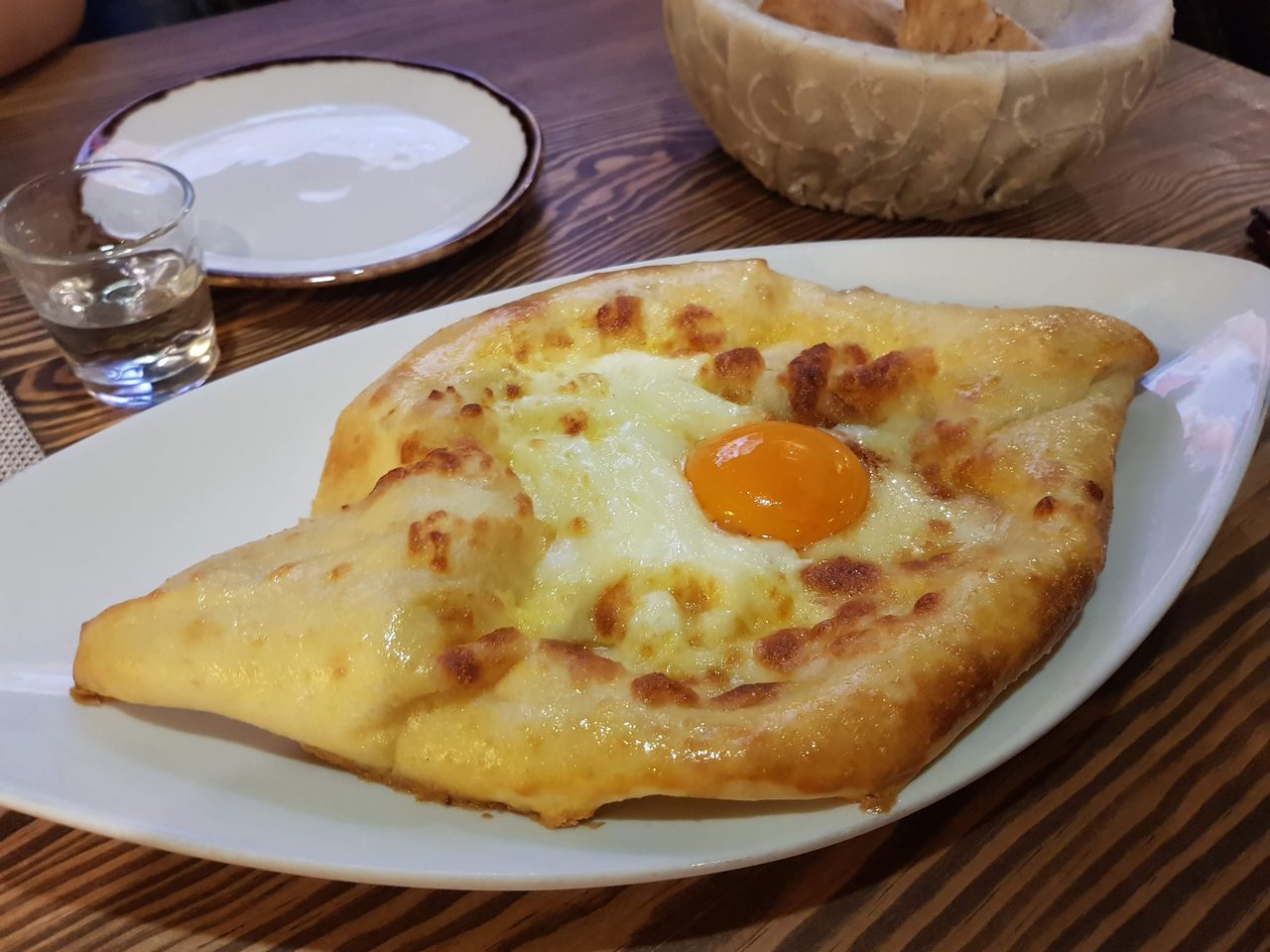
- What is in the photograph: served with bread to scoop the sauce. At a feast the bird goes in whole and the sauce is poured over it at the table.
Tips
- This is a nut sauce that is never cooked. Fesenjan is at one extreme — "Over two or three hours the walnuts break down completely and thicken the pot themselves, and it is finished when their own oil rises dark on the surface." — and egusi soup is at the other, where the protein coagulates with heat and sets into curds instead of dissolving: "There the walnuts break down completely over two or three hours and emulsify their own oil into a smooth sauce." Satsivi does neither. The walnuts are ground raw and let down with lukewarm broth, and the moment heat arrives the oil rises and the sauce breaks. Same ingredient, a third axis — whether heat is used at all.
- Grind until the oil comes out, or you have no sauce. A walnut is more than half fat and that fat sits inside cell walls. Grinding fine enough to rupture them releases the oil, and it is the oil going into suspension that gives the sauce its body and its gloss. Chopped coarse, you get broth with walnut pieces floating in it, which is not the same dish.
- Lukewarm broth, not hot. This is where it fails. Hot liquid makes the freshly released oil gather and float, and once it has floated no amount of stirring brings it back (why sauces split).
- The spices are not bloomed. Most recipes here wake ground spice in hot fat to open its aroma. There is no hot fat in this one, so fineness does that job instead — the finer the powder, the more surface there is for a cold liquid to draw from. That is why these are ground spices rather than whole ones.
- Season for cold. Salt and acid both read weaker chilled. Seasoned to taste while warm, it comes out of the fridge flat. Taste it again once it is cold.
- The meat is cooked and the sauce is not, and the two halves have different temperature histories. The "cold" in the name describes the finished plate, not the bird — pour the sauce over a hot-from-the-pot chicken and the meat heats the sauce and breaks it for you.
- Use fresh walnuts. Walnut oil is largely polyunsaturated and turns rancid quickly, and in this sauce that oil is the whole thing, so stale nuts taste of nothing else (cooking oils). Shelled walnuts are better bought from a freezer.
The basics behind this dish
- Browning and the Maillard ReactionMeat fails to brown for one of three reasons: it is wet, the pan is cool, or you put too much in at once. Plus how the brown film stuck to the pan becomes your sauce.
- Cooking Meat: Temperature, Resting, and Cutting Against the GrainDoneness is a core temperature, not a number of minutes. What resting actually does, how to handle a thick cut, and why the direction you slice changes the texture.
- Knife Skills: Grip, Cuts, and Why Size MattersHow you hold the knife matters more than how fast you cut. The pinch grip, the claw hand, and why uniform size is a cooking decision rather than a cosmetic one.
More of the same kind


More from this country


Sign in to edit.
AI-drafted, editor-reviewed · edits: 0 ·Edit history
https://cookiki.com/en/r/satsivi · cookiki · User contributions are licensed under CC BY-SA 4.0.