
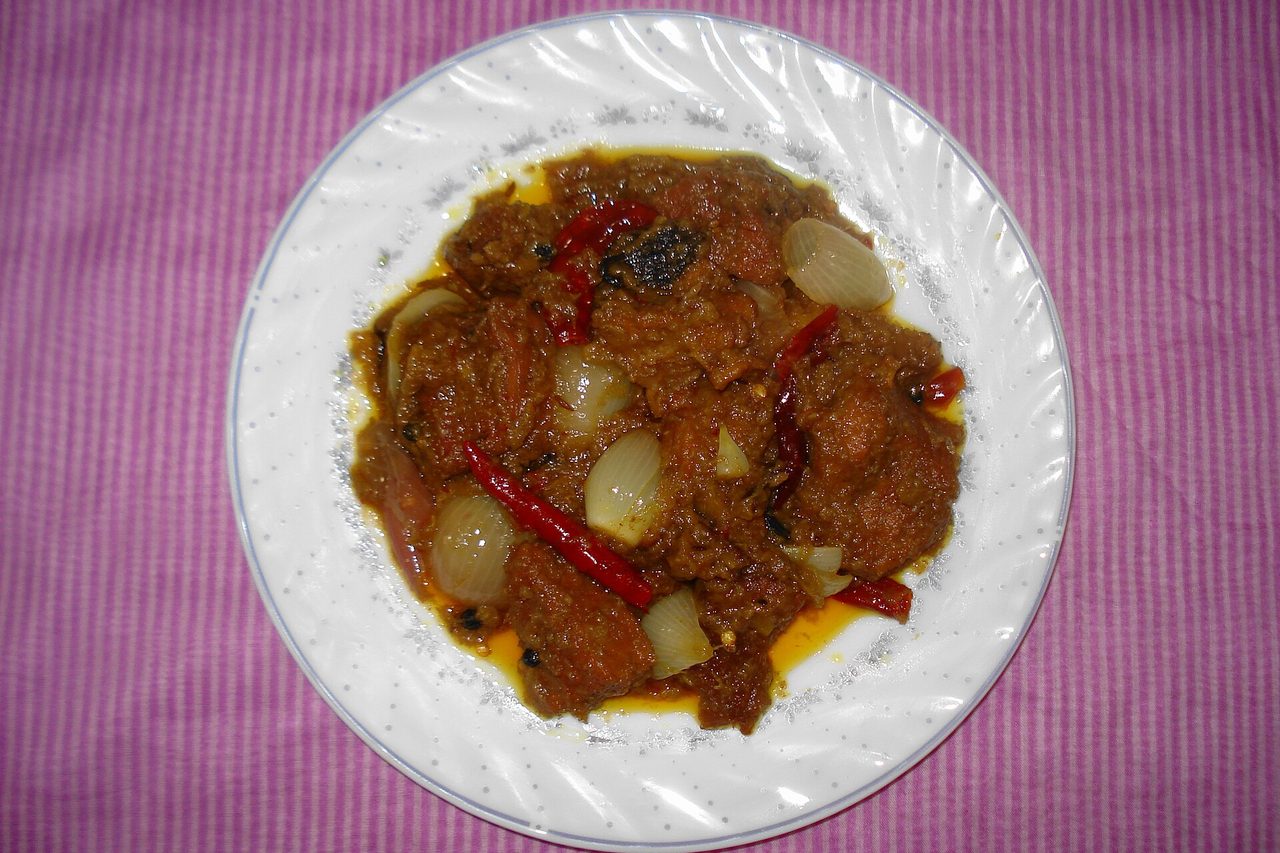
Photo: Ardhendu Bose · CC BY 4.0
Ilish Paturi (Mustard-Marinated Fish in Banana Leaf)
A Bengali dish and one of the national dishes of Bangladesh: fish marinated in ground mustard, wrapped in banana leaf and steamed. There is no heat in a mustard seed. The pungency does not exist until the cells are broken in water, it evaporates once made, and heat destroys it. Every hot thing on this site so far has been capsaicin, and capsaicin does none of those three. So the paste is ground with cold water, used within ten minutes, and shut inside a leaf. The mustard oil in the same dish is treated in exactly the opposite way — heated until it smokes, deliberately, to drive the same molecule off.
Ingredients
- The fish (serves 4)
- ilish (hilsa) · about 600g; frozen from South Asian grocers. Substitutes below4 steaks
- turmeric1 tsp
- salt1 tsp
- The mustard paste
- yellow mustard seeds · soaked 30 minutes3 tbsp
- black mustard seeds · or all yellow1 tbsp
- green chillies · two ground in, two left whole4
- salt · ground in with the seeds; it holds the bitterness down1 tsp
- cold water · cold, not warm4 tbsp
- turmeric1 tsp
- plain yoghurt · doi; optional2 tbsp
- And
- mustard oil · heated to smoking, then cooled4 tbsp
- banana leaves · 25cm square; sold frozen4 pieces
Steps
- ⏲ 30 min
Soak the mustard seeds in cold water for 30 minutes. Dry seeds skitter away from the stone rather than breaking; soaked, the cell walls are soft and they crush properly in a mortar or a blender.
- ⏲ 7 min
Pour the mustard oil into a pan and heat it hard until it smokes, then take it off and let it cool. Bengali cooks do this every time, because the oil carries the same pungent compound and raw it is sharp in the nose. Here the aim is to drive it off.
- ⏲ 5 min
Drain the seeds and grind them fine with two green chillies, the salt and 4 tbsp of cold water. In a blender, work in short bursts: run it long and the blade heats the paste, and ground mustard turns bitter with heat. The salt and chilli are the traditional guard against that bitterness.
- ⏲ 10 min
Put the paste in a bowl and leave it 10 minutes. That is the enzyme making the pungency. Then stir in the turmeric, the yoghurt and 3 tbsp of the cooled mustard oil. The acid goes in now, after the reaction, so it fixes the heat at the level it has reached.
- ⏲ 30 min
Rub the fish with turmeric and salt, leave 10 minutes, then coat both sides with the mustard paste and marinate 20–30 minutes. Longer buys nothing: the salt gets in, but the mustard aroma is fading the whole time.
- ⏲ 5 min
Soften the banana leaves by passing them over a flame for a few seconds — the same move fish amok uses. Folded cold they split along the grain.
- ⏲ 5 min
On each leaf put a piece of fish, the remaining paste and a whole chilli, then fold the four corners over and seal, pinning with a toothpick or tying with string. The leaf is a lid, not decoration: the pungent compound is volatile, and cooked uncovered it simply leaves.
- ⏲ 18 min
Steam over medium-low heat for 15–18 minutes, until the flesh comes away from the bone. Steamed hard, the yoghurt splits and leaves a watery pool.
- ⏲ 5 min
Take them off and rest 5 minutes before serving. Bring the parcels to the table closed and let people open their own: the smell that comes up is half the dish. With plain rice.
Tips & Variations
Variations
- If you cannot get ilish: the second most common version in Bengal is bhetki paturi (a white barramundi-type fish), which is far easier to find and has none of ilish's fine bones. Mackerel and pomfret work well too. But ilish is a very oily fish, so a white-fish version is less the same dish than a lighter cousin; with an oily fish, lengthen the mustard a little.
- Pan-fried rather than steamed: oil a tawa, lay the parcels on it, cover, and cook both sides. The leaf scorches and the aroma deepens, and there is less liquid than in the steamed version. Both are common in Bangladesh and in West Bengal.
- With coconut: grind fresh coconut or coconut cream in with the mustard. It rounds the heat down and brings sweetness up, and it is the version to start with if mustard is new to you.
- Vegetarian and other proteins: potato, aubergine, paneer and prawn all take the same paste and the same parcel. Chingri paturi, made with prawns, is especially common in Bangladesh.
- Bengal spans two countries. This is a dish of both Bangladesh and the Indian state of West Bengal. ko.wikipedia opens by calling it "a South Asian fish dish" and then records that it is considered one of the national dishes of Bangladesh;
origin_countryfollows that second sentence.
Tips
- There is no heat in a mustard seed. Inside the seed, a compound called sinigrin and an enzyme called myrosinase are held in separate cells. They only meet when the cell walls break and water reaches them, and only then is allyl isothiocyanate — the pungency — created. So mustard heat is not something in the ingredient, it is something you make, and it has three conditions: grind it fine, have water present, and keep that water cold.
- Almost every rule in chilli and heat is reversed here. That guide is about capsaicin, which is already present in the white pith, dissolves in fat, is not reduced by cooling, and does not cook off. Mustard is the opposite on all four: it is not in the seed, water opens it rather than oil, heat destroys it, and it fades noticeably in an open bowl within the hour. No dish makes the point more plainly that heat is not one property.
- A seeded dish already treats the same seed the opposite way. The masala in dosa puts mustard seeds into hot oil until they pop. That destroys the enzyme, so there is no pungency at all — only a nutty aroma. Same ingredient, opposite handling, opposite result (blooming spices).
- The mustard oil goes the other way. Heating it to smoking in step 2 is not carelessness, it is the tradition. The oil carries the same compound, and in the oil it is unwelcome, so it is driven off on purpose. One plate, one molecule, kept on one side of it and thrown away on the other.
- Wait ten minutes, then add the acid. The enzyme reaction is not instant. Yoghurt or lime added the moment you finish grinding stops it at a low level; added ten minutes later it fixes the heat where it has got to. If you want to dial the pungency, dial it here.
- Bitterness means you ground it too long. Blender blades generate heat. Work in short bursts, and keep the Bengali habit of grinding salt and a green chilli in with the seeds.
- The leaf is a lid. Wrapping in banana leaf is already explained on fish amok. What is different here is why: amok uses the leaf as a vessel, paturi uses it to trap a volatile aroma. With no leaves, greaseproof paper folded the same way does the same job.
The basics behind this dish
- Blooming Spices: Why Aromatics Go into Fat FirstStir ground spice into liquid and half the aroma never arrives, because most aroma compounds are fat-soluble. The thirty-second window, and the order things go in.
- Chilli and Heat: Where It Lives and How to Take It BackHeat is not a taste but a pain signal. Where capsaicin actually sits, why water does nothing, and the four ways to pull a dish back once it has gone too far.
- Cooking Oils: Smoke Point and What Each One Is ForWhat a smoke point actually marks, how much headroom deep frying needs, and why sesame oil and extra-virgin olive oil are finishing oils rather than cooking oils.
More of the same kind


Sign in to edit.
AI-drafted, editor-reviewed · edits: 0 ·Edit history
https://cookiki.com/en/r/ilish-paturi · cookiki · User contributions are licensed under CC BY-SA 4.0.