
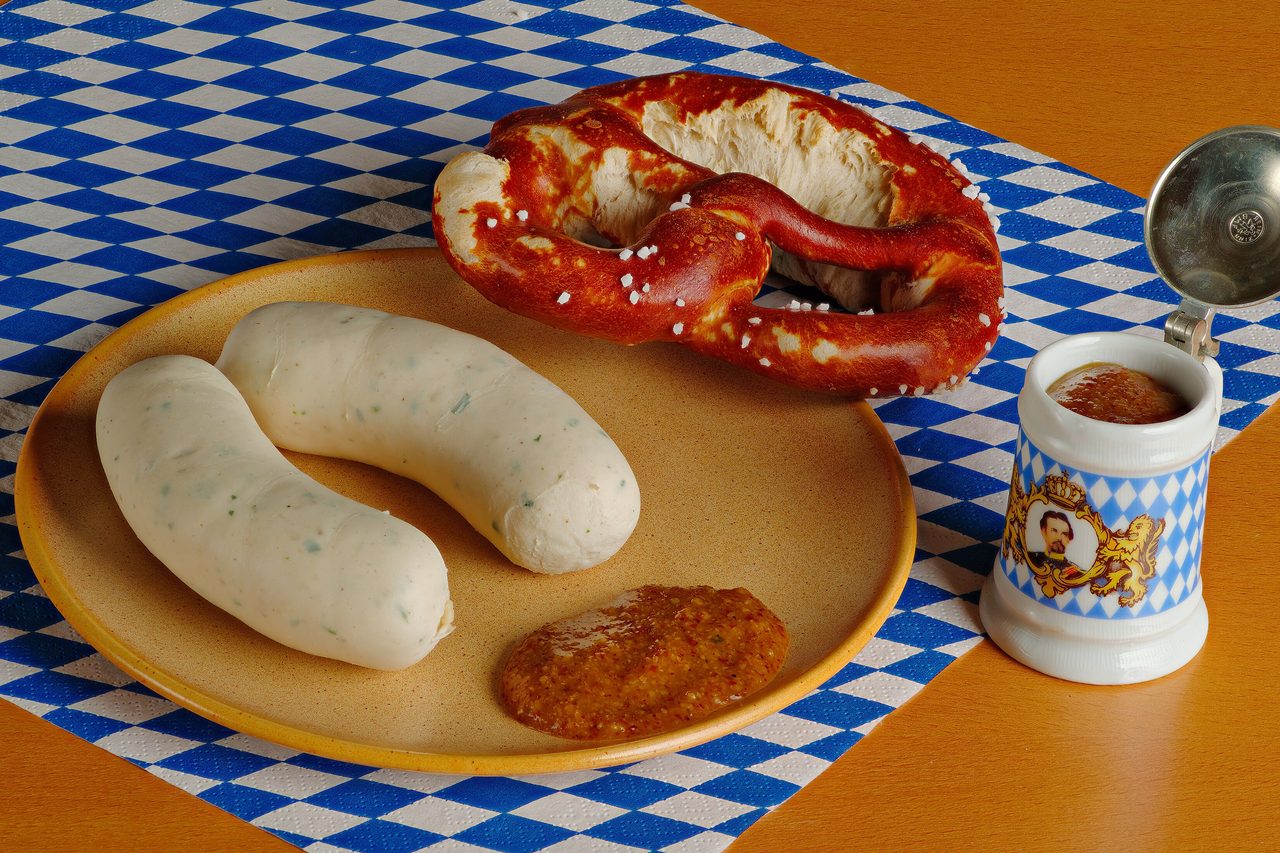
Photo: Rainer Zenz · CC BY-SA 3.0
Obatzda (Bavarian Ripened-Cheese Spread)
The cheese spread of the Bavarian beer garden. Ripe camembert is mashed with half its weight of butter and seasoned with paprika, caraway, finely chopped onion and a spoonful or two of beer. No heat is used at any point. What made the cheese soft is ripening rather than heat, which is why it has to be a cheese ripe right to the middle. Spread on a pretzel or rye bread.
Ingredients
- Obatzda
- camembert · ripe and soft right to the middle; romadur works too200 g
- unsalted butter · half the weight of the cheese, soft at room temperature100 g
- onion · very finely chopped0.5
- sweet paprika2 tsp
- hot paprika · or a pinch of cayenne0.25 tsp
- caraway seeds · ground, or toasted in a dry pan0.5 tsp
- beer · a pale lager or wheat beer2 tbsp
- salt and pepper · salt last, after tasting
- To finish and serve
- onion · in thin rings0.25
- chives · snipped; or spring onion greens
- pretzels or rye bread
Steps
- ⏲ 60 min
Take the camembert and butter out of the fridge an hour ahead. Press the middle of the camembert with a finger: it should give all the way through. If you can feel a firm white core, the cheese needs a few more days.
Cut the camembert, rind and all, into 2cm pieces. If the rind is thick enough to bother you, trim some of it off.
Put the cheese and butter in a bowl and mash them together with a fork. Do not make it completely smooth: a few small lumps left in are the texture of this spread.
Add the onion, both paprikas, the caraway and pepper, then the beer a spoonful at a time until it is soft enough to spread. Taste, and only then add salt.
- ⏲ 30 min
Cover and chill for at least 30 minutes so the flavours come together.
- ⏲ 20 min
Take it out 20 minutes before serving: straight from the fridge the butter is too hard to spread. Heap it on a plate, top with onion rings, chives and a pinch of paprika, and serve with pretzels or rye bread.
Tips & Variations
Variations
- Liptauer: the Austrian, Hungarian and Slovak relative. The spicing is nearly the same, but fresh curd cheese (bryndza or quark), still worked with butter, takes the place of the ripened soft cheese. Nothing has been done by ripening there, so the softness comes from the water a fresh cheese holds and from the butter. Same seasoning, the opposite cheese.
- With romadur: the sources name it as the alternative to camembert. It is the same kind of soft ripened cheese, so the method does not change.
- With cream cheese: replacing some of the butter with cream or cream cheese makes it less rich and paler. That is not a departure; the sources list it alongside the original.
- What goes with it: it is usually spread on bread or a pretzel, and it is the textbook food of the beer garden, served alongside the beer.
- More seasoning: some kitchens add a little garlic, horseradish or clove.
Tips
- What made the cheese soft is ripening, not heat. Dairy and heat sorts cheeses by what heat does to them, and says itself what that list assumes: "Everything above describes cheese as it comes off the ageing shelf, where how it melts was settled by moisture and time." No heat touches obatzda. The softness is already inside the cheese. A ripe camembert is soft right to the middle; an under-ripe one still has a firm, chalky white core, and that core does not break down under a fork. It stays as grains.
- The cheese aligot avoids is the ingredient here. Aligot says "that stretch survives only in a cheese whose casein network ripening has not yet cut apart." and "An aged cheese will give you oil however long you beat it." In a dish that has to stretch, ripening is the enemy; in a dish that is mashed and spread, ripening has already done the work. Here it is the under-ripe cheese that fails.
- The butter is half the weight of the cheese. Two parts cheese to one of butter is the original ratio. Cold, the butter sets and holds the whole mass together; at room temperature it softens again and spreads. That is why it should not go to the table straight from the fridge.
- The paprika goes in raw. Polbo á feira keeps its oil cold "because the paprika must not scorch." In this dish the question never comes up, and nor does the care goulash takes to land the paprika on fat and soft onion. The colour still comes out. As chicken paprikash puts it, "its colour is a fat-soluble carotenoid, so it needs fat to give that colour up at all." In this bowl the fat is the butter and the cheese, and within minutes the whole mass turns orange.
- Beer a spoonful at a time. Its job is to set the consistency. Pour it in all at once and it goes sloppy, and there is no taking it back.
- Salt last. A ripened cheese is already salty. Taste once everything else is in.
- Eat it within two days. There is raw onion in it, and left longer the onion takes over.
The basics behind this dish
- Knife Skills: Grip, Cuts, and Why Size MattersHow you hold the knife matters more than how fast you cut. The pinch grip, the claw hand, and why uniform size is a cooking decision rather than a cosmetic one.
- Salt: When You Add It Matters More Than How MuchThe same amount of salt either draws water out or seasons all the way through, depending on when it goes in. Osmosis, seasoning in layers, and why salt types are not interchangeable by volume.
- Heat Control: Preheating, Oil, and Reading the PanThe same ingredients become a different dish depending on pan temperature. When to add the oil, how to read heat by sound, and which dishes want low heat instead.
More of the same kind


More from this country


Sign in to edit.
AI-drafted, editor-reviewed · edits: 0 ·Edit history
https://cookiki.com/en/r/obatzda · cookiki · User contributions are licensed under CC BY-SA 4.0.