
Photo: Traumrune · CC BY-SA 3.0
Eisbein (Cured Pork Knuckle Boiled with Sauerkraut)
A German dish of pork knuckle brined for several days and then boiled, usually with sauerkraut. It is the same cut as suyuk or jokbal, in the same water, for about the same time, and it comes out different because of one step that happens before any of that. Boiling moves a meat’s flavour out into the water; salt that went in days earlier makes the proteins hold on to their own moisture, and the seasoning is already inside where the water cannot take it. Curing salt also leaves the cooked meat pink instead of grey — which is the visible evidence that it was cured at all.
Ingredients
- The brine
- pork knuckles · about 1kg each, skin on2
- water3 L
- salt · 6 percent of the water180 g
- curing salt (sodium nitrite) · optional: with it the meat stays pink, without it it cooks grey. Reduce the plain salt by the same weight30 g
- sugar30 g
- bay leaves3
- black peppercorns15
- juniper berries · the German note in this cure10
- garlic · crushed4 cloves
- To boil
- onion1
- carrot1
- leek · white part1
- bay leaves2
- Sauerkraut
- sauerkraut · with its liquid700 g
- bacon or pork belly · diced100 g
- onion · sliced1
- juniper berries6
- apple · optional; softens the sourness1
- To serve
- potatoes · boiled800 g
- yellow pea puree · the Berlin accompaniment300 g
- mustard2 tbsp
Steps
- ⏲ 20 min
Warm the water with the salt, sugar and spices until everything has dissolved, then cool it completely. Meat put into a warm brine spends too long at room temperature in the middle.
Submerge the knuckles in the brine and refrigerate for three to five days. Weight them under a plate if they float, and turn them once a day.
- ⏲ 30 min
Lift them out and soak them in fresh cold water for thirty minutes to draw the surface salt back off. Skip this and the finished broth is too salty to use.
- ⏲ 15 min
Put the knuckles into a large pot with the onion, carrot, leek and bay, cover with cold water and bring it up slowly, skimming the foam as it rises.
- ⏲ 150 min
Drop the heat until the surface barely trembles and cook for two and a half hours. It is done when the meat is coming away from the bone and the skin has gone jelly-soft. A hard boil splits the skin and breaks the meat up.
- ⏲ 10 min
Meanwhile, make the sauerkraut. Render the bacon, soften the onion in its fat, then add the sauerkraut with its liquid, the juniper and the apple.
- ⏲ 40 min
Ladle in two spoonfuls of the pork cooking liquid and let the sauerkraut simmer for forty minutes. That liquid is what rounds off its sourness and balances the salt.
- ⏲ 5 min
Lift the knuckles out, let them drain, and serve with the sauerkraut, boiled potatoes and pea puree, with mustard alongside.
Tips & Variations
Variations
- Schweinshaxe: the Bavarian version. Same cut, but it is not cured and it is roasted. Its whole point is skin that puffs and crackles, which is the opposite of the jelly-soft skin boiling produces here. Eisbein in the north, Haxe in the south is roughly right.
- Berlin style: served with yellow pea puree (Erbspüree). That, rather than sauerkraut and potatoes alone, is the older plate.
- Eisbein in aspic: the cooking liquid set into a jelly around the meat. There is so much gelatine from the skin and sinew that it sets without any being added — pyeonyuk uses the same fact to a different end.
- The name is not “ice leg”: it is usually traced either to an old word for the hip bone, or to the practice of making skate blades from that bone.
Tips
- Curing salt is a question of colour, and of safety. Nitrite binds to myoglobin and stays pink through cooking. Leave it out and the dish still tastes right, but it comes out grey, which is to say it is boiled pork that sat in salt water. Curing salt is sold pre-mixed into salt, so follow the dose on the packet.
- Salt goes in; aroma does not. As what marinades do puts it, most aroma molecules stop within one to three millimetres of the surface and only the salt ion travels. The three days are not for the juniper — they are the time salt needs to reach the middle of a thick knuckle.
- The difference from suyuk and jokbal is that one step. Those go into the water unseasoned, so the broth takes the flavour — which is why they lean on doenjang and keep the broth. Here the flavour is already inside the meat. Carnitas is a third answer to the same problem: submerge it in fat rather than water and there is nowhere for the flavour to go.
- Keep the cooking liquid. Brined-then-boiled pork liquid is already seasoned, and it is the base for the sauerkraut, the pea puree and any lentil soup you make that week.
- If the cure came out strong, change the water once. Boil for thirty minutes, throw that water away and start again with fresh.
- It does not overlap bigos. There the sauerkraut is cooked for hours and is the dish; here it is simmered forty minutes and is the acidity set beside the meat.
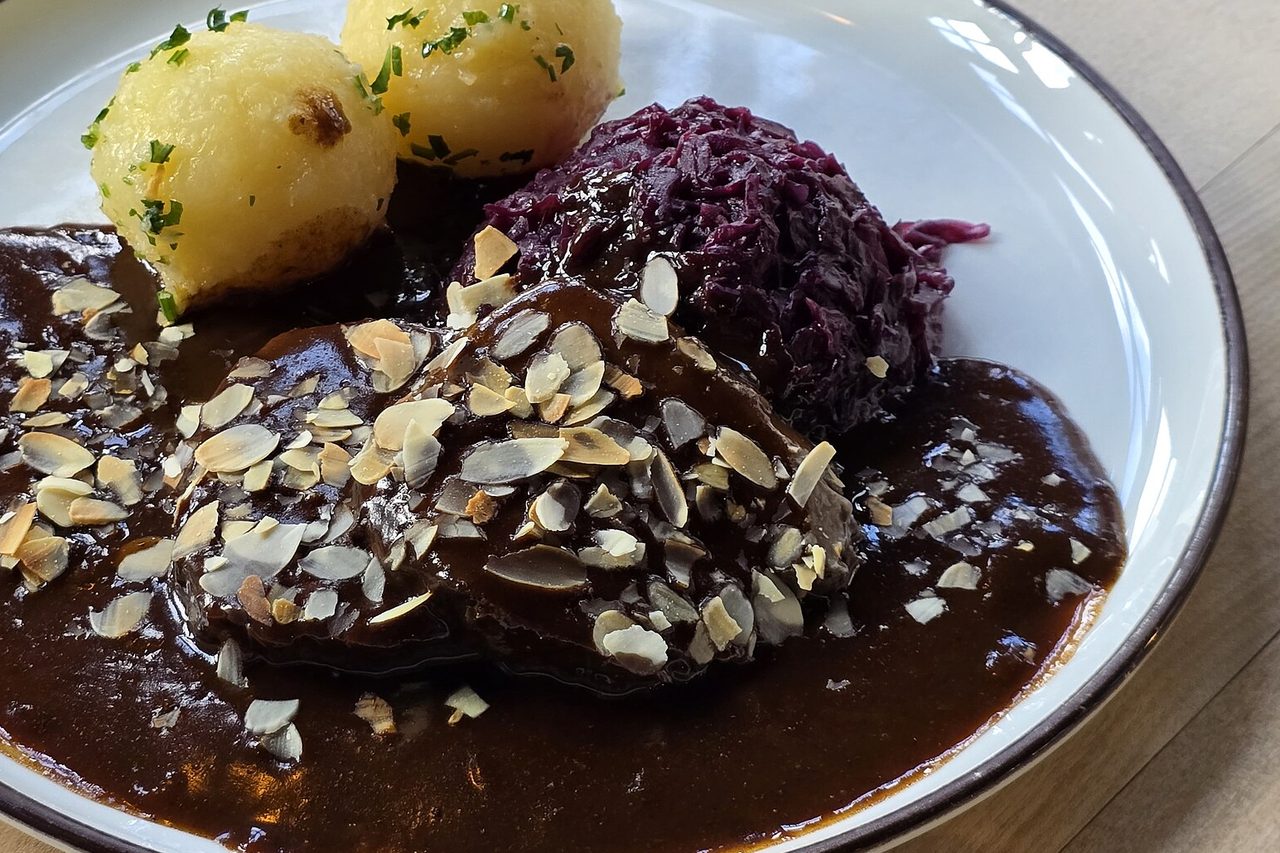
- Read it next to sauerbraten. There the thing steeped for days is vinegar, it does not tenderise, and the liquid becomes the sauce. Here the thing steeped for days is salt, and it genuinely gets inside.
The basics behind this dish
- Salt: When You Add It Matters More Than How MuchThe same amount of salt either draws water out or seasons all the way through, depending on when it goes in. Osmosis, seasoning in layers, and why salt types are not interchangeable by volume.
- Braising: Collagen, Time, and Why It Cannot Be RushedTough cuts turn tender not because the muscle relaxes but because collagen becomes gelatin — and that conversion needs time, not more heat.
- What Marinades Actually Do (and Do Not)A marinade penetrates one to three millimetres. Acid does not tenderise the way it is said to, and the only thing that really travels inward is salt.
More of the same kind


More from this country



Sign in to edit.
AI-drafted, editor-reviewed · edits: 0 ·Edit history
https://cookiki.com/en/r/eisbein · cookiki · User contributions are licensed under CC BY-SA 4.0.