
Photo: Thomon · CC BY-SA 4.0
Pumpernickel (Long-Baked Whole Rye Bread)
The black bread of Westphalia, made from whole rye and nothing else. Almost nothing you learned from wheat bread applies. Knead it as long as you like and no gluten appears; the sourdough is there for structure rather than flavour; and the colour comes from inside the loaf rather than from its surface. Sixteen hours in a covered tin at 110C is too cool for a crust to form, and in that time the sugars the rye makes with its own enzymes brown slowly right through. There is no sugar and no colouring in it.
Ingredients
- Sourdough (the day before)
- wholemeal rye flour · coarse; rye, not wheat200 g
- water · about 30C200 ml
- rye sourdough starter · yeast will not substitute — see below30 g
- Soaked grain (the day before)
- rye berries · coarsely cracked; they need a cut surface to take up water250 g
- boiling water300 ml
- salt12 g
- Final dough
- wholemeal rye flour250 g
- water · adjust to the consistency120 ml
- rye malt · optional, for aroma20 g
- cooking oil · for the tin1 tbsp
Steps
The evening before. Mix the starter into 200g rye flour and 200ml water and leave it at 26-28C for 16 hours. By morning it should have risen and taste distinctly sour. In this bread that sourness is structure, not flavour.
The same evening, pour 300ml boiling water over the cracked rye berries, stir in the salt, cover and leave overnight. Boiling water because whole grain will not soften through in lukewarm water even given a whole night (soaking).
- ⏲ 3 min
Next day. Put the sourdough, the soaked grain, the rest of the flour and water and the malt in one bowl and mix 3 minutes until uniform. Do not knead it. There is no gluten network in rye to build, so working it only makes it sticky. It is closer to a thick porridge than a dough, and that is correct.
Fill an oiled lidded pullman tin only two-thirds and press the top flat with a wet spatula. Any air pocket left in now stays as a hole later.
- ⏲ 120 min
Put the lid on and leave it at room temperature 2 hours. It will not double the way a wheat dough does. The edges lifting a little and small bubbles on the surface is enough.
- ⏲ 60 min
Heat the oven to 180C and bake 1 hour with the lid on. This is the stage that cooks the middle and sets the starch.
Drop the oven to 110C and leave it 15-16 hours. The lid stays on throughout. At that temperature no crust can form; instead the rye's own amylase keeps turning starch into sugar, and that sugar browns slowly. The loaf goes black because the inside is cooking, not because the outside is burning.
Cool it completely in the tin — turned out hot it falls apart. Then wrap it in cloth or film and leave it a day, two if you can. A rye crumb is set by pentosans holding water rather than by gluten, and that takes time.
Slice it very thin, 3-5mm. Cut thick it is heavy and claggy. A serrated knife, drawn slowly, cuts it cleanly.
Tips & Variations
Variations
- Rye is where "protein is the whole story" breaks hardest. Choosing flour reads a flour by its protein percentage, and this loaf is the case it names where that number and the behaviour come apart. Wheat is not exempt: the same guide sets out how bran cuts the network in a wholemeal dough like sangak, which is this problem far milder. Rye has glutenin and gliadin too, but it is also full of pentosans — gums that hold up to eight times their weight in water and physically sit between the proteins, so no amount of working builds a network. The structure of a rye loaf is a gum, not a protein, which means the kneading in dough and gluten has nothing to do here.
- Which is why the sourdough is not optional. Rye is unusually rich in amylase. In the 60-75C window where starch sets, that enzyme keeps cutting the starch up, and the crumb never firms — it stays wet and gummy. Acidify the dough to around pH 4.3 and the amylase is disabled, while the pentosans swell properly at the same time. Commercial yeast produces none of that acid. Fermentation basics is about lactic ferments of vegetables and pastes; this is the first place on the site where acid is structural in a bread.
- And this loaf uses that enzyme instead of fighting it. An ordinary rye bread is at war with its amylase. Pumpernickel spends sixteen hours creeping through exactly the band where the enzyme works hardest, and every sugar it makes becomes fuel for browning. The sweetness and the black colour both come from there — not from added sugar or colouring.
- The colour comes from inside, not from the surface. Browning and the Maillard reaction gives the condition as "the surface has to get well above the boiling point of water", which is true when you have minutes in a pan. This loaf sits soaking wet inside a covered tin, never above 100C, for sixteen hours. The reaction is slow at that temperature, not blocked — time stands in for heat. Black garlic and dulce de leche work the same way.
- It is the exact opposite of a baguette. There the crust is the whole point, so you add steam and finish hot. Here you cover the tin and drop the heat precisely so that no crust can form. It is the only bread on this site whose aim is to have none.
- As a way of getting colour it is the other end from bagels and pretzels. Those paint the outside with alkali to drive surface browning; this puts nothing on the outside and makes the colour within.
- On the time axis it is the far end from Irish soda bread. That one is over from mixing bowl to oven door and counts in seconds; this takes two days. Neither is the yeast route wheat bread takes.
- A shorter version. If leaving an oven on overnight is not for you, four hours at 150C gives a perfectly good loaf — the colour stops at brown and it is less sweet. A slow cooker with a little water in the base and the tin standing in it, on low for twelve hours, also works, and its low steady temperature actually suits this.
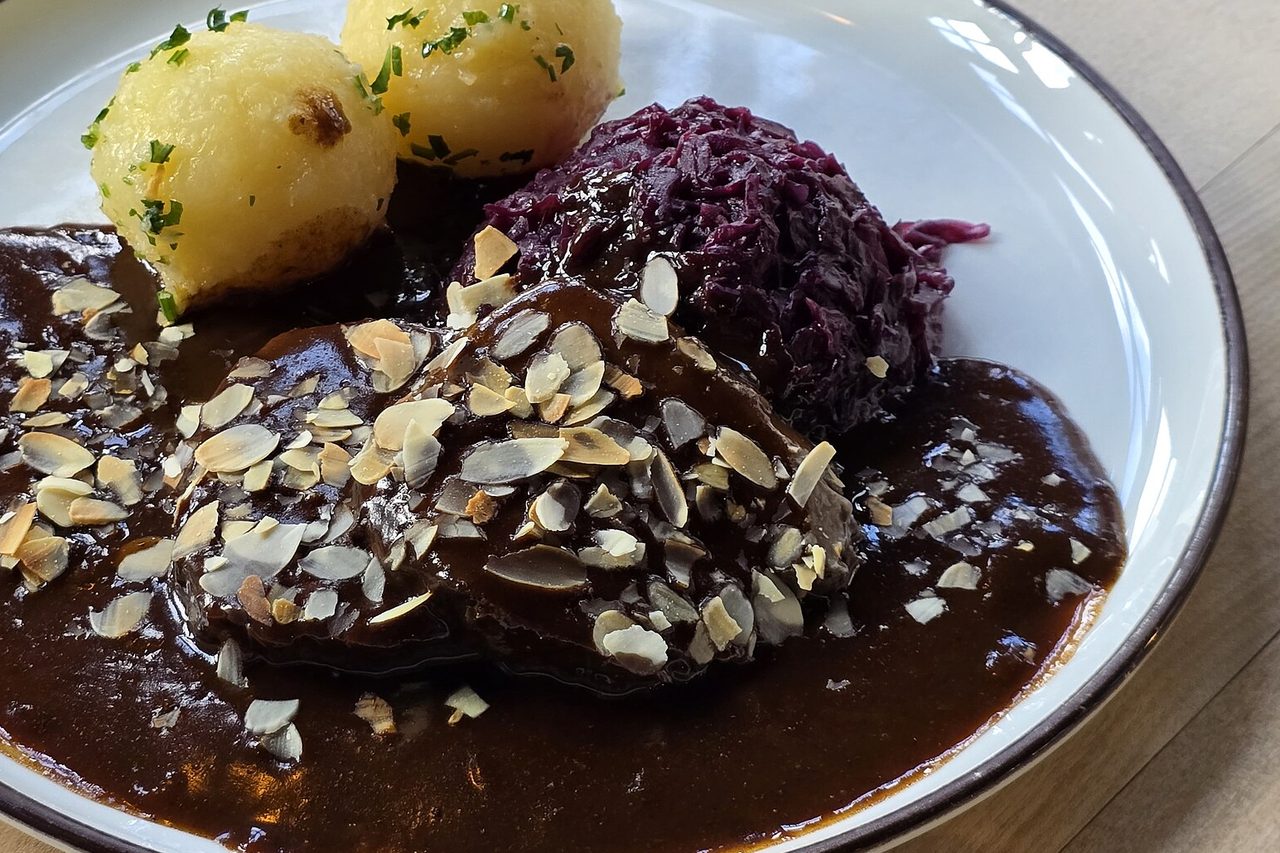
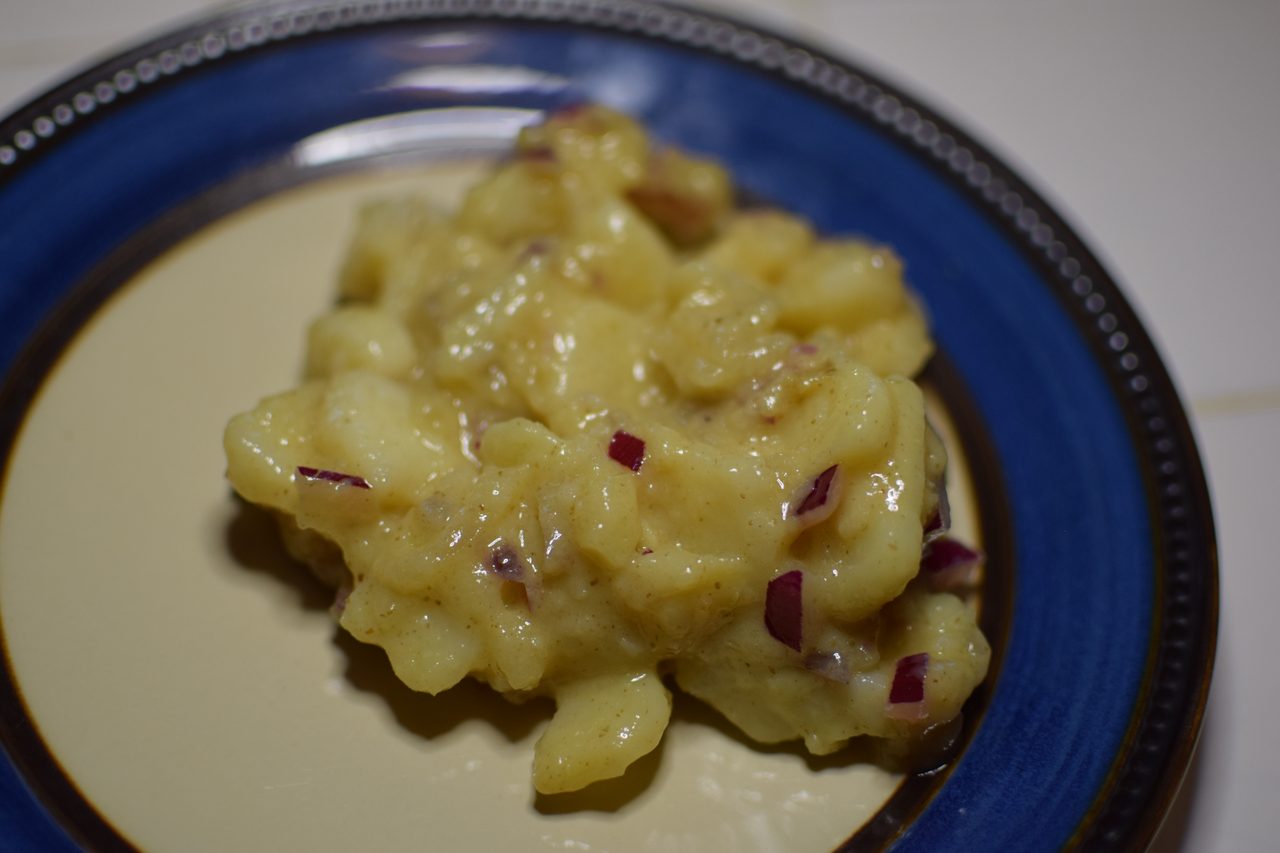
- How to eat it. Thin, with butter, smoked salmon, herring, cream cheese or a strong cheese. The German classic is Rübenkraut, sugar-beet syrup, spread on it. It also belongs beside German potato salad or Sauerbraten.
- The name. The folk etymology joins pumpern (to break wind) to Nickel (a goblin), which is memorable and not well evidenced. What is on record is that Westphalia was baking it by about 1450.
Tips
- Wholemeal rye, not wholemeal wheat. The commonest mistake, and the names are close enough to cause it. Swap in wheat and you get a dark wholemeal loaf in which none of the above happens.
- Do not knead it. Trying to work it smooth gets you a sticky mass on your hands and nothing else. Evenly mixed is finished.
- The lid is not optional. Without it moisture escapes, the surface dries, a dry surface becomes a crust, and under a crust the colour never develops. No lidded tin? Two layers of foil, pressed tight round the rim.
- Hold the low temperature. Above about 130C the outside dries while the middle stays as it was. Ovens routinely disagree with their own dials, so an oven thermometer is worth having (what your oven is doing).
- Do not cut it warm. This is not the usual "let it cool" — it needs a full day before it slices. Cut fresh from the oven it drags and smears on the knife.
- Thin. 3-5mm. There is a reason shop pumpernickel comes ready-sliced that way.
- Keeping. Wet and acidic, so it keeps unusually well: a week wrapped in cloth at room temperature, months sliced and frozen (freezing and thawing).
- No starter? Equal weights of wholemeal rye flour and water, fed once a day, is usually usable in five to seven days. A rye starter gets going far more easily than a wheat one.
The basics behind this dish
- Browning and the Maillard ReactionMeat fails to brown for one of three reasons: it is wet, the pan is cool, or you put too much in at once. Plus how the brown film stuck to the pan becomes your sauce.
- Dough and Gluten: When to Build It and When to Avoid ItThe same flour and water becomes a dumpling wrapper or a tender pancake. The difference is whether you built gluten or avoided it — and kneading and resting do different jobs.
- Dry Heat and Moist Heat: Choosing the MethodRoasting and simmering are not hotter and cooler versions of one thing — they are different families. One builds aroma, the other builds tenderness, and most good cooking uses them in sequence.
More of the same kind


More from this country


Sign in to edit.
AI-drafted, editor-reviewed · edits: 0 ·Edit history
https://cookiki.com/en/r/pumpernickel · cookiki · User contributions are licensed under CC BY-SA 4.0.