
Babka (Twisted Chocolate Yeast Bread)
A heavily buttered yeast dough spread with chocolate, rolled, split lengthwise and twisted before baking. It comes from the Jewish communities of Poland and Ukraine. Two things separate a babka from a chocolate loaf: an overnight cold rest for the dough, and syrup brushed on the second it leaves the oven, while it is still hot.
Ingredients
- One loaf tin (10 slices)
- Dough
- strong white flour320 g
- sugar55 g
- instant dried yeast6 g
- salt · kept apart from the yeast5 g
- eggs · room temperature2
- milk · lukewarm80 ml
- unsalted butter · soft, added in pieces once the gluten has developed110 g
- lemon zest · optional; it tidies up the sweetness0.5 lemon
- Chocolate filling
- dark chocolate · 55-70% cocoa120 g
- unsalted butter60 g
- icing sugar40 g
- cocoa powder · it sets both the colour and the consistency20 g
- ground cinnamon · optional0.5 tsp
- Syrup — leave it out and it is not a babka
- sugar100 g
- water80 ml
- To finish
- egg · for the wash, beaten with 1 tsp milk1
Steps
Put the flour, sugar and yeast in a bowl with the salt on the opposite side. Add the eggs and lukewarm milk and mix to a single mass.
- ⏲ 10 min
Knead 8-10 minutes to develop the gluten. No butter until this point — fat added early coats the gluten strands and the dough never becomes extensible.
Work the butter in in three additions, kneading each in fully. It looks slippery and split at first and comes together smooth if you keep going. Add the lemon zest last.
- ⏲ 90 min
Cover and prove at room temperature for 1 to 1½ hours, until it is about half again in size.
Knock it back, flatten it, wrap it and refrigerate overnight. This is not only a flavour step — a dough this buttery has to be cold to roll thin, and lukewarm it drags and smears the layers together. Four hours minimum, overnight is better.
Make the filling. Melt the chocolate with the butter over a water bath and stir in the icing sugar, cocoa and cinnamon. You want it spreadable but not runny. Hot, it soaks into the dough and leaks; set firm, it tears the dough. Let it come to barely warm.
Roll the cold dough thin, to about 30x40cm. Spread the filling over it leaving a 1cm border. Too much filling escapes during baking and burns on the tin.
- ⏲ 15 min
Roll it up tightly from the long side into a log and put it in the freezer for 15 minutes. Those 15 minutes are what make the next step possible — cut at room temperature, the filling drags along the blade and the pattern disappears.
Cut the log in half lengthwise, turn the cut faces upward, and twist the two strands around each other. Keeping the cut faces up as you twist is the condition for the pattern showing.
- ⏲ 120 min
Lay it in a lined loaf tin, cover, and prove at room temperature 1½ to 2 hours, until a press springs back slowly. Heat the oven to 180°C for the last half hour of that.
- ⏲ 45 min
Brush thinly with egg wash and bake 35-45 minutes. If the top is colouring hard by twenty minutes, tent it with foil. 88-90°C in the centre is the mark, and a skewer should come out with filling on it but no raw dough.
While it bakes, boil the sugar and water into a syrup and let it cool. It only needs to dissolve — do not reduce it.
The moment it comes out of the oven, while it is still hot, brush or spoon on all of the syrup. If it takes it up slowly, wait a couple of minutes and go again. A cooled loaf will not absorb it and it just sits on the surface.
- ⏲ 20 min
Leave it in the tin 20 minutes, then turn it out and cool it completely. Cut hot, the filling runs and the cross-section smears.
Tips & Variations
Variations
- Cinnamon babka: butter, sugar and cinnamon instead of chocolate, with a streusel crumb on top. That filling is looser than chocolate and escapes more easily, so leave a wider border.
- Krantz cake (עוגת קראנץ): the Israeli name for the same bread. Shape and syrup are all but identical, and hazelnut or halva versions are common there.
- Poppy seed babka: the older line in Poland and Ukraine. Ground poppy seed scalded and mixed with sugar and honey, which comes out a grey-black.
- Babka wielkanocna (Easter babka): the same word, a different bread. A Polish Easter cake baked in a crown-shaped tin with no twist at all, made with rum and raisins and finished with icing. Not the bread on this page.
- Babka ziemniaczana (potato babka): a Polish and Belarusian potato dish sharing only the name. Not sweet.
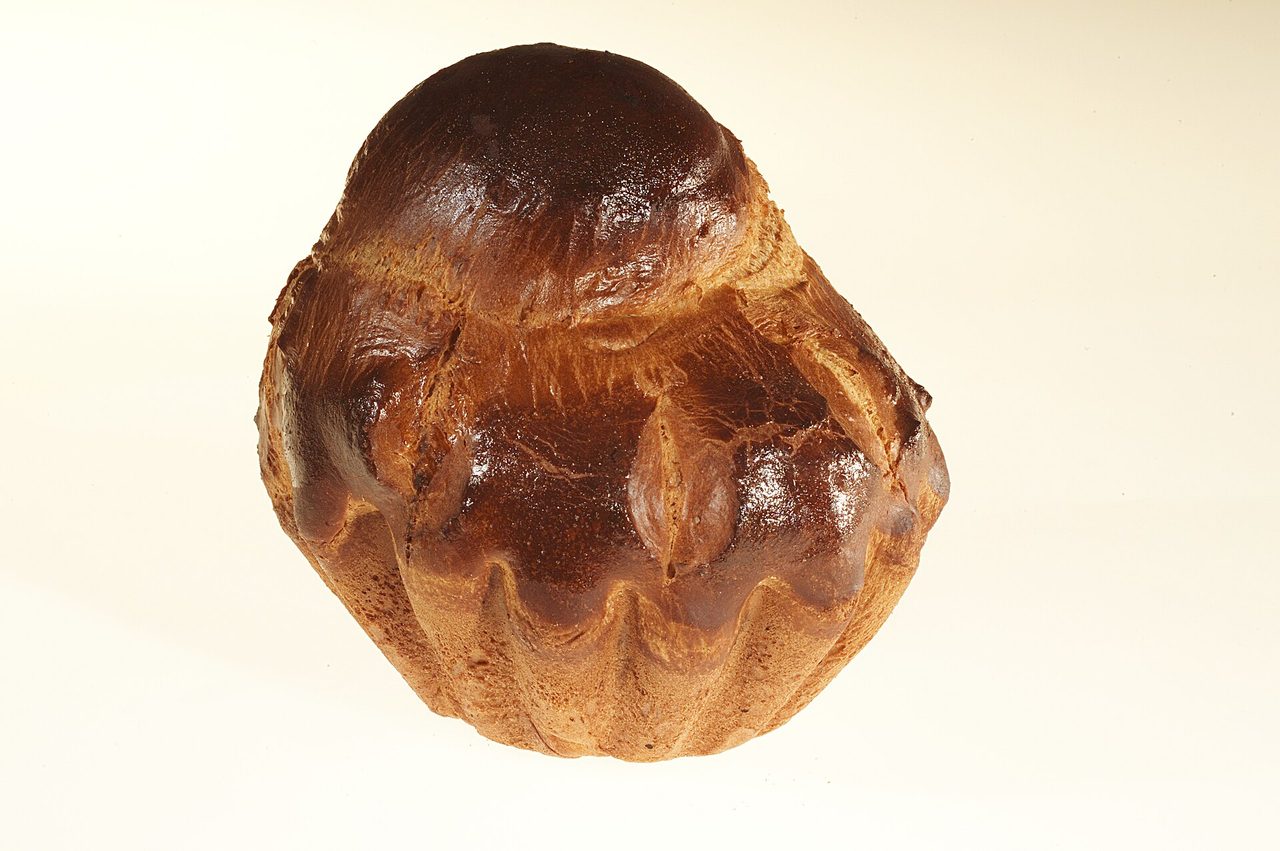
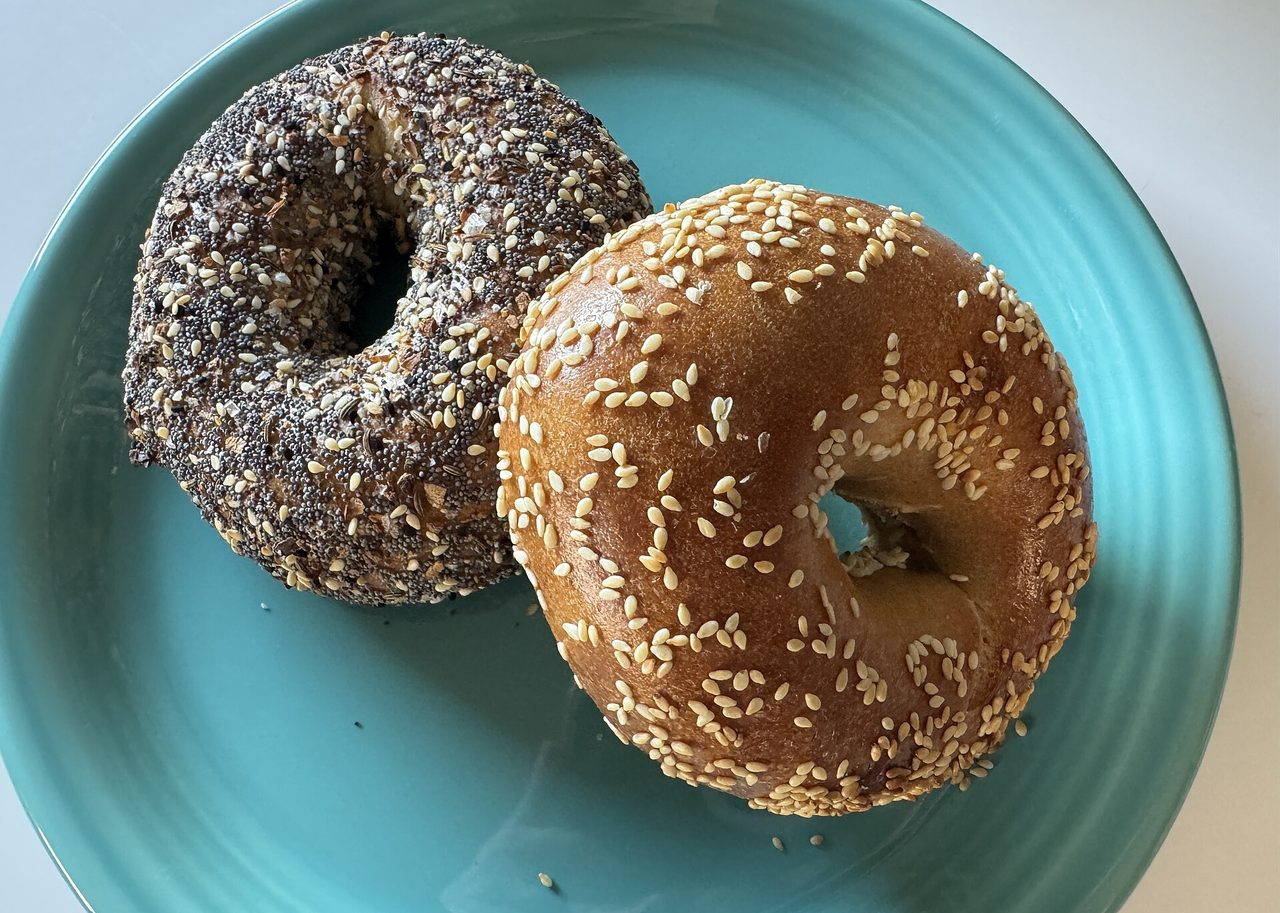
- The same dough family: brioche is the skeleton of this dough, and croissants take the opposite approach — the butter is folded in as layers rather than kneaded in. Bagels, from the same Polish Jewish communities, are already here.
Tips
- Cold dough is what makes the pattern. With 110g of butter in it, this dough drags at room temperature, and a room-temperature log smears the filling along the knife instead of cutting through it. The overnight chill and the 15 minutes in the freezer are the two moments of cold that decide the cross-section (dough and gluten, freezing and thawing).
- Syrup while it is hot, and all of it. Straight out of the oven the loaf is at its most absorbent, with steam still escaping. That is the moment syrup travels into the crumb and gives you the moisture and the shine. Brushed on cold it stays tacky on the surface while the inside is just dry bread. Skip this step and you have made a chocolate loaf (what sugar does).
- Butter goes in after the gluten. Fat added first coats the gluten strands and the network never forms. Knead 8-10 minutes to a windowpane, then add it in pieces — the same order as brioche.
- Keep the salt away from the yeast. Dry salt in direct contact kills yeast cells by osmosis. Once there is liquid in the bowl it no longer matters (fermentation basics).
- Filling temperature decides this. Hot, it soaks in and welds the layers together; set firm, it tears the dough as you roll. Barely warm to the back of your hand is right.
- Do not overfill. Chocolate that escapes burns on the base of the tin and passes that bitterness into the sides of the loaf. The 1cm border is not optional (wrapping and sealing).
- Twist with the cut faces upward. That is the only condition for the pattern being visible. Cut faces down and you get a smooth loaf with the swirl locked inside it.
- Use strong flour. It has to carry the weight of the filling and stretch while you twist, so it needs the protein. Made with a soft flour it rises and then sinks (choosing flour).
- Have foil ready at twenty minutes. Between the egg wash and the sugar, the top darkens first. Judge it by the centre temperature, 88-90°C, not by the colour of the crust (what your oven is doing, browning).
- Cut it cold. Hot, the filling runs and the crumb compresses. Once it has taken up the syrup it is arguably better the next day.
- Store at room temperature, wrapped. Refrigerated, the starch retrogrades and it goes dry. Two or three days at room temperature; after that, slice it and freeze. To reheat, a toaster or oven beats a microwave — the syrup melts again and the crumb comes back (reviving leftovers, serving temperature).
The basics behind this dish
- Dough and Gluten: When to Build It and When to Avoid ItThe same flour and water becomes a dumpling wrapper or a tender pancake. The difference is whether you built gluten or avoided it — and kneading and resting do different jobs.
- Heat Control: Preheating, Oil, and Reading the PanThe same ingredients become a different dish depending on pan temperature. When to add the oil, how to read heat by sound, and which dishes want low heat instead.
- Knife Skills: Grip, Cuts, and Why Size MattersHow you hold the knife matters more than how fast you cut. The pinch grip, the claw hand, and why uniform size is a cooking decision rather than a cosmetic one.
More of the same kind


More from this country
Polish →
Sign in to edit.
AI-drafted, editor-reviewed · edits: 0 ·Edit history
https://cookiki.com/en/r/babka · cookiki · User contributions are licensed under CC BY-SA 4.0.