
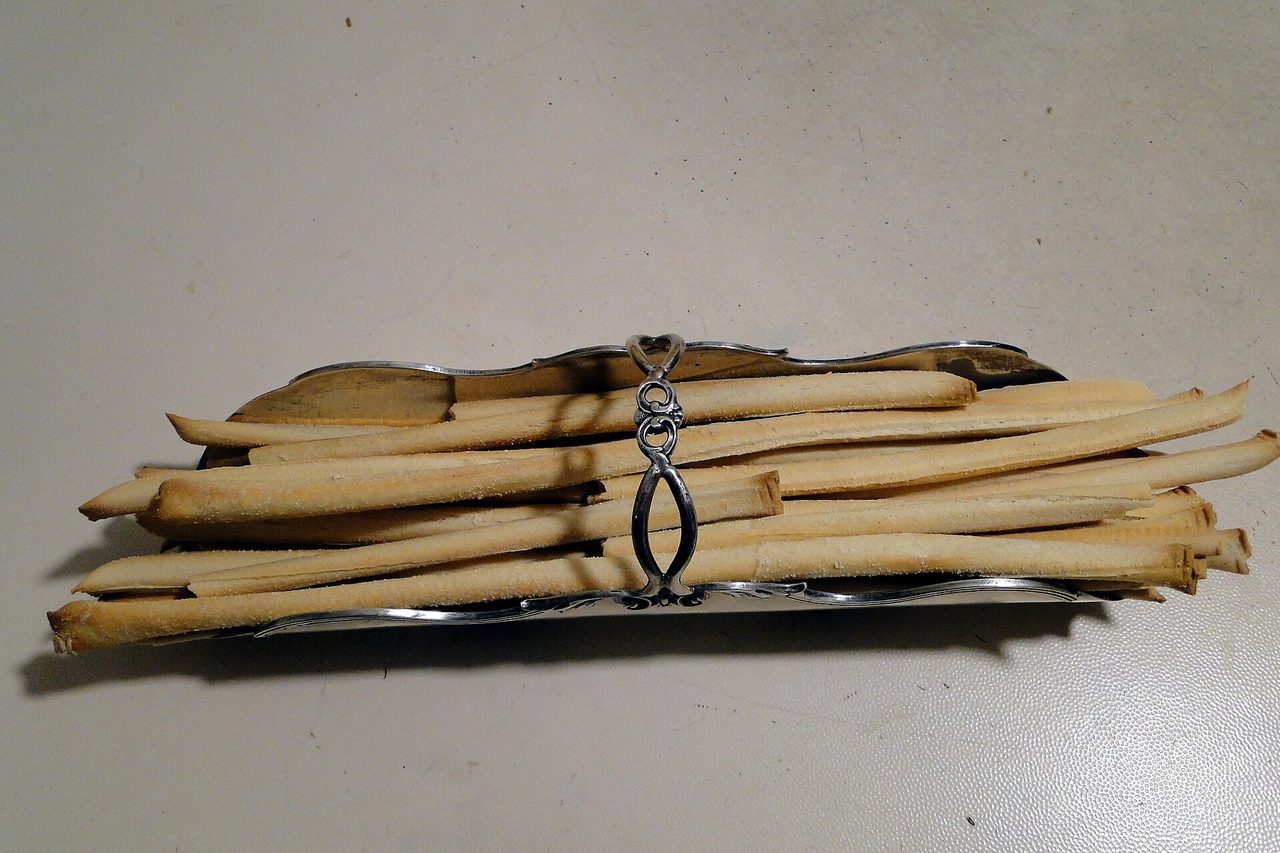
Photo: Shardan · CC BY-SA 3.0
Pane Carasau (Flatbread Split in Two and Baked Again)
Sardinia's thin bread: a durum wheat dough rolled thin and put into a very hot oven, where it swells into a ball and parts into two layers. Those are cut apart into two sheets and baked again until crisp. Kept dry, it lasts up to a year.
Ingredients
- Dough
- finely milled durum wheat semolina · semola rimacinata500 g
- dried yeast3 g
- salt10 g
- lukewarm water300 ml
- Baking
- pizza stone or heavy steel1
- semolina for dusting to taste
Steps
- ⏲ 15 min
Dissolve the yeast in the water, mix with the semolina and salt and knead hard for 15 minutes to a smooth dough. The longer it is worked, the better the result.
- ⏲ 120 min
Cover and leave an hour and a half to rise. Divide into 8, round them and leave covered 30 minutes more.
- ⏲ 45 min
Put the stone in the oven and heat it at the highest setting for 45 minutes.
- ⏲ 15 min
Dust with semolina and roll each piece evenly to a 25cm round 2mm thick. Stack the rounds between dry cloths.
- ⏲ 1 min 30 sec
Put one round on the stone. When it swells into a ball, within 1-2 minutes, take it out at once.
- ⏲ 1 min
As soon as it is out, run a knife round the edge and pull it apart into two sheets. If the air escapes and it cools and sags, the two halves stick back together. Stack the sheets between cloths.
- ⏲ 1 min 30 sec
When all are split, return the sheets one at a time to the stone for 1-2 minutes, until crisp and lightly coloured. Cool, stack and keep somewhere dry.
Variations
- Pane guttiau. A sheet sprinkled with a few drops of olive oil and salt and toasted briefly.
- Pane frattau. Carasau served with tomato sauce and egg.
- Pane lentu. Eaten straight after the first bake. It folds and rolls but does not keep.
- Barley dough. Poorer households made a dark version from barley flour or bran.
Tips
- Knead for a long time.
- Roll to an even thickness. Thick and thin patches do not swell evenly.
- Oven at maximum, stone thoroughly hot.
- Split it the moment it puffs. Once it sags, the halves stick back together.
- Keep it dry. Damp takes the crispness away.
- A splash of water softens it again, enough to roll round ham or cheese.
More detail and the reasons why (2)
- A bread that uses the puff all the way. Chapati balloons with steam and collapses, which is what should happen, and inside it has separated into two layers. Piadina treats a balloon as a fault and pricks it. Carasau cuts the two layers apart. According to Italian Wikipedia, the dough swells into a ball in the hot oven and the air inside parts the two layers, and they must be separated quickly once it is out, before the air leaks or it sags as it cools. That is why one sheet has the smooth outer face and the other the rough inner one.
- Why it is baked twice. The same article says the bread from the first bake (pane lentu) is pliable enough to fold or roll but does not keep; baked again until crisp, it is carasau, a name from the Sardinian word for toasting. English Wikipedia says it was made for shepherds away from home for months and lasts up to a year kept dry. It is the route lavash takes, dried until brittle to keep for months and brought back with water.
The basics behind this dish
- Dough and Gluten: When to Build It and When to Avoid ItThe same flour and water becomes a dumpling wrapper or a tender pancake. The difference is whether you built gluten or avoided it — and kneading and resting do different jobs.
- Heat Control: Preheating, Oil, and Reading the PanThe same ingredients become a different dish depending on pan temperature. When to add the oil, how to read heat by sound, and which dishes want low heat instead.
- Knife Skills: Grip, Cuts, and Why Size MattersHow you hold the knife matters more than how fast you cut. The pinch grip, the claw hand, and why uniform size is a cooking decision rather than a cosmetic one.
More of the same kind


More from this country


Sign in to edit.
Written with AI · how we check it · Edit history
https://cookiki.com/en/r/pane-carasau · cookiki · User contributions are licensed under CC BY-SA 4.0.