
Photo: Martin Lindstrom · CC BY 2.0
Tunnbröd (Thin Flatbread Raised with Baker's Ammonia)
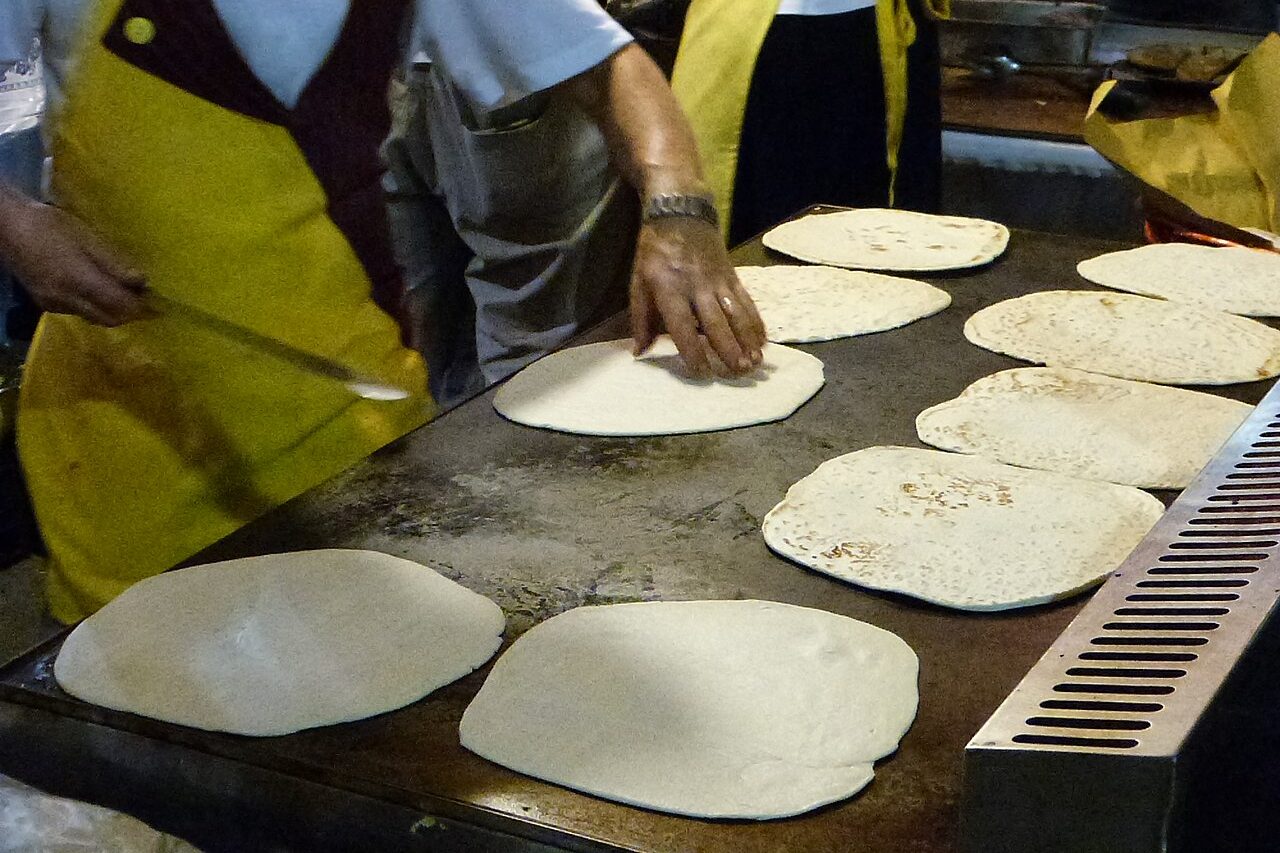
Northern Sweden's thin bread: a wheat-and-barley dough rolled to 2mm and baked for two or three minutes in the hottest oven you have. It is raised with yeast and with baker's ammonia, a salt that turns to gas on heat alone, with no acid, and leaves nothing behind in the bread — which is why the bread has to be thin enough for that gas to get out. Baked soft it is used as a wrap; dried out it is eaten crisp.
Ingredients
- milk250 ml
- butter50 g
- dried yeast5 g
- golden syrup or honey1 tbsp
- plain flour300 g
- barley flour · plus a little for rolling100 g
- salt1 tsp
- baker's ammonia (ammonium carbonate) · or 1.5 tsp baking powder, for a less light bread1 tsp
Steps
Warm the milk with the butter until it melts, then let it cool to about 37°C. Stir in the yeast and syrup.
Mix the flours, salt and baker's ammonia in a bowl. If the ammonia salt has lumps, crush them between your fingers so it is spread through all the flour.
- ⏲ 5 min
Pour in the milk and knead for 5 minutes to a soft dough that sticks to your hands a little.
- ⏲ 40 min
Cover and leave somewhere warm for 40 minutes, until it has risen by about half.
- ⏲ 30 min
Heat the oven to its highest setting (250-275°C) with a heavy tray or baking stone inside for 30 minutes.
- ⏲ 10 min
Divide the dough into 8. Roll each piece to a 25cm round 2mm thick, dusting with barley flour, and prick it all over with a fork.
- ⏲ 3 min
Bake one at a time on the hot tray for 2-3 minutes, until the surface has puffed and has pale brown spots.
Stack each bread between cloths as it comes out; the trapped steam keeps them soft. For crisp tunnbröd, turn the oven down to 150°C when all are baked and dry them one at a time for 10 minutes more.
Tips & Variations
Variations
- Soft or crisp: Korean Wikipedia notes that tunnbröd can be soft and that crisp tunnbröd exists as well. This recipe bakes it soft; drying it at a low heat in the last step makes it crisp.
- As a wrap: soft tunnbröd is used to wrap food the way a crêpe or a burrito is, and a tunnbröd roll — mashed potato and a hot dog rolled in one — is a well-known Swedish fast food. It does the job of a burrito's tortilla.
- With rye: the dough is mostly wheat and barley, and some recipes add rye. Swapping half the 100g of barley flour for rye flour darkens it.
- With surströmming: Korean Wikipedia notes it is traditionally served with fermented herring.
Tips
- There are two leaveners. Korean Wikipedia says both yeast and ammonium carbonate are used. The yeast raises the dough while it rests; the ammonium salt works the moment the oven's heat reaches it. Korean Wikipedia's article on the salt says it breaks down easily on heating into ammonia and carbon dioxide, and that its main use is as a leavener in traditional cooking, Nordic and Scandinavian cooking above all.
- It needs no acid. Irish soda bread rises on bicarbonate of soda, and as that page puts it, "All of its lift is carbon dioxide from an acid meeting a base, and that reaction starts the instant the buttermilk touches the flour." — which is exactly why the buttermilk is compulsory rather than optional. Ammonium carbonate turns to gas on heat alone, with no acid, so there is no buttermilk or yoghurt in this dough.
- It leaves nothing behind. Heated without an acid, bicarbonate of soda gives off carbon dioxide and water and turns into sodium carbonate, per Korean Wikipedia's article on it, so something stays in the bread after the gas has gone. The ammonium salt, the ammonium carbonate article says, turns entirely into gas during baking. There is no salt left over.
- Which is why it is rolled thin. The ammonium carbonate article describes the gas making bubbles that grow and finally burst, letting the gas out, and leaving the bread very porous. The gas needs a short way out, so the dough is rolled to 2mm and baked briefly in a very hot oven.
- Prick it all over. Mille-feuille gives the reason: "Without the holes, steam collects at whatever point is weakest and lifts that one spot into a dome." A thin sheet then bakes flat and even instead of ballooning in one place (what your oven is doing).
- Baking powder will do, but it is not the same. The ammonium carbonate article says so outright: baking powder can stand in, but the result is not as light as the original recipe. Use 1.5 tsp if you cannot find the ammonia salt.
The basics behind this dish
- Dough and Gluten: When to Build It and When to Avoid ItThe same flour and water becomes a dumpling wrapper or a tender pancake. The difference is whether you built gluten or avoided it — and kneading and resting do different jobs.
- Heat Control: Preheating, Oil, and Reading the PanThe same ingredients become a different dish depending on pan temperature. When to add the oil, how to read heat by sound, and which dishes want low heat instead.
- Knife Skills: Grip, Cuts, and Why Size MattersHow you hold the knife matters more than how fast you cut. The pinch grip, the claw hand, and why uniform size is a cooking decision rather than a cosmetic one.
More of the same kind


More from this country


Sign in to edit.
AI-drafted, editor-reviewed · edits: 0 ·Edit history
https://cookiki.com/en/r/tunnbrod · cookiki · User contributions are licensed under CC BY-SA 4.0.