
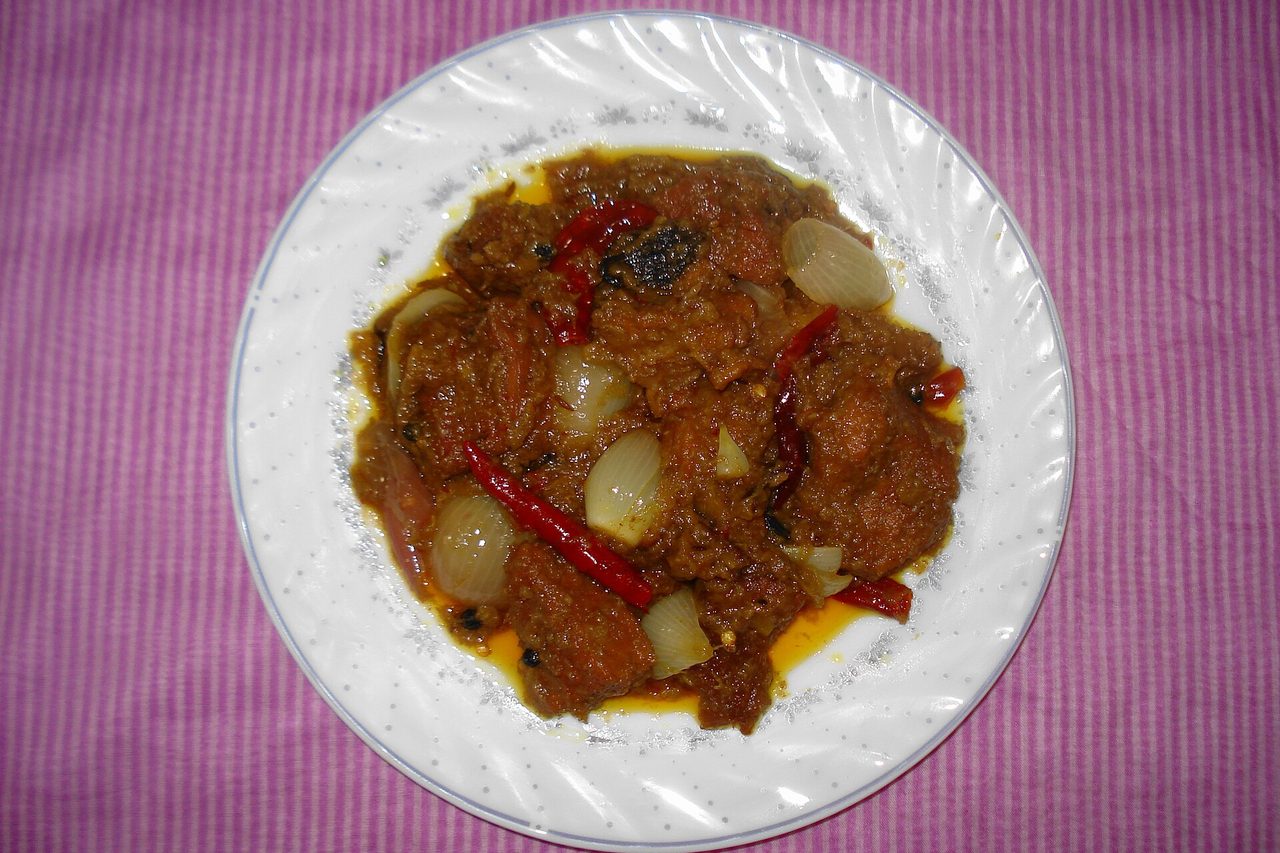
Photo: Gunawan Kartapranata · CC BY-SA 3.0
Ikan Pepes (Spice-Paste Fish Steamed and Grilled in Banana Leaf)
East Timor's national dish: fish coated in a pounded spice paste, wrapped in banana leaf and steamed, and then put on the coals still wrapped. Every other leaf-wrapped dish on this site stops at the steaming. This one has a second stage, and the order cannot be reversed. Steaming cooks the fish and fixes the paste onto the flesh, but it leaves the surface wet. Grilling drives that water off, and while it does the leaf scorches and its smoke goes inward. Skip the steaming and grill it from raw, and the leaf turns to ash before the fish is done.
Ingredients
- The fish (serves 4)
- carp or sea bream · whole; mackerel works well too800 g
- lime juice2 tbsp
- salt1 tsp
- The bumbu (pounded paste)
- shallots8
- garlic5 cloves
- ginger20 g
- galangal · use more ginger if you have none30 g
- fresh turmeric · or 1 tsp ground20 g
- bird's eye chillies · to taste6
- candlenuts · or macadamias; they hold the paste together4
- salt1 tsp
- Into the leaf
- banana leaves · about 30x30cm, passed briefly over a flame to soften4
- lemongrass · split and bruised2 stalks
- kaffir lime leaves6
- salam leaves · Indonesian bay; bay leaves otherwise4
- tomatoes · thinly sliced2
- lemon basil · Thai basil otherwise1 handful
Steps
- ⏲ 15 min
Scale and gut the fish and slash it diagonally on both sides. Rub with the lime juice and salt and leave 15 minutes.
- ⏲ 10 min
Make the bumbu: pound the shallots, garlic, ginger, galangal, turmeric, chilli, candlenuts and salt in a mortar for 10 minutes. A mortar beats a blender here because blades cut cells open and release juice, while pounding crushes the fibres into a paste that clings to the flesh (knife skills).
- ⏲ 5 min
Pass the banana leaves over a flame or a hot pan for a few seconds a side to soften them. Skip that and they split as you fold — amok gives the same reason.
- ⏲ 10 min
Lay salam leaves and lemon basil on the leaf, set the fish on top with half the bumbu already rubbed over it, and spread the rest on top, pushing it into the slashes. Add the lemongrass, lime leaves and tomato, then fold the sides in to overlap and turn both ends up, and pin with a toothpick.
- ⏲ 25 min
Steam 25 minutes over a rolling boil (steaming). This is the stage that cooks the fish and fixes the paste onto it. Stop here and you have made something like amok or ilish paturi.
- ⏲ 10 min
Take the parcels out and put them straight onto coals or a grill pan, still wrapped. Do not unwrap them. Four or five minutes a side, until the leaf is blackened and dry. The water the steaming left on the surface goes off, and while it does the smoke from the scorching leaf works inward.
- ⏲ 1 min
The order cannot be reversed. Grilled from raw, the banana leaf turns to ash before the fish is cooked, and the inside is neither steamed nor grilled.
- ⏲ 3 min
Open the leaf out on the plate and serve it in that. Lime alongside, and rice.
Tips & Variations
Variations
- The name and the region: pepes ikan in Indonesian, pais lauk in Sundanese. "Pepes" names the method — cooking wrapped in banana leaf — rather than a dish, so there is also pepes ayam (chicken), pepes tahu (tofu) and pepes campur (mixed). ko.wikipedia files this one as "동티모르와 인도네시아의 생선 요리" and adds that it is considered East Timor's national dish.
- Choosing the fish: Indonesia uses carp (ikan mas) or mackerel. The firmer the flesh, the better it survives two stages. A soft white fish is better stopped after the steaming.
- Grilled without steaming: some places do it and call it pais, but the leaf burns first. It only works with very small fish or with fillets.
- Against amok and ilish paturi: both wrap and steam. Amok uses the leaf as a vessel and ilish paturi uses it as a lid. Here the leaf takes a third role — in the second stage it becomes an ingredient by scorching.
- Against ota ika and bougna: the Pacific's leaf cookery. Bougna goes into an earth oven; this goes into a steamer and then onto coals.
- One way it is the opposite of ilish paturi: that dish uses the leaf as a lid to keep mustard's volatile pungency in. Here the leaf has to be open to the fire for the smoke to get in, so in the second stage it is deliberately dried out and burnt.
Tips
- Steam first, then grill. The order is not interchangeable. This is the one place the dish is lost.
- Use a mortar. A blended bumbu is watery, runs out during the steaming, and does not stay on the fish. If you must blend, add no water at all and pulse.
- Always pass the banana leaf over a flame. A raw leaf tears instead of folding.
- Push paste into the slashes. A whole fish has nowhere for flavour to get in except the surface.
- Serve it in the leaf rather than lifting the fish out. The aroma the second stage put into the leaf keeps coming off it at the table (serving temperature).
The basics behind this dish
- Blooming Spices: Why Aromatics Go into Fat FirstStir ground spice into liquid and half the aroma never arrives, because most aroma compounds are fat-soluble. The thirty-second window, and the order things go in.
- Steaming: Water Level, Condensation, and StackingSteam never exceeds 100°C and still cooks faster than boiling water. The reason is latent heat; the commonest failure is the drip off the lid; and stacking does not work the way people think.
- Browning and the Maillard ReactionMeat fails to brown for one of three reasons: it is wet, the pan is cool, or you put too much in at once. Plus how the brown film stuck to the pan becomes your sauce.
More of the same kind


Sign in to edit.
AI-drafted, editor-reviewed · edits: 0 ·Edit history
https://cookiki.com/en/r/ikan-pepes · cookiki · User contributions are licensed under CC BY-SA 4.0.