
Photo: Ryan Snyder · CC BY 2.0
Laap (Minced Meat Salad with Toasted Rice)
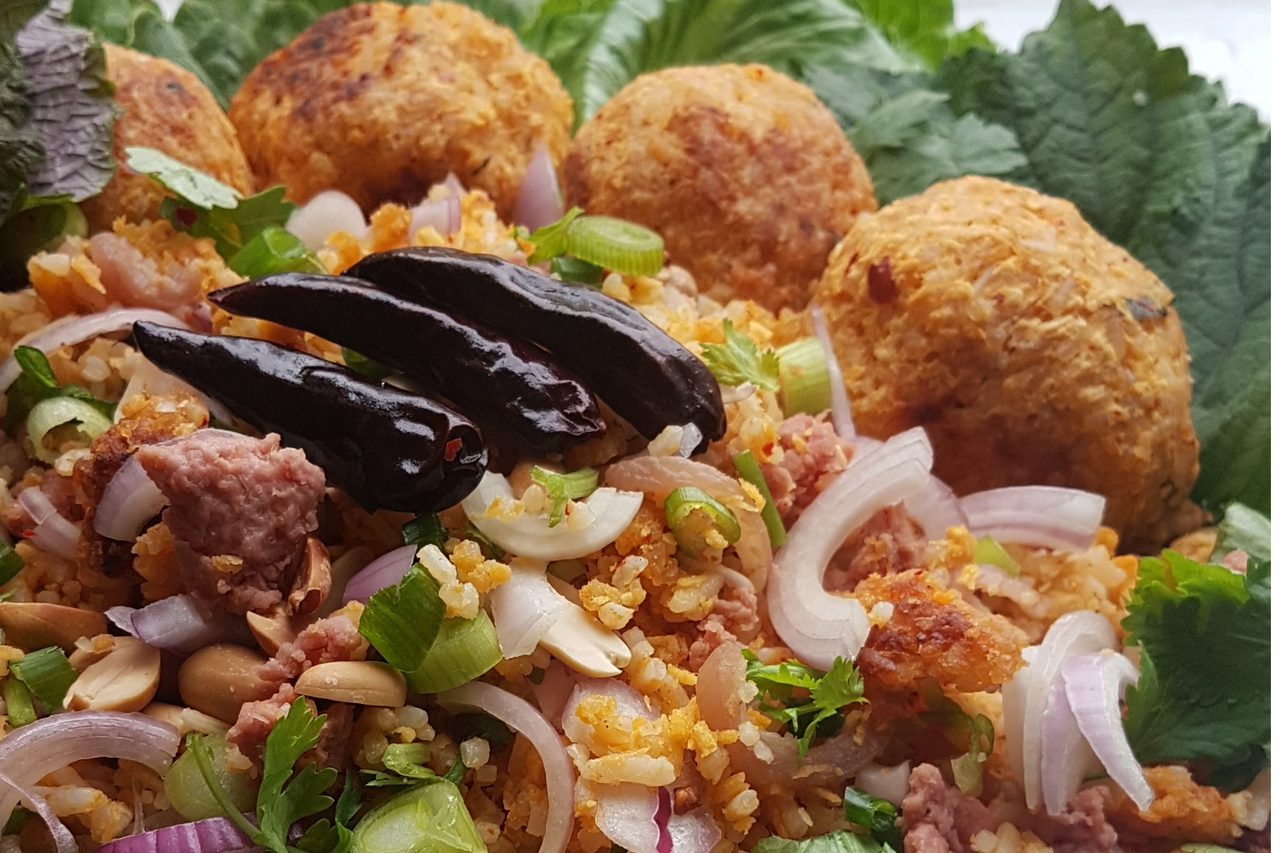
Laos's national dish: minced meat cooked without liquid, dressed with lime, fish sauce and herbs, and bound with toasted ground sticky rice. Without the toasted rice — khao khua — it is not laap, and the dressing and herbs go in only after the pan is off the heat.
Ingredients
- The meat
- Minced beef or pork · Chicken and duck are also usual; not too lean500 g
- Water or stock · It cooks in its own juices, not fried4 tbsp
- Khao khua (toasted ground sticky rice)
- Glutinous rice · Raw. This is what makes it laap3 tbsp
- Dressing
- Lime juice · Lime, not lemon, and be generous4 tbsp
- Fish sauce · The salt and the savouriness3 tbsp
- Toasted chilli flakes · Dried chillies toasted then ground; to taste1 tsp
- Sugar · The Lao version does not use it — see the tips
- Herbs and vegetables
- Shallots · Thinly sliced; red onion instead4
- Spring onions · Thinly sliced4
- Mint · Leaves only. Do not leave this out1 cup
- Coriander · Chopped, stems included0.5 cup
- Lemongrass · Optional; shaved very thin1 stalk
- To serve
- Sticky rice · Eaten by hand; laap's partner
- Raw vegetables · Cabbage, cucumber, long beans, to scoop it up
Steps
- ⏲ 15 min
Make the khao khua first. Toast the raw glutinous rice in a dry pan over medium-low heat, stirring constantly, for 10–15 minutes until deeply brown — closer to coffee than gold, or there is no aroma.
- ⏲ 5 min
Grind the toasted rice coarsely in a mortar or grinder. You want the texture of sand, not flour — the texture is half the dish.
- ⏲ 3 min
Toast the dried chillies in a dry pan for 30 seconds and grind them. Toasted and untoasted chilli smell nothing alike.
- ⏲ 8 min
Put the mince in a pan with just the 4 tbsp of water and cook over medium heat without letting it fry. You are cooking it in its own juices, not browning it — Maillard flavour fights the herbs and lime here.
- ⏲ 2 min
Once the meat is cooked and the pan is nearly dry, take it off the heat completely. Nothing after this point sees a flame.
- ⏲ 3 min
Off the heat, stir in the lime juice, fish sauce and toasted chilli, and taste. Sour, salty and hot in balance is the axis of the dish — see Balancing flavour.
- ⏲ 2 min
Add the shallots, spring onions and khao khua and mix. The toasted rice takes up the remaining moisture and makes the dressing cling to the meat.
- ⏲ 1 min
Add the mint and coriander last, folding them through briefly. Left in residual heat they lose their aroma and their colour.
- ⏲ 2 min
Serve just warm — neither hot nor cold is the point. Eat it with balls of sticky rice pressed by hand, or spooned onto cabbage leaves.
Tips & Variations
Variations
- Which meat: beef (laap ngua), pork (laap moo), chicken (laap kai) and duck (laap ped) are all standard. Fish laap uses cooked white fish flaked apart.
- With offal: many Lao cooks add boiled liver or tripe, finely chopped. It deepens the savouriness considerably.
- Laap dip (raw): there is a traditional raw version made with raw meat and blood. This recipe is the cooked one, and the raw version is not recommended for safety reasons.
- The relationship with Thai Isan: laap is both the national dish of Laos and a signature dish of northeastern Thailand. It is one dish straddling a border — and the Thai version often takes a little sugar while the Lao one does not. Som Tam has the same relationship.
- Vegetarian: crumbled tofu or finely chopped mushrooms work the same way. Swapping fish sauce for soy or salt costs you savouriness, so add a little dried shiitake liquid — see Building umami.
- Other herbs: Lao cooks also use dill or sawtooth coriander. Mint is the one not to omit.
Tips
- Do not skip the khao khua. The toasted rice is structure, not garnish: it supplies the nutty aroma and absorbs the remaining liquid so the dressing clings to the meat. Without it you have dressed mince.
- Toast the rice to coffee colour. Stopping at gold gives almost no aroma. Ten to fifteen minutes of constant stirring, until it smokes faintly and smells strongly nutty. Burnt is bitter, so the skill is stopping just before.
- Grind it coarse. Fine flour clumps into paste. Sand-sized grains are what give you texture.
- Do not brown the meat. A few tablespoons of water and its own juices is correct. Maillard aroma is a distraction here — the contrast is set out in Browning.
- Dress it off the heat. Heated lime juice loses its brightness and turns flat. The herbs are more sensitive still and fade even in residual heat.
- No sugar. Lao laap balances on sour, salty and hot. Add sweetness and you have drifted towards the Thai version.
- Serve it just warm. Hot drives off the herb aroma; cold sets the fat and makes it claggy.
- With sticky rice. In Laos laap is not a side dish — it is what you eat sticky rice with, pressed into balls by hand. Cooking sticky rice is covered in Cooking rice.
The basics behind this dish
- Building Umami: Glutamate, Synergy, and LayersUmami is built in layers, not added from one bottle. The key is synergy: glutamate plus nucleotides multiply each other rather than adding up.
- Fresh Herbs: Hardy, Delicate, and When to Add ThemAroma is volatile, so timing is the whole game. What separates a hardy herb from a delicate one, why the stems are worth more than you think, and why basil should never meet a knife.
- Knife Skills: Grip, Cuts, and Why Size MattersHow you hold the knife matters more than how fast you cut. The pinch grip, the claw hand, and why uniform size is a cooking decision rather than a cosmetic one.
More of the same kind


More from this country
Lao →
Sign in to edit.
AI-drafted, editor-reviewed · edits: 0 ·Edit history
https://cookiki.com/en/r/laap · cookiki · User contributions are licensed under CC BY-SA 4.0.