
Photo: Z thomas · CC BY-SA 4.0
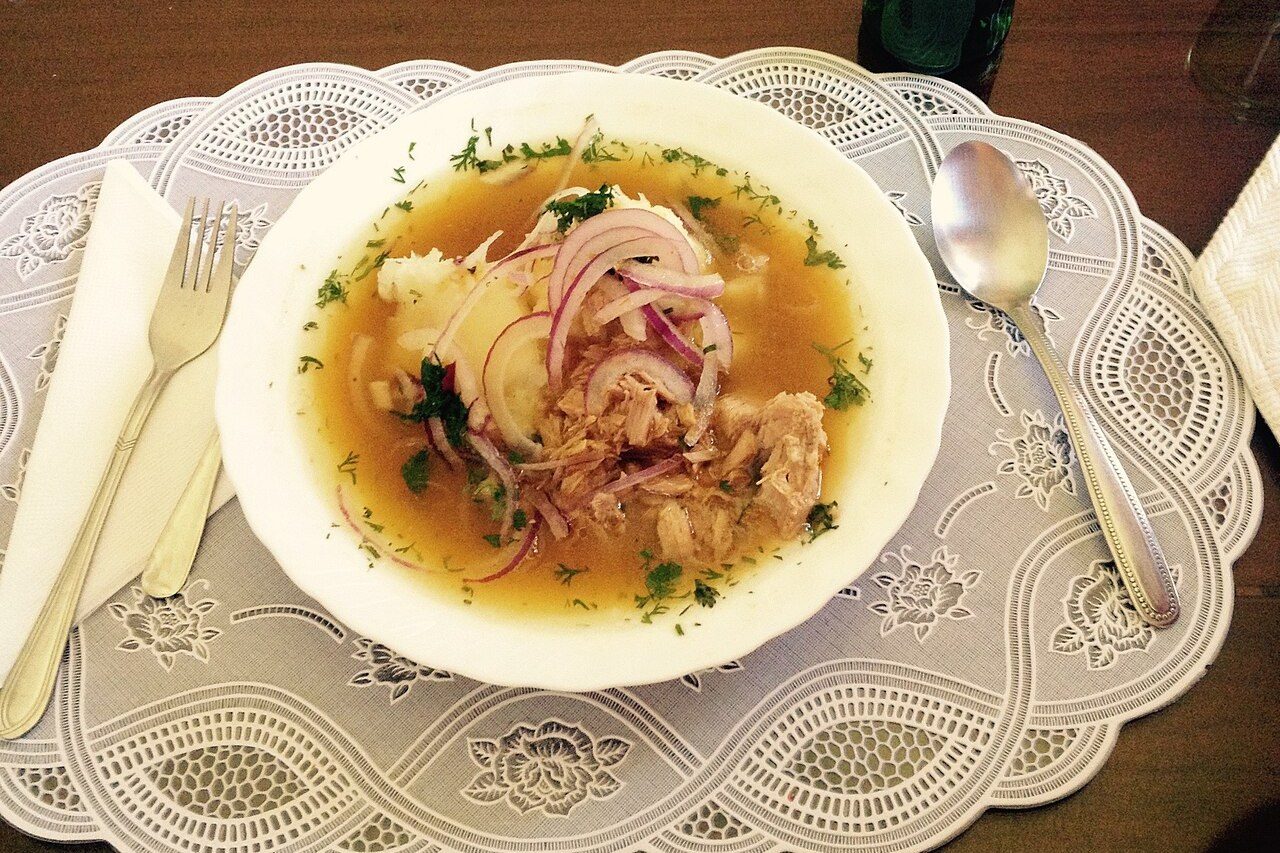
Romazava (Clear Beef and Greens Broth with Mafana)
Madagascar's national dish: beef and pork simmered into a deliberately clear broth, with three Malagasy leaf greens wilted in at the end and red rice alongside. The name means "clear broth". What defines it is not heat but mafana — paracress leaf and flower bud — whose spilanthol neither burns like capsaicin nor rushes up the nose like mustard. It tingles, numbs a little, and makes the mouth water. The chilli stays out of the pot and comes to the table as sakay.
Ingredients
- The broth
- beef shin · cut in large pieces400 g
- pork shoulder300 g
- onion · thickly sliced1
- tomatoes2
- garlic4 cloves
- ginger15 g
- water1.5 L
- salt2 tsp
- The greens
- mafana leaves and flower buds · paracress; see the substitute in Tips80 g
- mustard greens · standing in for anatsonga150 g
- watercress or spinach150 g
- Sakay, to serve
- small hot chillies6
- garlic2 cloves
- ginger10 g
- neutral oil3 tbsp
- salt0.5 tsp
- Alongside
- red rice · brown rice otherwise400 g
Steps
- ⏲ 10 min
Put the meat in a pot, cover with cold water and bring to the boil. Skim every bit of the scum off. Skip this and the dish does not deserve its name.
- ⏲ 90 min
Drop the heat until the surface barely trembles. Add the onion, garlic and ginger and simmer an hour and a half, until the meat is tender.
- ⏲ 20 min
Add the tomatoes in large pieces and simmer 20 minutes more. Do not crush them — the broth clouds.
- ⏲ 3 min
Season with salt. The broth should be clear and faintly gold; lift off any fat with a ladle.
- ⏲ 5 min
Add the mustard greens first and give them 5 minutes. The tough leaf goes in ahead.
- ⏲ 2 min
Add the mafana and the watercress and cook two minutes only. Simmered long, mafana keeps its tingle but the leaf goes limp and turns grassy.
- ⏲ 5 min
Make the sakay: pound the chillies, garlic and ginger, salt them and stir in the oil. It does not go into the pot.
- ⏲ 2 min
Serve with red rice. If the tip of your tongue buzzes a moment after the first spoonful, the mafana went in right.
Tips & Variations
Variations
- The meat: beef alone or pork alone are both common. In Madagascar it is zebu, whose lean muscle is firm enough to want closer to two hours.
- Fish romazava: on the coast, white fish replaces the meat and the simmer drops to twenty minutes. The order of the greens does not change.
- The greens: the canonical three are anamafana (mafana), anatsonga (a mustard green) and anamamy (a nightshade leaf). Mustard greens and watercress stand in for two of them. Mafana is the one with no good substitute.
- Against abgoosht: that dish separates broth from solids and then mashes the solids. Romazava stays one bowl, and keeping the pieces intact is the point.
- If you want it hot: sakay goes into each person's bowl. Keeping it out of the pot is the whole arrangement.
Tips
- What mafana gives is not heat. Chilli and heat ends by splitting capsaicin from mustard's allyl isothiocyanate: capsaicin is already present, dissolves in fat and survives boiling, while mustard's pungency does not exist until cells break, needs water, and is driven off by heat. Spilanthol is neither. It is an alkylamide, so instead of a burn it produces tingling, a mild local numbness, and a flood of saliva. The plant is called the toothache plant for exactly that reason.
- Sichuan pepper belongs to the same family. The hydroxy-alpha-sanshool behind the buzz in mapo tofu and malatang is an alkylamide too. But that one arrives as a dried spice woken in oil, with the tingle out in front of the dish; mafana arrives as a leaf, cooks for two minutes at the end, and leaves the broth clear.
- "Clear broth" is the name. Ro is broth, mazava is clear. Everything stocks and broths asks for — start in cold water, skim, never let it boil — is here a matter of keeping the name honest rather than a preference. Pot-au-feu sets the same conditions for the same reason.
- The greens go in on two clocks. Straight out of fresh herbs — hardy first, delicate last: five minutes for the mustard greens, two for the mafana and watercress. That is a different aim from how sigeumchi-namul and horta handle boiled leaves, since here the leaves stay in the liquid rather than being lifted out of it.
- When you cannot get mafana. Growing paracress (Acmella oleracea) from seed in a pot and picking the leaves is the practical route. To gesture at it, grind a teaspoon of Sichuan pepper in at the end — you get a comparable tingle and none of the salivation or the grassy note. Better to serve it without and call it something else.
- Do not crush the tomatoes. It is the commonest way the broth goes cloudy. Left whole, twenty minutes gets all the flavour out of them anyway.
The basics behind this dish
- Chilli and Heat: Where It Lives and How to Take It BackHeat is not a taste but a pain signal. Where capsaicin actually sits, why water does nothing, and the four ways to pull a dish back once it has gone too far.
- Stocks and Broths: Clarity, Time, and Why You Do Not Salt ThemWhat separates a clear stock from a cloudy one is temperature, not ingredients. Why you start in cold water, how long each ingredient wants, and why salt comes later.
- Salt: When You Add It Matters More Than How MuchThe same amount of salt either draws water out or seasons all the way through, depending on when it goes in. Osmosis, seasoning in layers, and why salt types are not interchangeable by volume.
More of the same kind


Sign in to edit.
AI-drafted, editor-reviewed · edits: 0 ·Edit history
https://cookiki.com/en/r/romazava · cookiki · User contributions are licensed under CC BY-SA 4.0.