
Photo: Jocelyndurrey · CC BY-SA 4.0
Yeongeun-jeonggwa (Lotus Root Candied in Syrup)
A Korean confection of lotus root sliced thin and simmered for over an hour in syrup until it is translucent and chewy right through. The method is to start with a thin sugar solution and let it get sweeter only as fast as the water boils off, rather than dropping the slices into a heavy syrup. Sugar is a large, slow molecule, and it needs that time to take the place of the water inside the root.
Ingredients
- lotus root · thick, straight pieces300 g
- vinegar · split between the soaking and blanching water1 tbsp
- Syrup
- water400 ml
- sugar120 g
- salt1 pinch
- rice syrup (mulyeot) or glucose syrup · goes in halfway60 g
- honey · to finish, optional1 tbsp
Steps
Peel the lotus root and cut it into 0.7cm rounds. Put each slice straight into cold water with a little of the vinegar — the cut face browns quickly in the air.
- ⏲ 3 min
Bring a pan of water to the boil with the rest of the vinegar, blanch the slices for 3 minutes and drain.
Lay the slices in a wide pan in one layer and add the 400ml of water, the sugar and the salt. Bring to the boil on high heat, then turn it down to the lowest heat. The syrup is meant to be thin at this point.
- ⏲ 40 min
Simmer uncovered on low for 40 minutes. Do not stir; turn the slices over one at a time now and then. When the syrup has reduced to about half, move on.
- ⏲ 30 min
Add the rice syrup and simmer on low for 25-30 minutes more. When the slices are translucent right through, the syrup clings to them thickly and the bubbles rise slowly, take it off the heat and turn the honey through.
- ⏲ 90 min
Lift the slices out one by one onto a rack or paper and let the surface dry for 1-2 hours. Once they no longer stick to each other, pack them in a sealed box and keep them in the fridge.
Tips & Variations
Variations
- Other roots and fruits: ko.wikipedia describes jeonggwa as a confection of fruit or roots boiled down in sugar. Bellflower root, ginger, kumquat, carrot and apple all become jeonggwa the same way. The harder the root, the longer it simmers; the softer the fruit, the shorter.
- The old honey version: according to ko.wikipedia, lotus-root jeonggwa in old texts such as the Sallim gyeongje was sweetened mainly with honey, and they wanted it a deep reddish-brown and said to cook it slowly over a gentle fire. Using 150g of honey in place of the sugar and rice syrup brings it closer to that colour.
- Coloured jeonggwa: make the syrup with omija infusion or gardenia water for pink or yellow slices. It is how a tray of hangwa gets several colours.
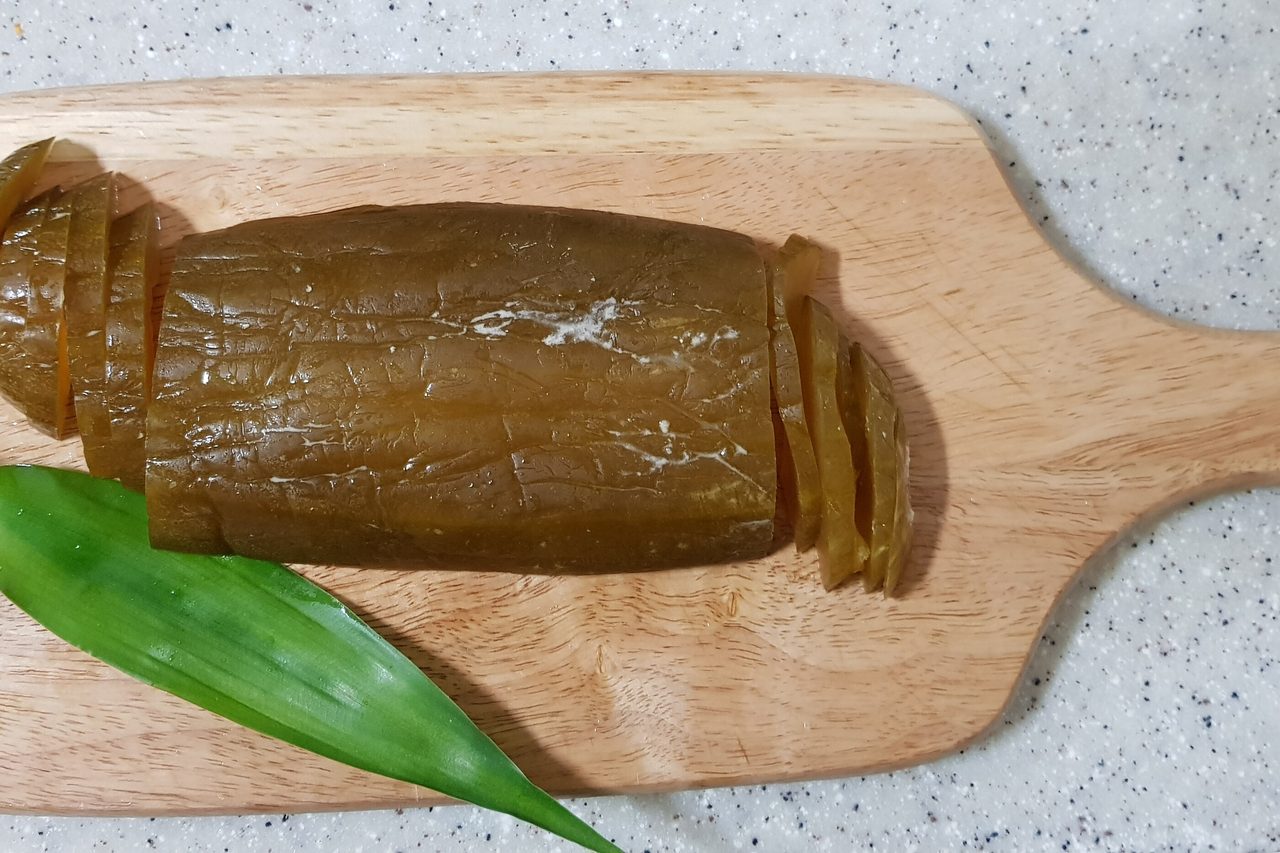
- The one in the photograph: simmered long enough to take on a deep colour. Take it off the heat a little sooner and it stays pale amber and softer.
- Same root as bugak, opposite direction: bugak blanches thin lotus-root slices, paints them with glutinous rice paste, dries them and fries them. Jeonggwa replaces the same root's water with sugar instead of taking it away. One ends up crisp, the other chewy.
Tips
- Starting thin is the method. What sugar does gives the reason fruit is cooked in syrup: "Twenty minutes in plain water reduces a pear to mush; in a syrup sweeter than the fruit, its cell water has no reason to leave and the shape survives" (poire belle Hélène). That is a twenty-minute story. Jeonggwa simmers for over an hour with the aim of replacing the water in the root with sugar outright, and then the question becomes how much sweeter the syrup can be. Put the slices straight into a heavy syrup and water leaves them faster than sugar gets in: the outside shrivels and toughens while the middle stays under-sweet. Start with a thin sugar solution and let it concentrate only as fast as the water boils off, and the difference between inside and outside stays small the whole way.
- Sugar goes in slowly. The reason nikujaga puts its sugar in first is this confection's clock: "a sucrose molecule is much larger and heavier than the ions salt separates into, so it travels into a potato far more slowly". That is why it takes most of an hour to reach the middle of a 0.7cm slice, and why the old texts ko.wikipedia cites said to cook it slowly.
- The rice syrup goes in halfway. As the syrup concentrates it is more and more ready to crystallise as it cools. What sugar does describes the maltose in grain syrups this way: "Maltose is about a third as sweet as sugar, browns readily, and resists crystallising". Added as the syrup starts to thicken, it means the finished slices come out glossy rather than crusted with white sugar. As the same sentence says, it also colours well, and the deep amber in the photograph comes in at this stage.
- Translucent means done. Raw lotus root is white and opaque. As syrup takes the place of the water in the tissue, light passes through and the slice turns see-through. Cut one open: if the centre is still white and cloudy, the sugar has not got there yet, so keep going.
- Into vinegar water as you cut, then blanch once. Bugak gives the reason for blanching lotus root: "The blanching is to wash off loose starch and stop the slices browning". In jeonggwa, browning would also cloud the colour of the syrup.
- One layer in a wide pan, turned rather than stirred. Slices stacked on each other sit at different depths in the syrup and do not cook evenly. The syrup thickens and catches more easily towards the end, so keep the heat at its lowest throughout.
- Lift them out and dry the surface. Left piled up out of the syrup, the slices stick together as they cool. Spread them apart to dry before packing them away.
The basics behind this dish
- Eggs: Coagulation Temperatures and What They DecideWhite sets at 62°C, yolk at 68°C. Those two numbers explain scrambled eggs, boiled eggs, steamed custard and crème anglaise all at once.
- Why Sauces Split: Emulsions and Pan SaucesA cream sauce breaking and a carbonara scrambling are the same failure. Temperature and emulsifiers — plus how to bring a split sauce back.
- Knife Skills: Grip, Cuts, and Why Size MattersHow you hold the knife matters more than how fast you cut. The pinch grip, the claw hand, and why uniform size is a cooking decision rather than a cosmetic one.
More of the same kind


More from this country


Sign in to edit.
AI-drafted, editor-reviewed · edits: 0 ·Edit history
https://cookiki.com/en/r/yeongeun-jeonggwa · cookiki · User contributions are licensed under CC BY-SA 4.0.