
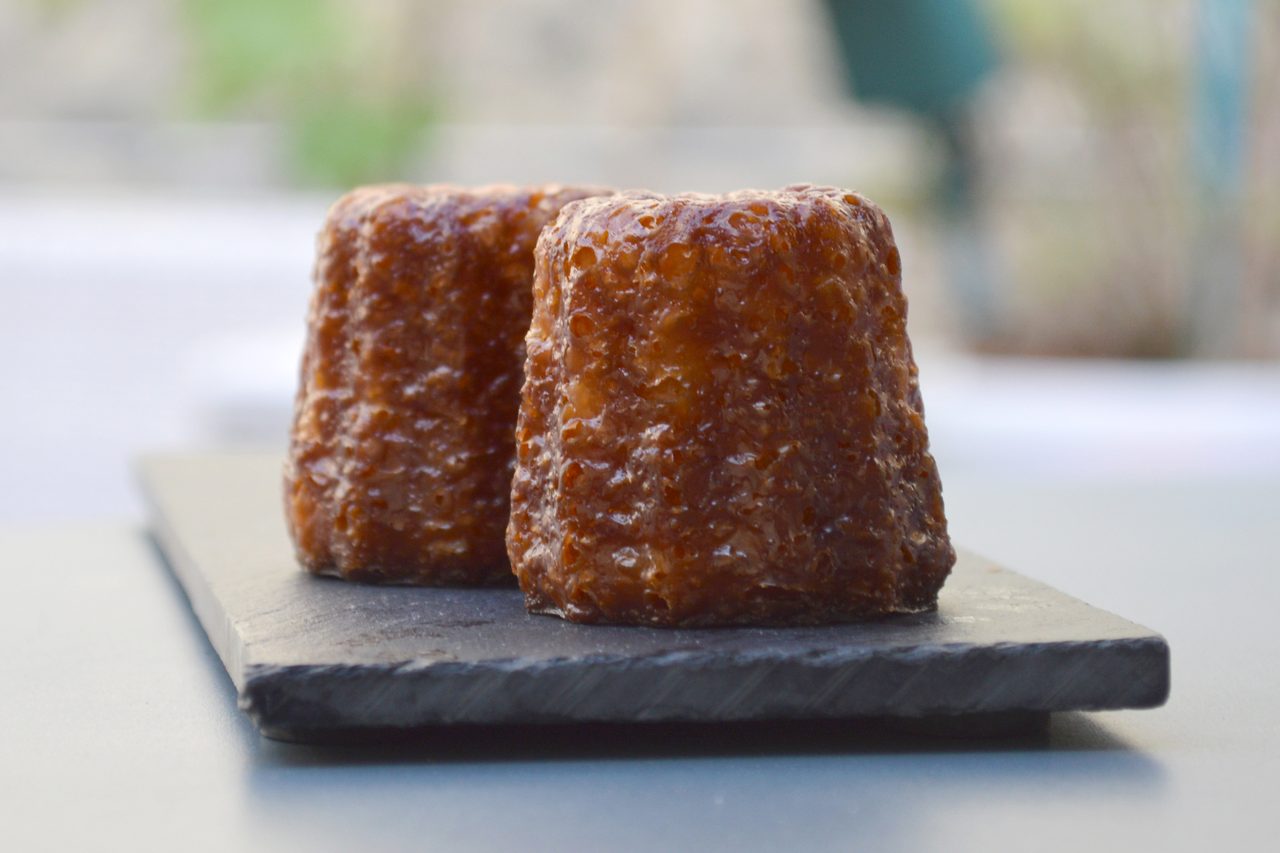
Photo: Arnaud 25 · CC BY-SA 4.0
Kouign-amann (Laminated Cake with Sugar Folded In)
A Breton cake from Douarnenez around 1860 whose name means "bread and butter". Butter is folded into a yeast dough as for a croissant, and in the last two folds sugar goes in with it. Between the layers the sugar draws water out of the dough into a syrup, and in the oven that syrup and the melted butter turn to caramel in the tin and all but fry the outside. So the inside is chewy rather than croissant-light, and the outside shatters like glass.
Ingredients
- Dough
- plain flour300 g
- instant yeast5 g
- salt · 8g if the butter is unsalted5 g
- lukewarm water190 ml
- melted butter20 g
- For folding
- salted butter · cold; Breton demi-sel (lightly salted) butter200 g
- sugar · in two halves180 g
- For the tin
- butter · soft30 g
- sugar30 g
Steps
- ⏲ 60 min
Mix the flour, yeast, salt, water and melted butter and knead 5 minutes. When smooth, cover and leave 1 hour.
- ⏲ 30 min
Press the dough flat, wrap it and chill 30 minutes. Meanwhile beat the cold butter between sheets of baking paper with a rolling pin into a 15cm square.
- ⏲ 5 min
Roll the dough into a 30cm square, lay the butter on it as a diamond, and fold the four corners over to enclose it completely.
- ⏲ 30 min
First fold: roll to a 45x15cm rectangle and fold it in three like a letter. No sugar yet. Wrap and chill 30 minutes.
- ⏲ 10 min
Second fold: roll out again, scatter half the sugar evenly over it and fold in three. From here on, hurry. Rest it only 10 minutes in the fridge.
- ⏲ 5 min
Third fold: roll out, scatter the rest of the sugar and fold in three. When the surface starts to look wet, that is the sugar drawing water out of the dough.
- ⏲ 5 min
Roll to a 25cm square, fold the four corners into the middle, press and round it. Put it in a 23cm metal tin that has been buttered and sugared.
- ⏲ 30 min
Prove at room temperature for 30 minutes only. Longer, and the melted sugar pools in the bottom.
- ⏲ 37 min 30 sec
Bake at 200°C for 35-40 minutes, until the top and edges are deep amber and caramel is bubbling up at the rim of the tin.
- ⏲ 5 min
Take it out and turn it out of the tin onto a rack within 5 minutes. Once the caramel cools it glues the cake to the tin. Cool 20 minutes before cutting.
Tips & Variations
Variations
- Kouignettes: small kouign-amann baked one to a muffin tin. This is the shape most Breton bakeries sell; the same dough is cut into squares and the corners folded in. Being small, more of each one touches the caramel, so they come out crisper.
- With apple: thin slices of apple folded in at the last turn. The apple's water melts the sugar faster, so the proof is shorter again.
- With unsalted butter: if there is no demi-sel butter, use unsalted and raise the salt in the dough to 8g. The salt in the butter is there to hold up the sweetness; without it the cake tastes only of sugar.
Tips
- The butter does what it does in a croissant. Croissant writes that half down: "In the oven that water turns to steam and forces the layers apart, and the fat left behind fries the dough." The butter here does the same. What differs is the sugar that goes in with it in the last two folds.
- Sugar between the layers starts a clock. What sugar does calls one of sugar's jobs "Taking water off something else", with crème caramel's caramel pulling water out of its custard as the example. Here the thing being robbed is the dough. Sugar scattered between the layers draws the dough's water out into a syrup within minutes; the dough slackens and the syrup seeps out at the seams. That is why the sugar goes into the last two folds only, and why there is no room after it for the thirty-minute rest a croissant gets between every fold.
- It is there to join the layers, not to keep them apart. Dough and gluten sums up the ways to protect layers: "Three answers to one problem, then: keep the fat cold, take the water out of the fat, or pick a fat that is stable at room temperature to begin with." All three keep what is between the layers from soaking into the dough. The sugar here goes in to soak into the dough, and in the oven it turns to caramel and sticks neighbouring layers together. So the inside is dense and chewy rather than a croissant's honeycomb. The layers are not there to come apart; they are there to hold the caramel.
- The bottom fries in caramel. Butter running out of the layers meets the sugar in the tin and turns to caramel, and the underside and sides of the dough cook in it. What sugar does says of caramelisation: "Around 160C it breaks down into colour and bitter aromatics." So the end of the bake is judged by colour, not the clock. Stop at deep amber; past it, it is bitter. Use a metal tin, which carries the heat.
- Turn it out hot. The property that guide describes in crème caramel — "Poured in hot, the caramel sets like glass" — is the problem here. Cooled caramel glues the cake into the tin. Turn it out within five minutes, onto a rack rather than a plate: on a plate steam is trapped underneath and softens the caramel.
- Keep the proof short. In the tin the sugar goes on drawing water out of the dough. Proved for long, the syrup pools in the bottom before the dough has risen.
The basics behind this dish
- Eggs: Coagulation Temperatures and What They DecideWhite sets at 62°C, yolk at 68°C. Those two numbers explain scrambled eggs, boiled eggs, steamed custard and crème anglaise all at once.
- Why Sauces Split: Emulsions and Pan SaucesA cream sauce breaking and a carbonara scrambling are the same failure. Temperature and emulsifiers — plus how to bring a split sauce back.
- Knife Skills: Grip, Cuts, and Why Size MattersHow you hold the knife matters more than how fast you cut. The pinch grip, the claw hand, and why uniform size is a cooking decision rather than a cosmetic one.
More of the same kind


More from this country


Sign in to edit.
AI-drafted, editor-reviewed · edits: 0 ·Edit history
https://cookiki.com/en/r/kouign-amann · cookiki · User contributions are licensed under CC BY-SA 4.0.