
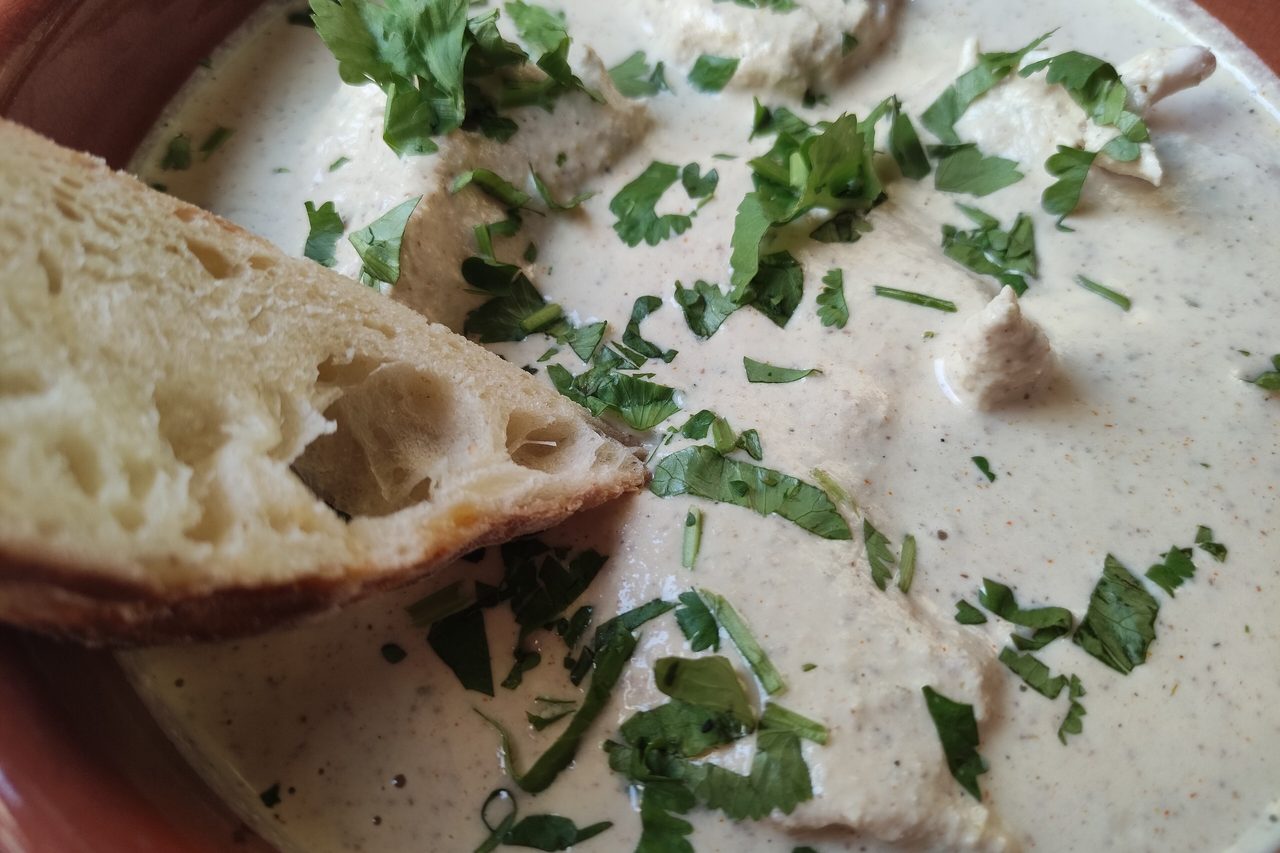
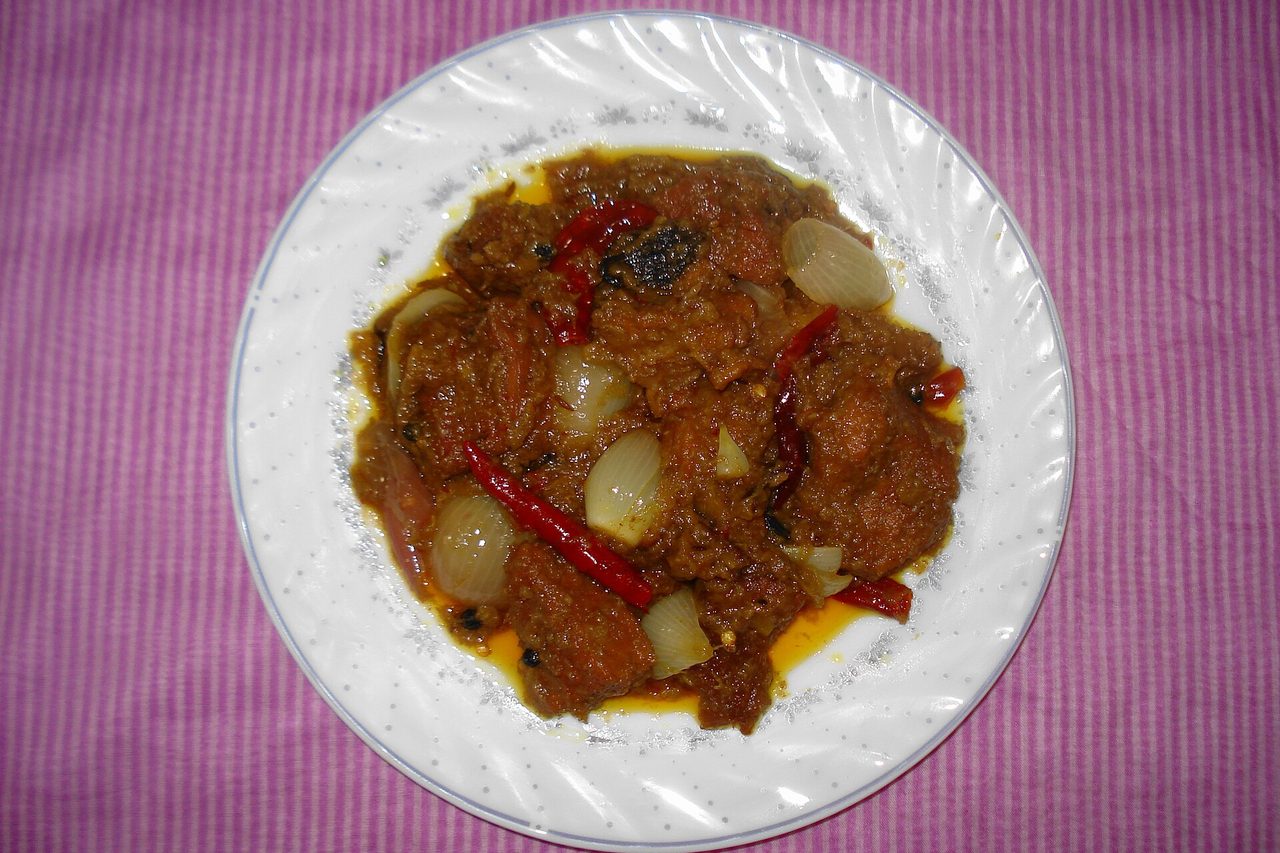
Photo: Romainbehar · CC0
Chakhchoukha (Torn Flatbread with Lamb and Chickpea Sauce)
Algeria's signature dish: paper-thin semolina flatbread torn up by hand and moistened with a red lamb and chickpea sauce. Despite the similar name it has nothing to do with Tunisian shakshuka, and crisping the bread ruins it.
Ingredients
- Rougag (the thin bread)
- Fine semolina · Durum semolina; the basis of the dish300 g
- Plain flour · Helps the sheets hold together as you tear them100 g
- Salt1 tsp
- Warm water · Adjust to your semolina250 ml
- Oil · For your hands and the worktop — be generous
- The sauce (marqa)
- Lamb · Bone-in neck or shoulder600 g
- Onion · Finely chopped1
- Garlic · Minced3 cloves
- Tomato paste · Where the red comes from3 tbsp
- Cooked chickpeas · Not optional200 g
- Olive oil3 tbsp
- Paprika1 tbsp
- Ground cumin1 tsp
- Ground coriander1 tsp
- Ground cinnamon · A little is enough0.25 tsp
- Harissa · Optional, for heat1 tsp
- Water · It needs to stay brothy1.2 L
- Salt · After the meat is tender
- Optional vegetables
- Courgette · In large pieces1
- Carrot · In large pieces1
- Turnip · Used in some regions1
- To finish
- Parsley or coriander · Chopped, scattered over
Steps
- ⏲ 40 min
Make the dough first. Mix the semolina, flour and salt, work in the warm water gradually, and knead 10 minutes to a smooth, quite soft dough. Rest it covered 30 minutes — semolina needs time to take up water. See Dough and gluten.
- ⏲ 12 min
Start the sauce. Brown the lamb in the olive oil, then add the onion and garlic and fry 5 minutes.
- ⏲ 3 min
Add the tomato paste and all of the paprika, cumin, coriander, cinnamon and harissa and fry 2–3 minutes. Ground spices open up in hot fat — see Blooming spices.
- ⏲ 70 min
Pour in the 1.2L of water, cover, and simmer on low for 60–75 minutes until the lamb falls off the bone — see Braising: collagen and time.
- ⏲ 20 min
In the last 20 minutes add the chickpeas and, if using, the courgette, carrot and turnip. Salt it once the vegetables are done — after the liquid has reduced, not before. See Salt and seasoning.
- ⏲ 30 min
Make the bread. Divide the dough into balls the size of a ping-pong ball and oil your hands and the worktop generously. Forget the rolling pin: press and push each ball out with your palms until it is paper-thin. Getting it thin is the whole skill of the dish.
- ⏲ 15 min
Heat a dry pan over medium and cook each sheet for 30–60 seconds a side — just set, lightly spotted. Never let it crisp: it should bend rather than snap when folded.
- ⏲ 15 min
Stack the cooked sheets, let them cool a little, then tear them by hand into 1–2cm pieces. Do not cut them with a knife — ragged pieces hold sauce far better, and that tearing is where the dish's name comes from.
- ⏲ 10 min
Put the torn bread in a wide bowl and ladle the hot broth over it a little at a time, folding gently. The pieces should swell and soften while keeping their shape; poured on all at once it turns to porridge. (Steaming it 5–10 minutes over the pot works too.)
- ⏲ 4 min
Heap the moistened bread on a serving plate and spoon the sauce, chickpeas and lamb over it. Scatter parsley, and serve the remaining broth separately so everyone can add more.
Tips & Variations
Variations
- Biskra style vs M'sila style: Biskra tears the bread finer and keeps the sauce concentrated; M'sila leaves the pieces larger and sends a generous bowl of broth round separately. This recipe leans Biskra.
- Without meat: a vegetarian version with plenty of chickpeas and vegetables is common. The spice blend is unchanged, so the structure holds.
- Buying the bread: Algerian grocers sometimes sell rougag (or trid). Failing that, a very thin unleavened flatbread will do — avoid thick breads, which disintegrate when moistened.
- Can you use a rolling pin? If it gets thin enough, yes. Semolina dough stretches thinner by hand though, and tears less.
- The dish with the confusing name: Tunisian shakshuka is eggs cooked in tomato sauce — an entirely different dish. The spellings and pronunciations are close enough to be mixed up constantly, and the name is all they share.
- The North African neighbours: Moroccan couscous and tagine and Libyan bazin belong to the same family. What changes is the form the grain takes — separate grains, a mass of dough, or torn bread.
- Beyond Algeria: Tunisia and Libya have similar dishes, but chakhchoukha is best known as Algerian.
Tips
- Do not let the bread crisp. This is the most common failure. Crisp sheets shatter and turn to paste the moment they meet the broth. Thirty to sixty seconds a side, stopping while it still folds without breaking.
- Oil your hands and the worktop generously. Flour dries the dough out and it tears. Semolina dough has to be handled with oil to stretch thin.
- Keep the dough soft. A stiff dough will not go thin. It should feel slightly tacky, and it becomes much easier to handle after the 30-minute rest.
- Tear it by hand. Neat knife-cut squares let the sauce run off the surfaces. Torn edges catch and hold it.
- Add the broth a ladle at a time. Poured on all at once there is no way back. Watch the pieces swell and keep adding.
- Make plenty of broth. Torn bread drinks a great deal of it. Aim for something brothy rather than a thick stew, and send the remainder round separately.
- Serve it immediately. Left standing, the bread absorbs everything and sets into a solid mass. Moisten it at the last moment.
- Balance the sauce with acid. Tomato and paprika make it rich and easily heavy. A lemon wedge alongside lightens it considerably — see Balancing flavour.
The basics behind this dish
- Browning and the Maillard ReactionMeat fails to brown for one of three reasons: it is wet, the pan is cool, or you put too much in at once. Plus how the brown film stuck to the pan becomes your sauce.
- Cooking Meat: Temperature, Resting, and Cutting Against the GrainDoneness is a core temperature, not a number of minutes. What resting actually does, how to handle a thick cut, and why the direction you slice changes the texture.
- Knife Skills: Grip, Cuts, and Why Size MattersHow you hold the knife matters more than how fast you cut. The pinch grip, the claw hand, and why uniform size is a cooking decision rather than a cosmetic one.
More of the same kind


Sign in to edit.
AI-drafted, editor-reviewed · edits: 0 ·Edit history
https://cookiki.com/en/r/chakhchoukha · cookiki · User contributions are licensed under CC BY-SA 4.0.