
Photo: stringparts · CC BY 2.0
Fesenjan (Walnut and Pomegranate Stew)
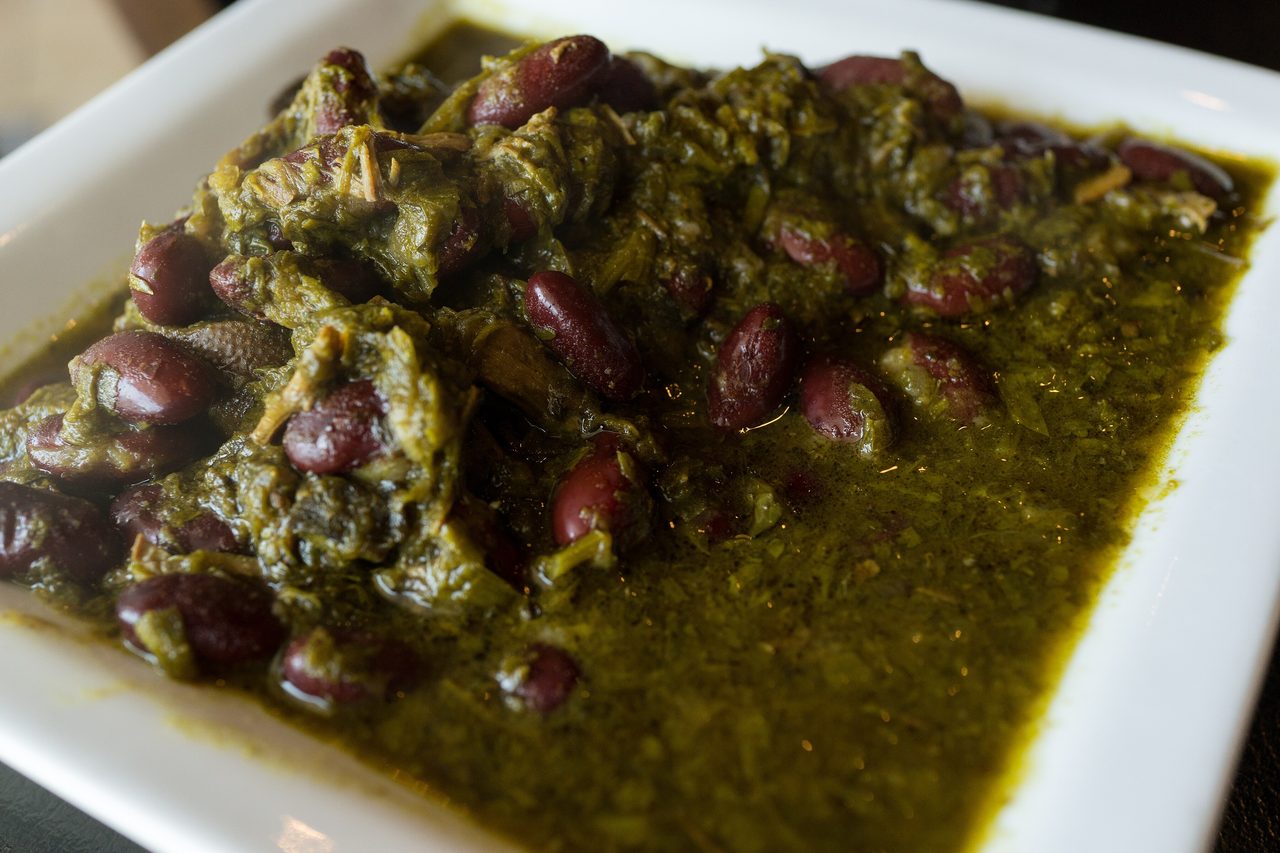
An Iranian stew that takes both its body and its sourness from two things: finely ground walnuts and pomegranate molasses. No flour, no starch. Over two or three hours the walnuts break down completely and thicken the pot themselves, and it is finished when their own oil rises dark on the surface. The colour moving from pale beige to nearly black is the cooking.
Ingredients
- Stew
- shelled walnuts · raw; all the body of this dish comes from them300 g
- chicken thighs · bone-in is good; duck is the grandest traditional version800 g
- onion · finely chopped1
- oil3 tbsp
- turmeric1 tsp
- water700 ml
- Sour and sweet
- pomegranate molasses · rob-e anar; the traditional kind is sour, not sweetened150 ml
- sugar · to taste; the north barely uses any2 tbsp
- salt1.5 tsp
- pepper0.5 tsp
- saffron · optional, steeped in 2 tbsp hot water and added at the end1 pinch
- To serve
- pomegranate seeds · optional3 tbsp
Steps
- ⏲ 5 min
Toast the walnuts in a dry pan over medium-low heat for 5 minutes. Stop before they colour — scorch them even slightly and the bitterness that comes out will not cook away in three hours.
Cool them completely, then grind them very fine in a processor: past wet sand and almost to a paste, with no grains left. How fine you grind them is the thickness of the dish — ground coarse, the stew stays thin and feels gritty.
- ⏲ 10 min
Soften the onion in oil for 10 minutes, then add the turmeric and cook 30 seconds more (blooming spices).
Brown the chicken in the same pot, season with salt and pepper, and lift it out.
Put the ground walnuts in the pot and loosen them with a little of the water until smooth, then add the rest.
- ⏲ 90 min
Half-cover and simmer very gently for 1 hour 30 minutes. It starts pale beige and thin; as the walnuts collapse the colour deepens and the liquid begins to cling. Scrape the base and stir every ten minutes — one patch of walnut caught on the bottom makes the whole pot bitter.
- ⏲ 60 min
Add the pomegranate molasses, the sugar and the chicken, and simmer 1 hour more. Added at the very start, the sourness reduces to something sharp over that long a cook.
Taste and balance the sour against the sweet (balancing flavour). Stir in the saffron now if you are using it.
It is done when the walnut oil rises dark red on the surface. The colour will have gone through deep brown to nearly black. Scatter pomegranate seeds over and serve with plain rice.
Tips & Variations
Variations
- It thickens with neither starch nor roux. Thickening a sauce lists three methods — starch, roux and reduction — and adds collagen as "the fourth method". Fesenjan is a fifth that is not on that list: finely ground nuts. Over a long simmer the walnuts' cell walls break down, their oil and fine particles disperse through the liquid and emulsify, and that is the body. Which is why how finely you grind them is part of the recipe rather than a preference.
- The sign that it is done is also different. When oil rises on a curry, that is added fat separating. What rises here is the walnuts' own oil — which is the evidence that the nuts have broken down completely.
- Pomegranate molasses does a different job here than elsewhere on this site. In baba ganoush, fattoush, tabbouleh and kibbeh it is a dressing spooned over at the end; in fesenjan it goes in as the backbone of the sauce. Buy the sour, unsweetened kind — it is better to add the sweetness yourself.
- North and south disagree. Gilan and Mazandaran barely sweeten it and it comes out frankly sour; Tehran and the south take it sweeter. Neither is the correct one.
- Meat: chicken thigh is the everyday version and duck is the grandest. Small meatballs are common, and a vegetarian version uses squash or aubergine.
- With ghormeh sabzi it makes the two poles of Iranian khoresh. That one fries herbs for twenty-five minutes, this one simmers nuts for two hours — both take one ingredient and work it long enough to change the whole pot.
- Against the peanut sauce in satay: both grind nuts into a sauce, but that one is simmered briefly with coconut milk and keeps its grain, while this is cooked until no grain is left at all.
Tips
- Do not scorch the walnuts. The light toasting is for aroma, not colour. Once they start to brown it is already too late, and nothing added later covers that bitterness. If in doubt, skip the toasting and use them raw.
- Grind them fine. Finer than that. This is what most often goes wrong. Do not pulse a few times and stop — scrape the sides down and keep going until it is a paste.
- Stir every ten minutes. Ground walnut is heavy, it settles, and what settles scorches. A thick-based pot helps a great deal.
- Keep the heat low. At a hard boil the walnut oil separates out early and the sauce splits. Aim for a surface that barely moves.
- Pomegranate molasses goes in partway, not at the start. Three hours of reducing makes the sourness sharp and the colour muddy.
- Balance the sweetness at the end. Brands differ enormously in sourness, so the sugar quantity is a starting point. Add a tablespoon at a time and taste.
- If it is thin, simmer it uncovered. Do not add starch — the moment you do it stops being this dish.
- It is better the next day, once the walnut oil and the pomegranate settle. Plenty of Iranian households make it a day ahead.
- Serve it with plain white rice. It is rich, sour and sweet all at once, and it needs something that tastes of nothing beside it.
The basics behind this dish
- Thickening a Sauce: Starch, Roux, and ReductionSlurry, roux, reduction — three methods that do not give the same result. Why a starch-thickened sauce thins on reheating, and why the slurry has to be mixed cold.
- Browning and the Maillard ReactionMeat fails to brown for one of three reasons: it is wet, the pan is cool, or you put too much in at once. Plus how the brown film stuck to the pan becomes your sauce.
- Cooking Meat: Temperature, Resting, and Cutting Against the GrainDoneness is a core temperature, not a number of minutes. What resting actually does, how to handle a thick cut, and why the direction you slice changes the texture.
More of the same kind


More from this country


Sign in to edit.
AI-drafted, editor-reviewed · edits: 0 ·Edit history
https://cookiki.com/en/r/fesenjan · cookiki · User contributions are licensed under CC BY-SA 4.0.