
Photo: 최광모 · CC BY-SA 4.0
Dotori-muk (Acorn Starch Jelly)
Acorn starch whisked into water, boiled and left to set. With only two ingredients the ratio is the recipe, and almost every failure is undercooking: it thickens and looks finished, but it needs another ten minutes after that or the set jelly weeps water. And once made it does not go in the fridge, which is the instruction people most often get the wrong way round.
Ingredients
- Serves 4 (one 18cm square mould)
- The jelly
- acorn starch powder100 g
- water · six times the weight of the starch; weigh it600 ml
- salt · goes in while it cooks0.5 tsp
- vegetable oil · gives a glossy surface and helps it leave the mould1 tsp
- Dressing
- soy sauce3 tbsp
- gochugaru1 tbsp
- garlic · minced1 tsp
- spring onion · chopped2 tbsp
- sesame oil1 tbsp
- sesame seeds1 tbsp
- sugar1 tsp
- To dress it with
- lettuce · torn by hand5 leaves
- cucumber · sliced on the diagonal0.5
- onion · sliced thin, soaked in cold water and drained0.25
Steps
- ⏲ 30 min
Whisk the acorn starch into 600ml of cold water until completely smooth and leave it 30 minutes. Lumps that go into the pan set as hard nodules and stay that way.
- ⏲ 10 min
Stir the settled starch back through and put the pan on from cold. Over a medium heat, stirring without stopping with a wooden spoon, cook 10 minutes. The cloudy liquid turns translucent and thickens; stop stirring and it catches on the bottom, and scorched flecks do not come out.
- ⏲ 10 min
Do not stop here. Add the salt and oil, turn the heat low and cook 10 minutes more. Big bubbles rising slowly and bursting with a plop, a spoon-line across the base that holds for a second, and the mixture starting to leave the sides are the signs. Skip these ten minutes and the set jelly weeps water.
Pour into a square mould rinsed with water and level the top. Leave it uncovered so the steam can go.
- ⏲ 180 min
Let it set 3 hours at room temperature. Do not put it in the fridge — jelly set cold turns firm and crumbly and pushes water out of itself.
Mix the dressing. Soak the sliced onion in cold water to take its bite off and drain it, tear the lettuce by hand and slice the cucumber on the diagonal.
Turn the jelly out and cut it 1.5cm thick with a wet knife. A dry blade tears the faces, and thin slices break apart when dressed.
Once everything else is ready, pour the dressing over the jelly and vegetables and fold two or three times, lifting from underneath. Dressed early, the salt draws water out of the jelly and it pools in the dish.
Tips & Variations
Variations
- Muk-muchim: the version here, dressed with lettuce, cucumber and onion. A tablespoon of vinegar pushes it further towards a summer side dish.
- Muk-sabal / muk-bap: sliced jelly in cold anchovy broth or kimchi liquid with seaweed flakes and cucumber. It is the best thing to do with leftovers, and in Gangwon it is a meal in itself.
- Fried or stir-fried: a day-old block is too firm to dress well. Pan-fried in oil, or stir-fried with kimchi, it comes back (reviving leftovers).
- Muk-mallaengi: sliced and dried. Rehydrated and fried it turns chewy, and it is the only form that keeps for any length of time.
- The other muks: cheongpo-muk from mung bean (clear and mild, dressed as tangpyeongchae) and memil-muk from buckwheat (darker and stronger, usually served in broth). All three work the same way — one starch, water, and enough cooking.
- Starting from actual acorns means grinding them and leaching the tannins over several days with changes of water, then drying the settled starch. Bought acorn powder has been through that, which is why starting there is standard (soaking).
- What goes beside it: kongnamul muchim, sigeumchi namul, dubu jorim, kimchi.
- Summer company: naengmyeon, kongguksu. As drinking food it sits with golbaengi muchim and gamja jeon.
Tips
- The ratio is the recipe. One part starch to six parts water by weight; at five it is firm, at seven it barely sets. Starch content varies by brand, so follow the bag when it gives a ratio — but weigh it rather than measuring by cup.
- Undercooking is the one common failure. The point where it thickens is where gelatinisation is only beginning, not where it is finished. Ten more minutes on a low heat after that is what stops the set jelly weeping. Big slow bubbles bursting is the signal (thickening sauces).
- Mix into cold water and start from cold. Powder tipped into hot water cooks on contact into lumps that will not disperse however long you stir.
- Stir the entire time. Starch is heavy and settles, and starch that cooks where it settled welds to the pan. One scorched patch leaves bitterness and black specks through the whole batch.
- Do not refrigerate it. This is the instruction most often reversed. Cold speeds up retrogradation, the starch network rearranges more coarsely, and water is pushed out of it. Set it at room temperature, eat it at room temperature, and keep leftovers somewhere cool rather than cold (serving temperature, freezing and thawing).
- Freezing makes it a different substance. Frozen and thawed, it turns spongy and full of holes and sheds its water. There is no way back from that.
- Salt goes in while it cooks. You cannot season set jelly. The dressing covers it, but there is a difference between jelly with a little salt in it and none (salt and seasoning).
- Wet the knife. A dry blade drags and tears the cut faces; rinsing between cuts keeps them clean. Cut at least 1.5cm thick — thin slices fall apart while being dressed.
- Dress it in the last thirty seconds. Salt in the dressing pulls water out of the jelly, so dressed early it pools in the dish and the dressing thins. Two or three folds, no more.
- Soak the onion. Cold water takes the raw heat out and leaves the crunch. The jelly itself is so mild that raw onion overruns it (balancing flavour).
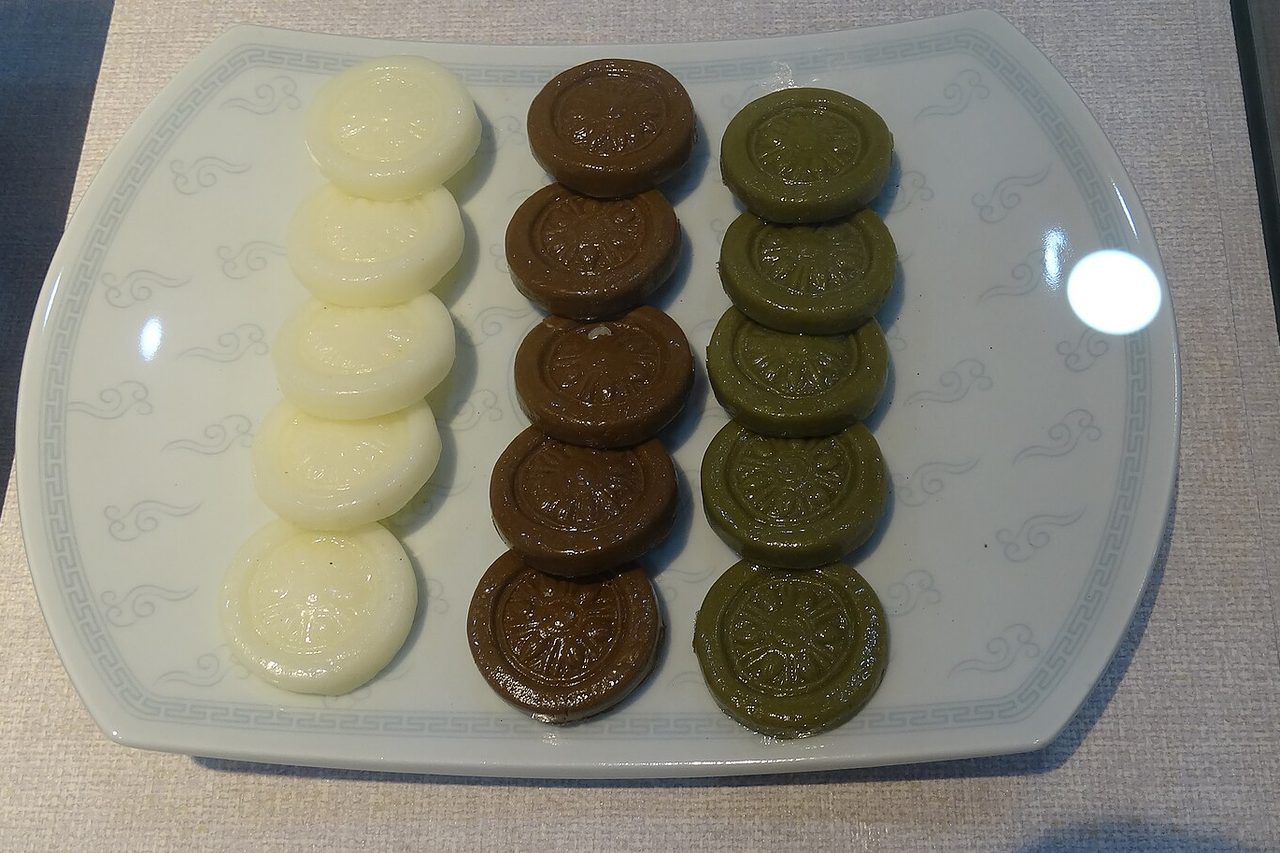
- Translucent is what good looks like. Properly cooked acorn jelly is closer to amber than to dark brown, and light passes through it. Opaque and very dark usually means a high starch ratio or added colour.
- Keep the dressing restrained. The jelly has almost no flavour of its own, so the dressing is the taste of the dish — but make it strong and there is no reason to be eating jelly. Three parts soy to one of gochugaru is the reference (chilli and heat).
The basics behind this dish
- Blanching: Keeping Vegetables GreenBlanched vegetables go dull because of acid and heat. Why the pot should be large, why the lid stays off, and what the ice bath is really for.
- Salt: When You Add It Matters More Than How MuchThe same amount of salt either draws water out or seasons all the way through, depending on when it goes in. Osmosis, seasoning in layers, and why salt types are not interchangeable by volume.
- Knife Skills: Grip, Cuts, and Why Size MattersHow you hold the knife matters more than how fast you cut. The pinch grip, the claw hand, and why uniform size is a cooking decision rather than a cosmetic one.
More of the same kind


More from this country


Sign in to edit.
AI-drafted, editor-reviewed · edits: 0 ·Edit history
https://cookiki.com/en/r/dotori-muk · cookiki · User contributions are licensed under CC BY-SA 4.0.