
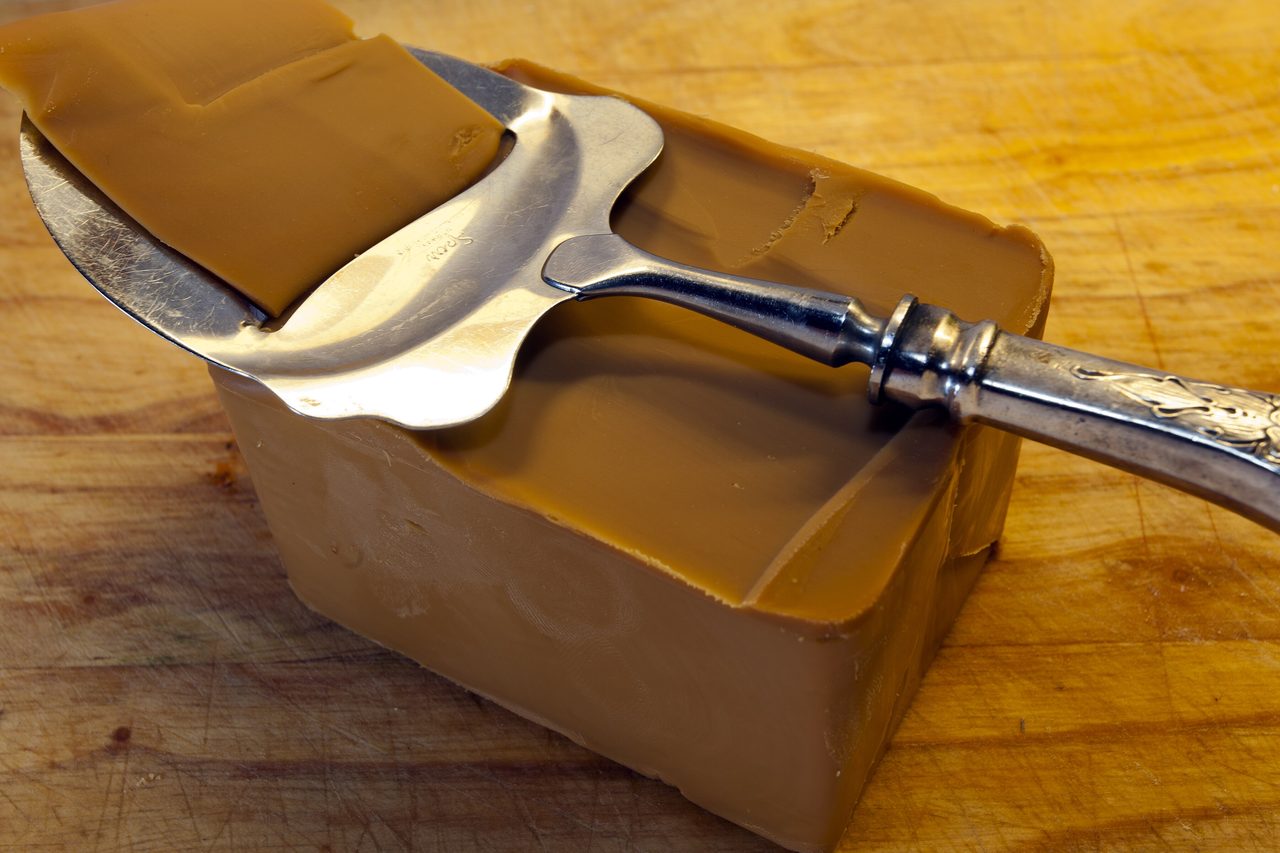
Photo: Turaids · CC BY-SA 4.0
Jāņu Siers (Caraway Curd Cheese Pressed into a Round)
One of Latvia's national dishes, and the one that does something this site has twice said cannot be done. The mozzarella page explains that acid strips the calcium out of casein and leaves a grainy curd, which is why such a curd can never be made to flow; the saganaki page counts a cheese that does not melt at all as a fourth case. Jāņu siers takes that same acid-set curd and makes it into a smooth flowing mass anyway. It does it by adding two things: bicarbonate of soda, which undoes enough of the acid for the casein to take up water and turn plastic, and egg, which binds it. Stir in caraway, press it hot, and it cools into a round you can slice.
Ingredients
- The cheese (one 15cm round, serves 8)
- fresh curd cheese · biezpiens: acid-set fresh cheese. Cottage cheese, quark or ricotta stand in1 kg
- milk · to heat the curd in and drive the whey out1 L
- butter60 g
- bicarbonate of soda · about 5g. The key ingredient here; leave it out and nothing flows1 tsp
- eggs · beaten2
- caraway seeds · about 12g, left whole2 tbsp
- salt1.5 tsp
- Optional
- dried dill · scattered over the top1 tsp
- To serve
- rye bread8 slices
Steps
- ⏲ 10 min
Heat the milk in a pan over low heat to about 80°C. Do not let it boil. Crumble in the curd cheese and stir often for 10 minutes, until clear whey separates out.
- ⏲ 15 min
Pour it into a cloth-lined sieve, throw the whey away, then gather the cloth and squeeze it for 15 minutes to drain. What is left is a grainy white mass — and in that state no amount of heat will make it flow. It is exactly the curd the mozzarella page describes.
- ⏲ 5 min
Wipe the pan, melt the butter, add the drained curd and scatter the bicarbonate over it. Keep stirring over low heat and inside four or five minutes it visibly changes: what was loose grains turns glossy and stringy and pulls together as one mass. The soda undoes enough of the acid for the casein to take up water and turn plastic (dairy and heat).
- ⏲ 4 min
Turn the heat right down, add the beaten egg and the salt, and stir in one direction for 3-4 minutes without stopping. Stop stirring here and the egg sets in lumps. It is ready when the mass thickens and starts pulling away from the sides.
- ⏲ 1 min
Off the heat, stir the caraway through. Leave the seeds whole — ground, the aroma spreads through the whole cheese, and the point of this one is the seeds bursting one at a time as you chew.
- ⏲ 5 min
Pour it while still hot into a cloth-lined sieve or a perforated mould, fold the cloth over the top, and press with a plate and a weight. Pressed while it is still plastic it knits into one block. Cold it will not knit at all.
Cool an hour at room temperature, then refrigerate at least four hours, and overnight is better. What sets it is the casein and the egg protein cooling together.
- ⏲ 3 min
Turn it out, peel off the cloth and scatter the dill over. Slice about 1cm thick and serve with rye bread.
Tips & Variations
Variations
- It is solstice food. Jāņi is Latvia's midsummer festival on 23-24 June, and this cheese is its emblem; the round shape is commonly explained as the sun. Nothing in it is seasonal, though, so it can be made any time and Latvian shops sell it all year. It has held an EU Traditional Speciality Guaranteed designation since 2015.
- The opposite direction from saganaki: that dish also takes a cheese that will not flow and uses it as it is, browning the outside while the inside stays a sliceable slab — but it will not flow for a different reason. Kefalotyri and graviera are low in moisture with a tightly knit casein network; this curd is acid-set, with no calcium bridging left to loosen. Two routes to the same refusal, and this one undoes it with soda. One exploits the property; the other reverses it.
- Against douhua and rasgulla: this site has three ways to set milk — acid, a calcium salt, and rennet. This page is not a fourth method but the sequel to the first one: what you can still do with a curd that acid has already set.
- Emulsifying salts of the kind used for processed cheese give a smoother result than soda, on the same principle: raise the pH and the casein disperses. That is how sliced cheese is made.
- Leave the egg out and you still get a flowing mass, but it never knits properly on cooling and crumbles instead. Germany's Kochkäse and Handkäse sit close to that state.
- Other seasonings: caraway is standard, but dill seed, cumin and peppercorns are all used. Sweet versions take sugar and raisins.
- To serve: rye bread and butter, and at midsummer, beer. It is also put out beside potatoes as a side dish.
Tips
- Do not leave out or cut the soda. Here it is chemistry rather than flavour. Without it the curd stays as loose grains however long you stir.
- Drain the curd properly. Any whey left behind runs out under the weight and cracks the set round afterwards. The test is squeezing the cloth until nothing more comes.
- Never let it boil after the egg goes in. Two of the three causes the dairy guide gives — boiling, and salt plus prolonged heat — apply at once here (dairy and heat).
- Press it hot. The same reason pyeonyuk is pressed hot, so its gelatine can spread between the fibres. Only the setting agent differs.
- A day makes a real difference. Four hours is enough to slice, but overnight lets the caraway carry through the whole cheese and the flavour settle.
The basics behind this dish
- Dairy and Heat: Why Cream Splits and Butter BurnsThe temperature butter burns at, the conditions that split cream, the order yoghurt goes in. Dairy fails under heat in a small number of specific ways, so avoiding them is specific too.
- Deep Frying: Temperature, Batter, and the Second FryFrying is not cooking in oil so much as trading the food's water for it. Two temperatures, what each kind of coating is for, and why the second fry exists.
- Heat Control: Preheating, Oil, and Reading the PanThe same ingredients become a different dish depending on pan temperature. When to add the oil, how to read heat by sound, and which dishes want low heat instead.
More of the same kind


Sign in to edit.
AI-drafted, editor-reviewed · edits: 0 ·Edit history
https://cookiki.com/en/r/janu-siers · cookiki · User contributions are licensed under CC BY-SA 4.0.