
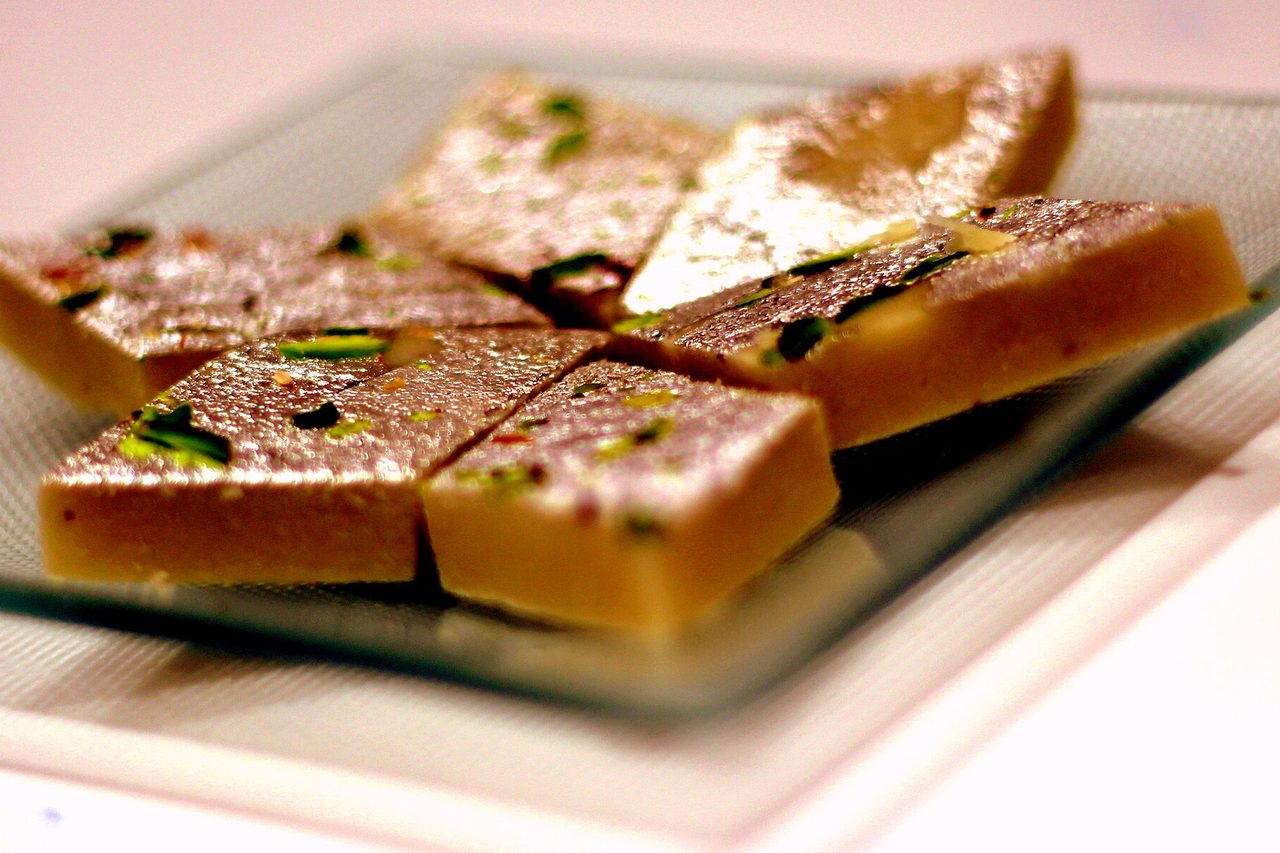
Photo: Nupur Das Gupta · CC BY 2.0
Rasgulla (Chhena Balls Boiled in Syrup)
An eastern Indian sweet: milk curdled with acid, the fresh curd kneaded into balls and boiled in a thin sugar syrup. Almost everywhere else on this site curdling is the failure you are trying to avoid; here it is step one. Acid is what gives you a curd to lift out and shape at all. And unlike almost every other syrup sweet the balls are not soaked but cooked in the syrup, which is what makes them swell to double and take it right through.
Ingredients
- Chhena (fresh curd)
- whole milk · full fat. Low-fat sets too softly, and UHT milk does not gather properly2 L
- lemon juice · or vinegar; dilute with the same amount of water3 tbsp
- iced water · for rinsing; it stops the curdling dead1 L
- Syrup
- sugar400 g
- water · it must stay thin; thick syrup cannot get in1.5 L
- green cardamom pods · lightly crushed4
- rose water · optional, off the heat1 tsp
Steps
- ⏲ 1 min
Heat the milk to just below boiling, take it off the heat the moment it rises, and let it stand a minute. Acid poured into furiously boiling milk curdles it coarsely and the curd comes out rubbery.
Add the diluted lemon juice a little at a time, stirring slowly. The instant the whey runs clear and pale green, stop. More acid than that toughens the curd, and what is left over shows up later as sourness. Acid leaves you a curd you can lift out and shape; a calcium salt, as in douhua, leaves a gel with nothing to lift (dairy and heat).
Pour it into a muslin-lined sieve and rinse it well with iced water. This washes out the lemon taste and any acid still working; skip it and the finished sweets taste sour. The cold also stops the curdling dead.
- ⏲ 30 min
Tie the muslin and hang it to drain for 30 minutes. This is the fork in the road — too dry and the dough cracks, too wet and the balls disintegrate in the syrup. Squeezed in the hand it should hold together without weeping water.
- ⏲ 10 min
Tip the curd onto a wide plate and knead it with the heel of your hand for 8-10 minutes, pushing rather than folding. It is ready when the graininess is gone, the mass is smooth, and your palm feels greasy. This is where the dish is won or lost — under-kneaded curd always cracks.
Divide into 12 and roll each one smooth, with no cracks at all. A hairline on the surface is exactly where it will burst in the pot. Roll between the palms until the seam disappears.
Bring the sugar, water and cardamom to the boil in a wide, deep pan. Do not reduce it to thread stage — thin syrup is what gets in (what sugar does).
- ⏲ 15 min
Drop the balls into the boiling syrup, cover, and boil hard for 15 minutes. They are cooked in the syrup, not soaked in it. They double in size, so the pan needs room, and as the syrup reduces add splashes of hot water to keep it thin.
Test one by dropping it into cold water. If it sinks it is done; if it floats, give them a few more minutes. Pressed, it should spring back like a sponge.
- ⏲ 120 min
Turn off the heat, add the rose water, and let them cool completely in the syrup. The syrup goes right through as they cool, so that time is part of the cooking. Chill at least 2 hours and serve cold (serving temperature).
Tips & Variations
Variations
- Rosogolla / Rasagola: rosogolla in Bengali, rasagola in Odia. West Bengal and Odisha argued over its origin for years, and it was settled by both winning Indian geographical indications — Banglar Rosogolla for West Bengal in 2017 and Odisha Rasagola in 2019. Both claims sit inside India.
- Rasmalai: the same chhena balls, steeped in reduced milk instead of syrup. Heavier and richer.
- Komola rosogolla: a Bengali winter version flavoured with orange juice and zest.
- Nolen gur rosogolla: made in Odisha and Bengal with date-palm jaggery, which turns them brown.
- The same starting point as palak paneer: paneer is also milk curdled with acid. Everything after that differs — paneer is pressed hard into a firm block, while chhena is never pressed but kneaded soft. You cannot make these from pressed paneer.
- Exactly the reverse of baklava: the syrup rule runs the other way. Baklava needs the pastry to absorb as little as possible so the layers stay crisp, which is why only one of the two is hot; here the point is to absorb as much as possible, so the balls are boiled in the syrup outright. Same physics, opposite objective.
- And tanghulu: the same sugar and water, opposite goals. That one is driven to 155°C to remove all the water and set like glass; this one is kept thin from beginning to end.
Tips
- This is the one dish that curdles milk on purpose. Everywhere else on this site, milk splitting under acid or salt is the accident you reorder your steps to avoid (dairy and heat). Here that accident is step one.
- Use whole milk. Low fat gives a soft curd that will not gather. UHT milk has already been through high heat, so it tends to set loose and grainy — gently pasteurised milk works better.
- Do not pour the acid into boiling milk. At a full boil the curd seizes coarse and hard. A minute off the heat gives a far softer mass.
- Do not use all the acid. The moment the whey runs clear is the signal. Lemon juice added after that only toughens the curd.
- Never skip the cold rinse. This step decides whether the finished sweets taste sour. Iced water is better still, because it stops the curdling immediately.
- The moisture is the fork in the road. Too dry and the dough cracks; too wet and the balls dissolve. Thirty minutes hanging is the benchmark, and if squeezing it makes water run, drain it longer.
- The kneading is the whole thing. Eight to ten minutes, pushing with the heel of the hand, until the graininess is gone and your palm feels greasy. Skimp here and nothing later can save it.
- A crack means a burst. Look at each ball before it goes in; if you can see a hairline, roll it again.
- Keep the syrup thin. A rasgulla is supposed to drink its syrup. Let it reduce and thicken and absorption stops: the outside turns sweet while the inside stays dense. Add hot water as it boils (what sugar does).
- Boil them, do not soak them. This is the reverse of most syrup sweets. The balls expand in the boiling syrup and the syrup follows into the space that opens up. A crowded pan leaves them no room and they come out squashed flat.
- The cold-water test. A cooked one sinks. If it floats, it needs longer.
- The cooling is part of the cooking. Lift them out hot and the middle never takes up the syrup. Cool them in the pan and chill them there. They are better the next day than on the day.
The basics behind this dish
- Stocks and Broths: Clarity, Time, and Why You Do Not Salt ThemWhat separates a clear stock from a cloudy one is temperature, not ingredients. Why you start in cold water, how long each ingredient wants, and why salt comes later.
- Blanching: Keeping Vegetables GreenBlanched vegetables go dull because of acid and heat. Why the pot should be large, why the lid stays off, and what the ice bath is really for.
- Dairy and Heat: Why Cream Splits and Butter BurnsThe temperature butter burns at, the conditions that split cream, the order yoghurt goes in. Dairy fails under heat in a small number of specific ways, so avoiding them is specific too.
More of the same kind


More from this country


Sign in to edit.
AI-drafted, editor-reviewed · edits: 0 ·Edit history
https://cookiki.com/en/r/rasgulla · cookiki · User contributions are licensed under CC BY-SA 4.0.