
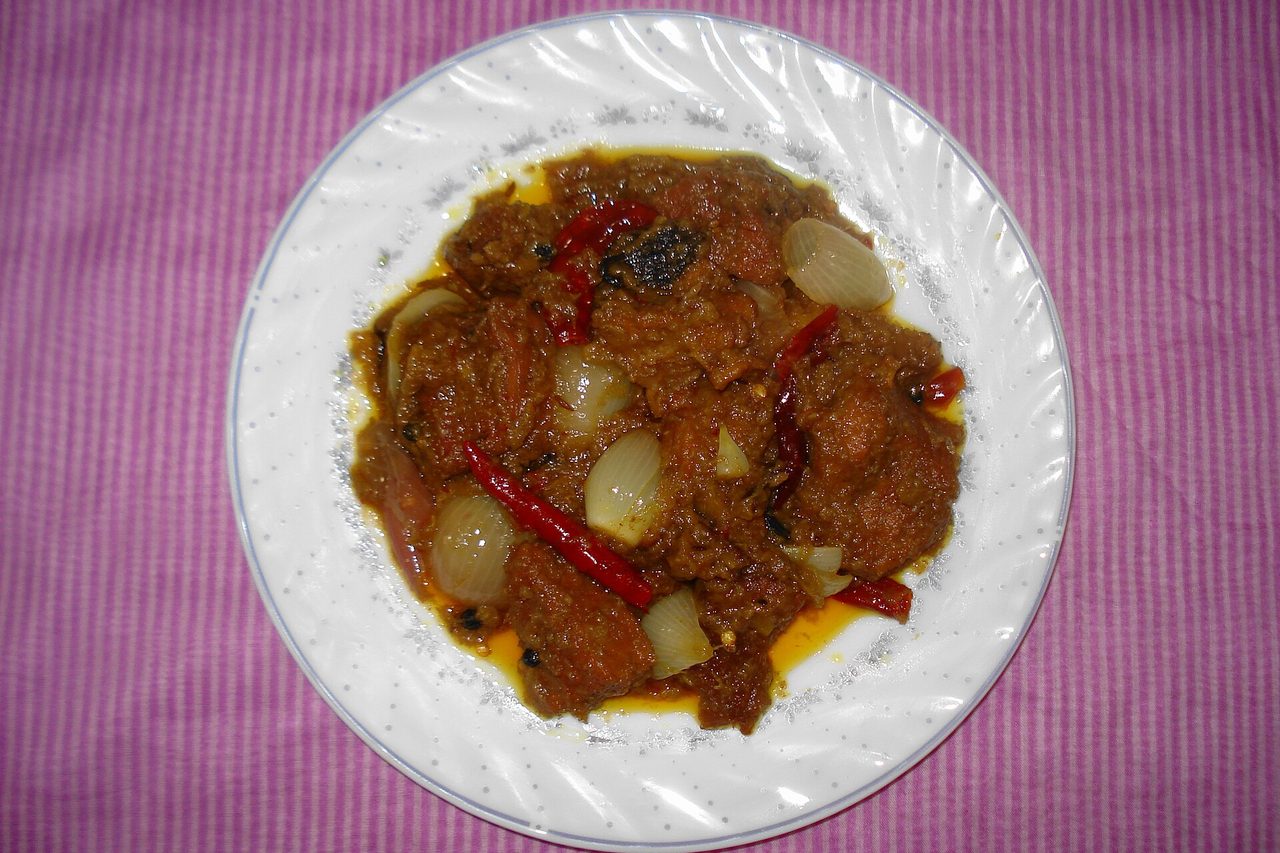
Photo: 赤猫法師 · CC BY-SA 4.0
Nihari (Slow-Cooked Beef Stew)
Pakistan's national dish: bone-in beef shank and marrow bones simmered five hours with a fennel-heavy spice blend, then thickened with a wheat-flour slurry. Melted collagen and marrow give it a broth that clings to your lips — and in Pakistan it's breakfast, eaten with naan before dawn.
Ingredients
- Beef shank · bone-in, in large pieces1 kg
- Marrow bones · the heart of the broth2 pieces
- Ghee or oil120 ml
- Onions · thinly sliced2
- Garlic paste1 tbsp
- Ginger paste1 tbsp
- Whole wheat flour · for body, slurried in water4 tbsp
- Water2 L
- Salt · to taste
- Nihari masala (or 3 tbsp store-bought)
- Fennel seeds · the signature aroma of nihari2 tbsp
- Coriander seeds1 tbsp
- Cumin1 tsp
- Black cardamom2 pods
- Green cardamom4 pods
- Cinnamon stick1 piece
- Cloves6
- Black peppercorns1 tsp
- Mace and nutmeg · ½ tsp and ¼ tsp
- Ground dried ginger1 tsp
- Kashmiri chili powder1 tbsp
- Turmeric1 tsp
- Garnish (don't skip it)
- Ginger · finely julienned, generous
- Cilantro and green chili · to taste
- Lemon · to squeeze over1
- Naan or kulcha · to serve
Steps
- ⏲ 10 min
Make the nihari masala: toast the whole spices in a dry pan until fragrant, then grind to a powder. Or substitute 3 tbsp of store-bought nihari masala.
- ⏲ 15 min
Fry the onions in ghee in a large pot for 15 minutes until deeply browned. Lift out half and reserve them for garnish.
- ⏲ 7 min
Add the garlic and ginger pastes for a minute, then add the shank and marrow bones and brown them all over.
- ⏲ 2 min
Add the nihari masala, chili powder, turmeric and salt and fry 2 minutes to bloom. Keep stirring — there's no liquid yet and it scorches easily.
Pour in 2 L of water, bring to a boil, then drop the heat as low as it goes, cover, and simmer 4–5 hours until the meat falls off the bone and the marrow has melted out. That long simmer is what gives nihari its clinging, gelatinous broth. (1 hour in a pressure cooker.)
- ⏲ 5 min
Whisk the flour into 200 ml of water until lump-free and pass it through a sieve. Add it to the pot a little at a time, stirring constantly. Dumped in at once it will clump, every time.
- ⏲ 10 min
Simmer 10 more minutes until the gravy coats the back of a spoon, then adjust the salt and take it off the heat.
Ladle into bowls and pile on the julienned ginger, cilantro, green chili and reserved fried onions, then squeeze over the lemon. Serve hot with naan or kulcha.
Tips & Variations
Variations
- Nalli nihari: Loaded with marrow bones as the centerpiece — the most sought-after version in Pakistan.
- Chicken nihari: Thighs cut it to an hour, though you lose much of that clinging body.
- Mutton nihari: Richer in aroma, similar cooking time.
- Pressure cooker: Turns 5 hours into 1. Add the flour slurry with the lid off.
- Baasi nihari: Traditionally yesterday's pot is poured into today's, carried forward indefinitely — old Lahore shops claim broth decades old. At home, adding leftover gravy to your next batch genuinely deepens it.
Tips
- The 4–5 hour low simmer is non-negotiable. Marrow and collagen melting into the broth until it clings to your lips is nihari. Rushed, it's just beef curry.
- Keep the bones in. Boneless meat will never give you that broth.
- Don't skip the fennel seeds. That's the aroma that separates nihari from every other subcontinental curry.
- Sieve the flour slurry and add it gradually. Get this wrong and you have flour lumps you cannot fix.
- The ginger, lemon and green chili aren't garnish — they're what cuts through a very rich, fatty gravy. Be generous.
- In Pakistan nihari is a breakfast dish, eaten with naan at shops that open before dawn.
- It's better the next day. It sets like jelly when cold — that's the sign you made it right.
The basics behind this dish
- Braising: Collagen, Time, and Why It Cannot Be RushedTough cuts turn tender not because the muscle relaxes but because collagen becomes gelatin — and that conversion needs time, not more heat.
- Reviving Leftovers: Reheating by Texture, Not by DefaultThe microwave is not the right tool for everything. What you do depends on what degraded — moisture, crispness, or starch — and the three want opposite treatments.
- Browning and the Maillard ReactionMeat fails to brown for one of three reasons: it is wet, the pan is cool, or you put too much in at once. Plus how the brown film stuck to the pan becomes your sauce.
More of the same kind


Sign in to edit.
AI-drafted, editor-reviewed · edits: 0 ·Edit history
https://cookiki.com/en/r/nihari · cookiki · User contributions are licensed under CC BY-SA 4.0.