
Photo: Jaume Escofet from London, UK · CC BY 2.0
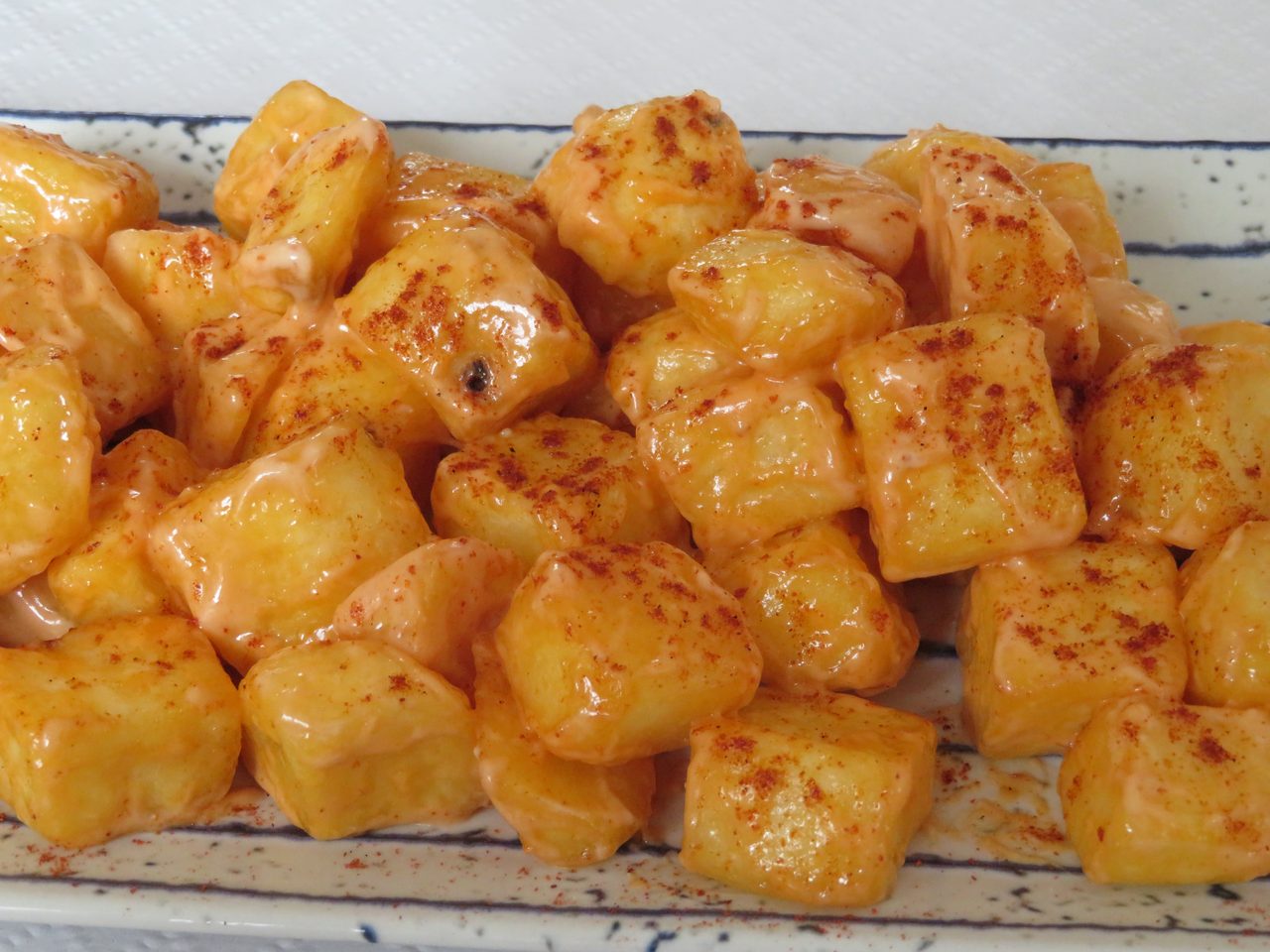
Papas Arrugadas (Wrinkled Potatoes in Salt Crust)
The Canary Islands potatoes boiled in their skins in water as salty as the sea, then drained and dried out in the pan until the skins wrinkle and salt crystallises on the outside. The salting guide puts blanching water at 10g of salt per litre. This is fifteen times that, and at that concentration what the salt does inverts: instead of seasoning its way in, it draws water out through the skin, and then stays behind as crystals once the water has gone.
Ingredients
- Serves 4 as a side
- small potatoes · waxy, 4-5cm across, skins left on1 kg
- water · only just enough to cover them1 L
- coarse salt · per litre; traditionally seawater does this150 g
- Mojo rojo (the red sauce)
- garlic4 cloves
- dried red chillies · seeded and soaked 30 minutes2
- paprika1 tsp
- ground cumin0.5 tsp
- vinegar2 tbsp
- olive oil100 ml
- salt0.5 tsp
- Mojo verde (the green sauce, optional)
- coriander1 handful
- parsley0.5 handful
- garlic2 cloves
- olive oil80 ml
- vinegar1 tbsp
Steps
- ⏲ 10 min
Scrub the potatoes and do not peel them. The skin is this dish's semi-permeable membrane — peeled and boiled in this water they turn into salty mush. Cut out eyes and bad spots only.
- ⏲ 5 min
Lay the potatoes in the pan one layer deep and add water to only just cover them. More water is more water to drive off later. Add 150g of coarse salt per litre — stirred in, some of it not dissolving is normal.
- ⏲ 25 min
Cover, bring to a hard boil and cook 20–25 minutes, until a skewer goes straight in. All that time the strongly salted water is pulling water out of the potato through its skin, and the flesh is getting denser for it (salt and seasoning).
- ⏲ 2 min
Pour nearly all the water away, leaving about 1cm in the bottom, and turn the heat low with the lid on. Everything from here is where the dish gets its name.
- ⏲ 10 min
5–10 minutes, until the water has gone completely. Shake the pan every so often to roll them. As the water evaporates the salt left behind settles on the skins as a white bloom, and the skins shrink onto the shrunken flesh and wrinkle.
- ⏲ 5 min
Off the heat, lay a dry cloth or kitchen paper over the pan and leave 5 minutes. The last of the steam goes into the cloth, the surface dries completely and the salt crystals sharpen.
- ⏲ 10 min
Mojo rojo: pound or blend the soaked chillies, garlic, paprika, cumin and salt, add the vinegar, then work in the olive oil in a thin stream. Mojo verde is the same with coriander and parsley in place of the chillies.
Serve warm. The salt crust has to survive, so do not pour the sauce over — send it out separately, to dip into. The skins are eaten.
Tips & Variations
Variations
- Papas bonitas: the Canary Islands' own landrace varieties (papa bonita, papa negra and others), old South American lines that are smaller, thicker-skinned and yellower-fleshed than mainland potatoes. Failing those, any small waxy potato.
- With seawater: the original method. Seawater is only about 3.5% salt, so it works because the water is never changed and is boiled down — the 150g per litre here is imitating that final concentration with tap water.
- Less salt: down to 100g per litre works, with shallower wrinkles and skins that are easier to eat. Below about 50g per litre you have made boiled potatoes.
- In the oven: 10 minutes at 200°C after boiling will also finish them. More even than the pan, but less salt settles.
- Without mojo: served plain beside grilled fish or meat.
Tips
- Go fifteen times past the number salt and seasoning gives and what the salt does inverts. That guide says blanching water "has to be salty for the seasoning to reach inside the ingredient — roughly 10g of salt per litre", and adds that "the water tasting salty and the finished dish tasting salty are separate questions." At 1% the brine is a medium that carries seasoning inward and stays behind in the pan. At 15% it is a drying agent: osmosis pulls water out of the potato through its skin, and once the water has boiled away the salt stays as crystals. Same substance, one order of magnitude, the opposite job.
- And what that guide files as an emergency measure is this recipe. Its first answer to an oversalted pot is "add a starchy or protein-rich mass — potato, tofu — and simmer. It absorbs salt." This dish does that deliberately and to the limit.
- The wrinkles are the skin shrinking onto shrunken flesh. Which is why peeling them gives you neither the wrinkles nor the crust: the skin is both the osmotic membrane and the finished surface.
- Use waxy potatoes. Mashed potatoes tells you to use starchy russets because it wants them to collapse and go fluffy. Here they have to survive twenty minutes in heavy brine and hold their shape, which is the opposite requirement.
- Do not rinse the starch off. Patatas bravas says to rinse the potatoes to wash off starch for a crisper exterior; here the whole point is not to disturb the skin at all.
- Do not walk away for the last 5–10 minutes. Left on the heat after the water has gone they simply scorch underneath; taken off early the surface is still wet, the salt is still dissolved in it, and no crystals form.
- Do not pour the sauce over. Mojo spooned on top dissolves the salt crust you spent ten minutes making. It goes out separately, to dip into.
The basics behind this dish
- Salt: When You Add It Matters More Than How MuchThe same amount of salt either draws water out or seasons all the way through, depending on when it goes in. Osmosis, seasoning in layers, and why salt types are not interchangeable by volume.
- Chilli and Heat: Where It Lives and How to Take It BackHeat is not a taste but a pain signal. Where capsaicin actually sits, why water does nothing, and the four ways to pull a dish back once it has gone too far.
- Blanching: Keeping Vegetables GreenBlanched vegetables go dull because of acid and heat. Why the pot should be large, why the lid stays off, and what the ice bath is really for.
More of the same kind


More from this country


Sign in to edit.
AI-drafted, editor-reviewed · edits: 0 ·Edit history
https://cookiki.com/en/r/papas-arrugadas · cookiki · User contributions are licensed under CC BY-SA 4.0.