
Photo: Acabashi · CC BY-SA 4.0
Sunday Roast (Roast Beef with Yorkshire Pudding, Roast Potatoes and Gravy)
Roast meat with roast potatoes, Yorkshire pudding and gravy: Britain's Sunday lunch. None of the individual parts is hard — the hard part is the timetable. The meat wants 160°C while the puddings and potatoes want 220°C, and the 20-30 minutes the meat has to rest is exactly the window for that high heat.
Ingredients
- Serves 4
- Roast beef
- beef sirloin or rump joint · out of the fridge an hour ahead; cold meat cooks only on the outside1 kg
- salt · all over, just before it goes in2 tsp
- black pepper1 tsp
- neutral oil1 tbsp
- Roast potatoes
- floury potatoes · cut into large quarters1 kg
- beef dripping or oil · dripping or duck fat is best; olive oil smokes too low4 tbsp
- salt · in the parboiling water1 tsp
- Yorkshire puddings (makes 6)
- eggs · room temperature3
- plain flour · equal in volume to the eggs and the milk100 g
- milk150 ml
- salt0.5 tsp
- neutral oil · divided between the tin holes3 tbsp
- Gravy
- plain flour1 tbsp
- beef stock400 ml
- red wine · optional; the vegetable water instead100 ml
- Vegetables and to serve
- carrots · split lengthwise and roasted alongside the meat3
- parsnips · or more carrots2
- broccoli · blanched at the last minute200 g
- horseradish · with beef; mint sauce if you are roasting lamb2 tbsp
Steps
- ⏲ 30 min
Make the Yorkshire batter first. Whisk the eggs, flour, milk and salt smooth and leave it at room temperature at least 30 minutes. The flour has to hydrate and the gluten relax before it will climb in the oven.
Take the beef out of the fridge an hour ahead. Heat the oven to 220°C.
- ⏲ 10 min
Cut the potatoes into large quarters and parboil them in salted water 8-10 minutes, until the outsides are just starting to break up.
Drain them completely, put the lid on and shake the pan hard to rough the surfaces up. That rough exterior is where the crust comes from — smooth potatoes never crisp, however long you roast them.
- ⏲ 20 min
Pat the beef dry, rub salt and pepper over the whole surface and oil it. Roast at 220°C for 20 minutes to set the outside, with the carrots and parsnips in the tin around it.
- ⏲ 45 min
Drop the oven to 160°C and give it 45 minutes more (for 1kg, medium-rare). Pull it at 52-54°C in the centre — it climbs another 3-4°C while resting.
- ⏲ 30 min
Move the beef to a board and tent it loosely with foil for 20-30 minutes. This is the hinge of the whole meal: from here the oven is used for high heat, and the gravy gets made now too. Wrapped tightly, steam softens the crust.
- ⏲ 50 min
Turn the oven to 220°C. Put 4 tbsp of fat in a roasting tin and heat it in the oven until it smokes, then add the parboiled potatoes and turn them to coat. Never into cold fat. Roast 45-50 minutes, turning once only.
At the same time, put half a tablespoon of oil in each hole of a muffin tin and heat it in the oven until smoking. Take it out and pour the batter in immediately, filling each two-thirds. Fat that has cooled will not lift them.
- ⏲ 25 min
Bake the puddings 20-25 minutes. Do not open the oven — the temperature drop collapses them where they stand.
- ⏲ 5 min
Make the gravy. Pour most of the fat off the meat tin and keep the browned residue stuck to the base. Stir in 1 tbsp flour and cook it a minute, add the wine and stock, scrape the base as it comes up, simmer 5 minutes, then strain and season.
Blanch the broccoli last. Carve the beef thinly across the grain, plate it with the potatoes, puddings and vegetables, pour over the gravy and serve at once with the horseradish.
Tips & Variations
Variations
- Change the meat: lamb (mint sauce), pork (apple sauce and crackling), a whole chicken (bread sauce), turkey (Christmas). Which sauce goes with which meat is fixed by convention, and that pairing is part of the meal. Only the roasting time changes; the structure does not.
- Nut roast: the standard vegetarian Sunday roast — nuts and pulses packed into a loaf tin, with the gravy built on mushrooms and Marmite instead of meat residue.
- One large Yorkshire: baked as a single bowl and filled with the meat and gravy. In Yorkshire the original order was the opposite of today's — the pudding came before the meat, eaten with gravy alone, as a cheap way to fill people up on flour.
- Parsnips instead of potatoes: parsnips carry more sugar, so they caramelise harder and burn more easily. Put them in about ten minutes after the potatoes.
- With one tin only: you have to roast the potatoes and the puddings in sequence while the meat rests, and the potatoes go lukewarm. Two oven shelves, or an air fryer alongside, is the realistic compromise.
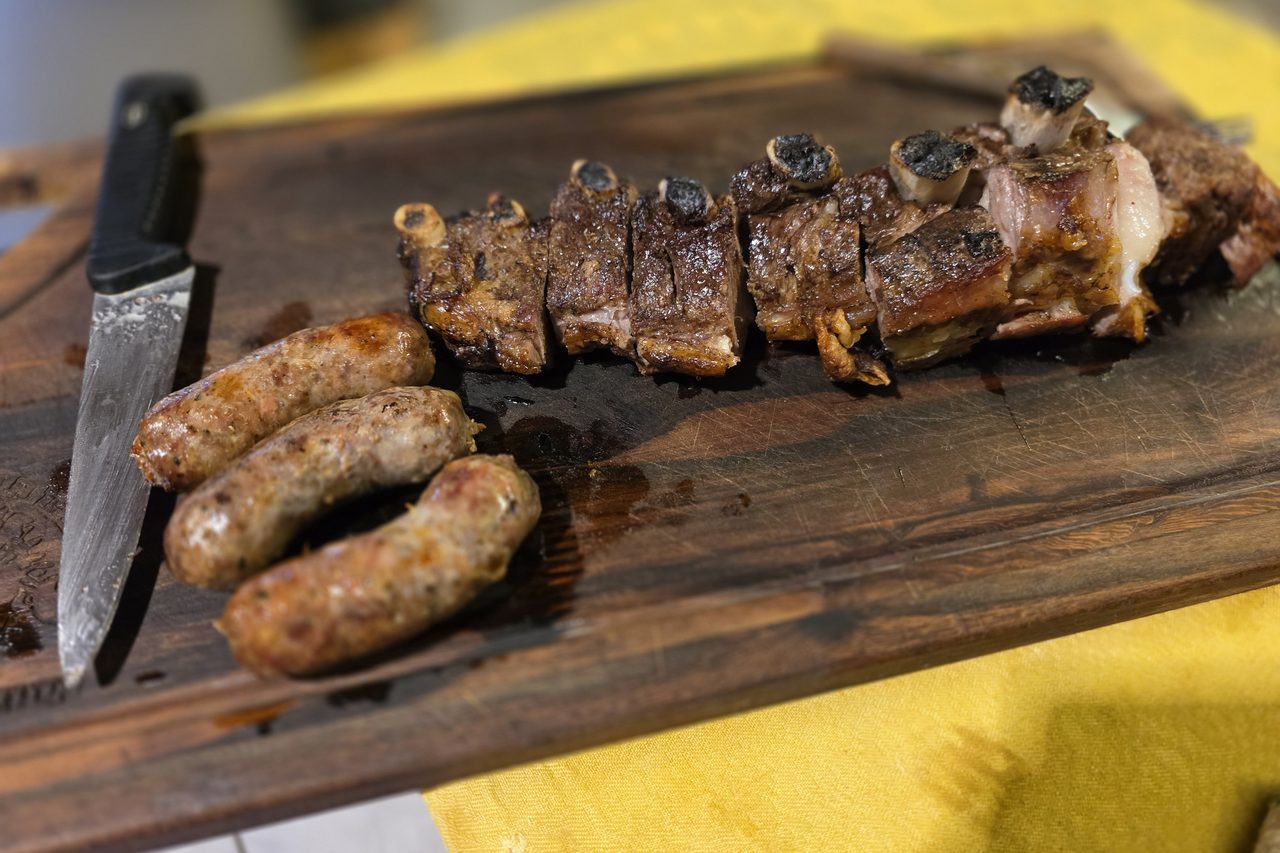
- British meals in the same line: shepherd's pie grew out of using up leftover roast meat, and fish and chips is the other national dish. As roasting goes, asado is the opposite extreme — radiant heat from coals instead of an oven, and salt as the only seasoning.
Tips
- The difficulty is the timetable, not the cooking. The meat wants 160°C and the potatoes and puddings want 220°C, and there is exactly one way to get both out of one oven: roast the meat first and use the 20-30 minutes it spends resting as the high-heat window. The rest is not dead time, it is the condition that makes the meal possible (cooking meat and resting).
- Parboil the potatoes, then shake them. This is the whole of roast potatoes. Parboiling gelatinises the surface starch, and roughing it up gives you a floury layer that fries in the fat into a crust. Raw potatoes straight into the oven stay smooth outside and undercooked inside.
- Potatoes go into hot fat only. Started in cold fat they absorb it as they cook and come out greasy and soft. Heat the tin in the oven first — they should hiss as they go in (cooking oils, browning).
- Yorkshire batter is 1:1:1 by volume. Match eggs, flour and milk by volume, not weight — three eggs at about 150ml means 150ml of flour (roughly 100g) and 150ml of milk. That ratio keeps the batter thin enough to be lifted by steam (cooking eggs, choosing flour).
- Rest the batter; smoke the fat. Miss either and they will not rise. Heat the tin in the oven and pour the moment it comes out — the batter should sizzle as it lands.
- Do not open the oven. A Yorkshire pudding is a structure held up by steam, and opening the door before twenty minutes drops the temperature and collapses it where it stands. Look through the glass (what your oven is doing).
- Tent the foil loosely. Wrapped tight, trapped steam softens the crust you just spent an hour building. Laid over is right.
- Gravy comes off the bottom of the tin. The browned residue stuck to the roasting tin is all of the flavour. Pour the fat off but keep that, cook the flour into it, and scrape it up with the stock. Granules skip the step that pays for itself (stocks and broth, thickening sauces).
- Pull it below your target. A 1kg joint climbs 3-4°C in the centre while it rests, so take it out at 52-54°C for medium-rare.
- Carve thin, across the grain. Roast beef needs its fibres cut short. Carved thick, the same joint eats tough.
- Broccoli last of all. Blanched early it loses colour and weeps. Put it in the water as you start carving (blanching vegetables).
- The leftovers are the next dish. That is the Monday custom in Britain: cold meat into sandwiches or hash, and leftover potatoes and vegetables fried down as bubble and squeak. Yorkshire puddings do not come back, so eat those on the day (reviving leftovers, serving temperature).
The basics behind this dish
- Browning and the Maillard ReactionMeat fails to brown for one of three reasons: it is wet, the pan is cool, or you put too much in at once. Plus how the brown film stuck to the pan becomes your sauce.
- Cooking Meat: Temperature, Resting, and Cutting Against the GrainDoneness is a core temperature, not a number of minutes. What resting actually does, how to handle a thick cut, and why the direction you slice changes the texture.
- Knife Skills: Grip, Cuts, and Why Size MattersHow you hold the knife matters more than how fast you cut. The pinch grip, the claw hand, and why uniform size is a cooking decision rather than a cosmetic one.
More of the same kind


More from this country
British →


Sign in to edit.
AI-drafted, editor-reviewed · edits: 0 ·Edit history
https://cookiki.com/en/r/sunday-roast · cookiki · User contributions are licensed under CC BY-SA 4.0.