
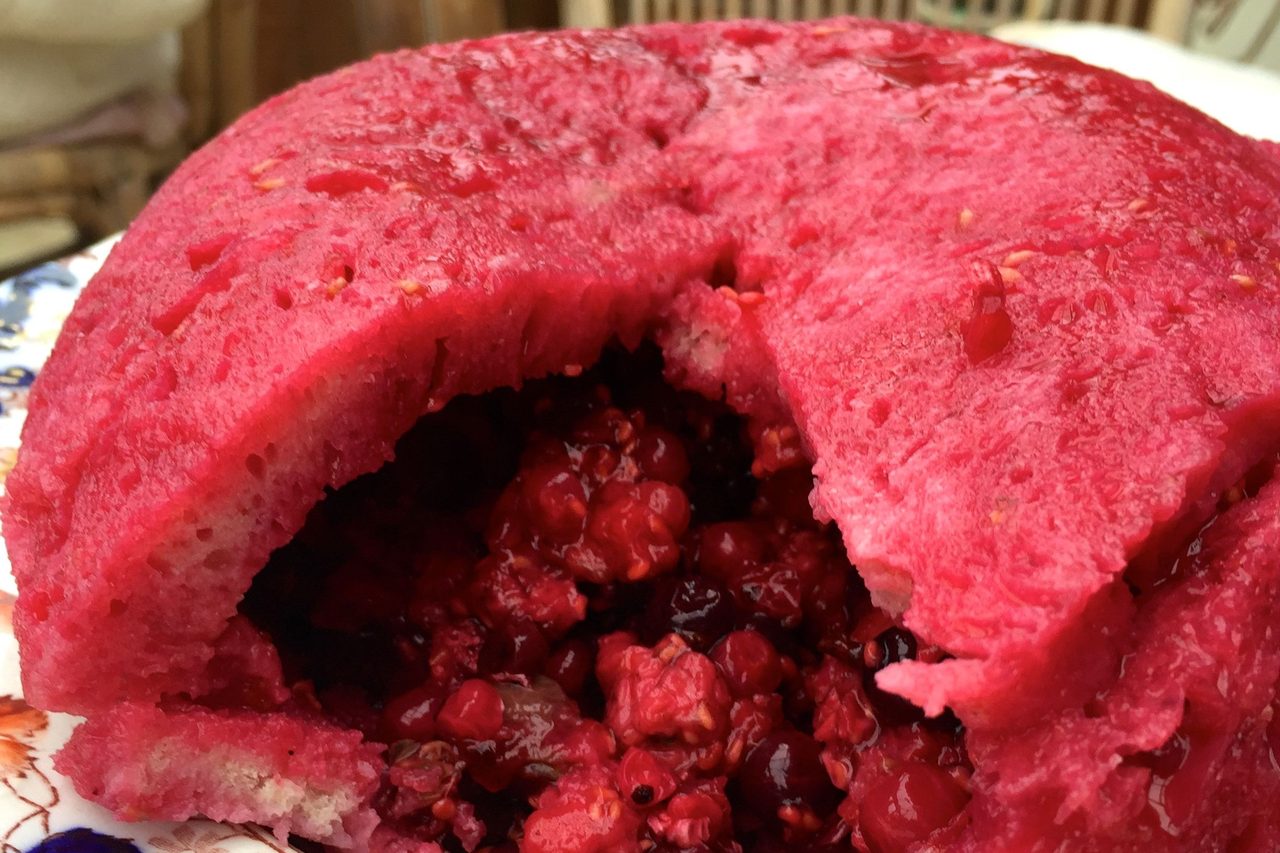
Photo: MarcellusW · CC0
Prinsesstårta (Marzipan-Domed Cream Cake)
A Swedish cake: sponge, jam and custard under a tall dome of whipped cream, sheeted over in pale green marzipan. What decides this cake is not the half minute when the marzipan goes on but the step before it. The cream dome has to be chilled genuinely firm for the marzipan to settle taut over it; on soft cream even a perfectly rolled sheet wrinkles and slides.
Ingredients
- Genoise (22cm)
- eggs · at room temperature4
- sugar120 g
- plain flour90 g
- potato starch · cornflour works; it keeps the crumb tender30 g
- baking powder1 tsp
- melted butter · cooled30 g
- Crème pâtissière
- milk400 ml
- egg yolks4
- sugar80 g
- cornflour35 g
- vanilla pod · or 1 tsp vanilla extract0.5
- butter · stirred in off the heat20 g
- Assembly
- raspberry jam · seedless150 g
- double cream · 35% fat or higher, cold500 ml
- sugar · for the cream2 tbsp
- Marzipan
- marzipan · 50% almond or higher handles best400 g
- green food colouring · pale green is the standard2 drops
- icing sugar · for the rolling surface, not flour4 tbsp
Steps
- ⏲ 25 min
Bake the genoise. Warm the eggs and sugar over a water bath to 40°C, then whip on high for 8 minutes — it is ready when a drizzle of batter holds its trace for a few seconds. Fold in the sifted flour, potato starch and baking powder, then the cooled melted butter last. Bake at 175°C for 25 minutes and cool completely.
- ⏲ 1 min
Make the crème pâtissière. Heat the milk with the vanilla, whisk it slowly into the yolks, sugar and cornflour, and return it to the pan. Bring it to the boil, stirring, and then keep it boiling for one more minute. That minute cooks the starch and kills the amylase in the yolks; skip it and the cream slackens back to liquid in the fridge.
- ⏲ 120 min
Off the heat, stir in the butter, spread it in a wide dish, press cling film onto the surface and chill 2 hours until properly cold. Lukewarm pastry cream melts the whipped cream that goes on later.
Slice the cooled sponge horizontally into three. Spread the bottom layer thinly with raspberry jam and half the pastry cream. Add the second layer, the rest of the cream, then the third. Keep the jam thin — a thick layer lets the whole stack slide.
Whip the cold cream with the sugar to firm peaks. Pile all of it on top and shape a tall dome with a palette knife, taking a thin coat down the sides and smoothing it. This dome is not decoration, it is the structure the marzipan will lie on.
- ⏲ 60 min
Chill 1 hour to set the cream — firm enough that a fingertip leaves no dent. This is where the cake is won or lost: on soft cream the marzipan wrinkles and slides off.
Knead a drop or two of colouring through the marzipan, only until the colour is even. Roll it out on a surface dusted with icing sugar to 36cm across and 3mm thick. Flour dries marzipan and makes it crack. Over-kneading brings the almond oil out and turns it sticky, so handle it as little as possible.
Drape the sheet loosely over the rolling pin, lay it down from the centre of the cake outwards, and smooth it from the top down with your palms, lifting the edge as you go to let air out. Trim the excess at the base with a knife.
- ⏲ 20 min
Dust with icing sugar and set a marzipan rose on top. Keep it refrigerated, and take it out 20 minutes before serving — cut straight from the fridge the slices are neat but the cream and marzipan taste of nothing.
Tips & Variations
Variations
- Colour: pale green is standard, but yellow and pink are sold in Sweden too. The pink one has become the breast cancer campaign's
rosa bandet-tårta, so the colour now carries a meaning of its own. - Operatårta: the sibling cake, sheeted in chocolate marzipan with chocolate cream inside. Same construction, different colour and flavour.
- The jam: raspberry is standard and strawberry is common. Seedless is preferred not for texture but because it spreads thinner.
- Where the name came from: it appeared in a 1930s book by the cookery teacher Jenny Åkerström, who taught the three Swedish princesses, and it was originally just
grön tårta— green cake. The princesses' fondness for it is the usual explanation for the change. Sweden even has a Prinsesstårta week in late September. - How it differs from dobos torte: both are layer cakes, but what stacks them and what covers them are opposites. Dobos stacks with buttercream and finishes with a caramel sheet, flat. This stacks with custard and whipped cream and finishes in marzipan, domed. One ends in sugar work, the other in pastry work.
- Against sachertorte: a ganache is a finish you pour and let flow; marzipan is a finish you roll and drape.
- Fondant instead of marzipan: easier to handle and it tastes only of sugar. Marzipan is half almond, so it works as an ingredient rather than a covering — a cousin of the ground almonds in a macaron.
- What it belongs with: if kanelbulle is the everyday coffee bread, this is the birthday cake — the course after Swedish meatballs.
Tips
- Set the cream dome hard before the marzipan goes near it. This is where the cake fails, and the cause is always the cream rather than the marzipan. If a fingertip leaves a dent, it is not ready. Do not shorten the hour, and give it longer in a warm kitchen.
- Roll on icing sugar. Flour dries the surface of marzipan and it cracks, and a crack only opens wider once the sheet is stretched over a dome. Icing sugar dissolves in and leaves no trace.
- Work the diameter out first. You need roughly cake diameter + height × 2 + 4cm of slack. A 22cm cake with a 5cm dome comes to 36cm. Falling short means balling it up and re-rolling, and marzipan gets slightly worse every time you do.
- Lay it down from the centre. Starting at one edge traps air on the far side and puts a fold in it. Landing the middle on the top of the dome and sweeping outwards is the only reliable way.
- Do not over-knead the marzipan. The almond oil comes out and the surface turns greasy and tacky. A drop or two of colouring, and stop the moment it is even.
- Boil the pastry cream a full minute after it thickens. Egg yolks contain amylase, an enzyme that breaks starch down, and without enough heat the cream slackens back to liquid in the fridge on its own. That minute is also when the raw starch taste goes (thickening, cooking eggs).
- Fold the genoise, do not stir it. There is a little baking powder, but the structure is whipped whole egg. Stirring knocks that out — the same principle as dobos torte and pound cake, with whole-egg foam doing the job here.
- Keep the jam thin. Between layers it behaves like a lubricant, and a thick layer lets the top slide as you cut.
- Cold cream, cold bowl. The fat has to be cold to whip firm. Lukewarm cream never reaches the stiffness a dome needs, however long you beat it (dairy and heat).
- Dip the knife in hot water and wipe it between cuts. It stops the marzipan and cream dragging.
- You can make it a day ahead — but not the marzipan. Sponge, pastry cream and the assembly are better done the day before; marzipan left overnight in a fridge takes up moisture and goes tacky.
The basics behind this dish
- Eggs: Coagulation Temperatures and What They DecideWhite sets at 62°C, yolk at 68°C. Those two numbers explain scrambled eggs, boiled eggs, steamed custard and crème anglaise all at once.
- Dairy and Heat: Why Cream Splits and Butter BurnsThe temperature butter burns at, the conditions that split cream, the order yoghurt goes in. Dairy fails under heat in a small number of specific ways, so avoiding them is specific too.
- Why Sauces Split: Emulsions and Pan SaucesA cream sauce breaking and a carbonara scrambling are the same failure. Temperature and emulsifiers — plus how to bring a split sauce back.
More of the same kind



More from this country


Sign in to edit.
AI-drafted, editor-reviewed · edits: 0 ·Edit history
https://cookiki.com/en/r/prinsesstarta · cookiki · User contributions are licensed under CC BY-SA 4.0.