
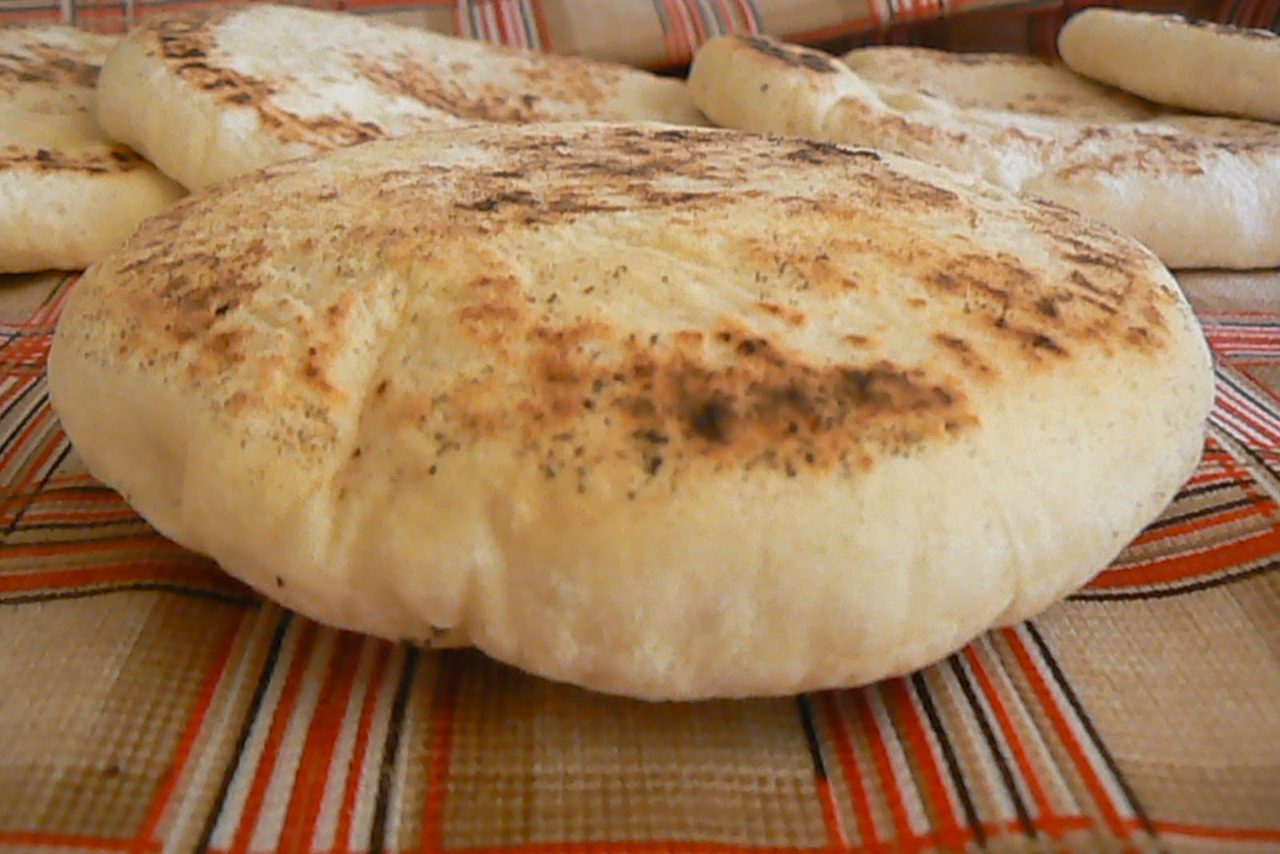
Photo: michael clarke stuff · CC BY-SA 2.0
Irish Soda Bread
An Irish loaf made from four things: flour, salt, bicarbonate of soda and buttermilk. No yeast, no rising time, no kneading. All of its lift is carbon dioxide from an acid meeting a base, and that reaction starts the instant the buttermilk touches the flour. What this bread is really built around is not time but the lack of it — mixed, gathered and into the oven inside two minutes.
Ingredients
- Basic (one 20cm loaf)
- plain flour · a soft, lower-protein flour is better here450 g
- bicarbonate of soda · 5g, and always sieved1 tsp
- salt1 tsp
- buttermilk · cold; substitutes in the tips400 ml
- For a wheaten loaf (optional)
- wholemeal flour · swapped in for that much of the plain200 g
- buttermilk · extra, as wholemeal drinks more50 ml
- For spotted dog (optional)
- raisins100 g
- sugar2 tbsp
Steps
Heat the oven to 220°C first. This dough will not wait for you, so the oven has to be ready before it exists. Line a tray, put it beside the oven, and have flour already scattered on the worktop. Anything still to be set up after you start mixing is gas lost.
Sieve the flour, bicarbonate of soda and salt into a big bowl and run your hand through it once more. Sieving the bicarb is not fussiness — a lump of it bakes into a yellow patch that tastes of soap, and there will be no time to mix it out later. Even it out now.
- ⏲ 30 sec
Make a well and pour in the cold buttermilk all at once. Spread one hand like a claw and stir in wide sweeps from the outside in, bringing it to a rough wet mass within 30 seconds. This is where the clock starts — carbon dioxide begins the moment the acid meets the base, and gas lost in the bowl is lift the oven never gets.
Tip it onto the floured worktop and roll it into a round with five or six passes of your palms, no more. It will be wet, sticky and rough-surfaced, which is correct. Do not knead it — there is no reason to build gluten here, and building it trades a tender crumb for a tough loaf.
Press it into a disc about 4cm deep and 20cm across and lift it onto the tray. Cut a deep cross with a sharp knife, two thirds of the way down. The story is that it lets the fairies out; what it does is get heat into the middle of a thick mass, and give you the lines to break the baked loaf into quarters.
- ⏲ 15 min
Into the oven immediately, 15 minutes at 220°C. That first hard heat expands what gas is left all at once and sets the crust around the shape it makes.
- ⏲ 25 min
Drop to 200°C and give it another 25-30 minutes. The crust goes deep brown and the cross opens and cracks apart. Do not keep opening the door.
Take it out and knock the base with a knuckle. A hollow sound means it is done; a dull one means five minutes more. Judging by colour alone gives you a dark loaf that is raw in the middle.
- ⏲ 30 min
Cool on a rack for at least 30 minutes. Cut hot, the crumb has not set and the knife compresses it into paste. Once cool, break it along the cross into quarters, cut thick slices and butter them.
Tips & Variations
Variations
- Wheaten bread: in the north of Ireland this is the more common loaf and it has its own name. Swap 200g of the plain flour for wholemeal and add 50ml more buttermilk, since the bran holds water and the same quantity would leave it stiff. Far better under smoked salmon or cheese.
- Spotted dog: 100g raisins and 2 tablespoons of sugar through the dry ingredients. The sweet version, and the name comes from the raisins studding the loaf.
- Farls: instead of baking it, cut the round right through into four and cook them in a covered cast-iron pan. This is what people did without an oven, and it is the flat bread on an Irish breakfast plate.
- How it differs from a scone: same chemistry, different construction. A scone has butter rubbed into the flour to make layers, is baked as individual pieces, and usually uses baking powder, which carries its own acid. Soda bread has no fat at all, bakes as one loaf, and uses bicarbonate alone — which is exactly why the buttermilk is compulsory rather than optional.
- Against baguette and focaccia: yeast makes gas over hours, and flavour comes with those hours. Soda bread gets its gas in two minutes and gives that flavour up in exchange. What it buys is a loaf on the table ninety minutes after you decide to make one.
- Against chapati: chapati has no leavening at all and puffs because water flashes to steam. Yeast, chemical and steam — three ways to inflate a dough, three different breads.
- What to serve it with: alongside Irish stew is the standard, and it suits any thick soup — caldo verde, for one.
Tips
- You can replace the buttermilk but you cannot replace the acid. Bicarbonate of soda is a base and makes no gas by itself. Without buttermilk, stir a tablespoon of lemon juice or vinegar into 400ml of milk and leave it ten minutes until it curdles, or thin plain yoghurt to the same consistency. Plain milk gives you no rise and leaves unreacted soda behind, which tastes of soap (vinegar, dairy and heat).
- Always sieve the bicarb. One lump is one yellow patch and one bitter mouthful. Do not be generous with it either — soda that finds no acid does not go anywhere.
- Two minutes. From the first stir to the oven door closing is the real time limit of this recipe. Every second spent tidying the dough into a neater shape is gas leaving the bowl, which is why having the tray and the oven ready is step one rather than an afterthought.
- Do not knead. In a yeast bread, kneading builds the net that will trap gas produced later. Here the gas is already being produced, so time spent building a net is time the gas uses to escape, and all you are left with is the toughness (dough and gluten).
- A softer, lower-protein flour is better — and this is roughly why the bread exists. Wheat grown in the Irish climate is low in protein and will not build a net strong enough to hold a long yeast rise. Strong bread flour here just makes it chewy (choosing flour, flour).
- A wet, sticky dough is correct. The urge is to add flour until it stops clinging to you, and that gives a dense, crumbly loaf. Tip it out wet and flour your hands instead.
- Cut the cross deep. A shallow one closes again as it bakes and leaves the thick middle underdone. Two thirds of the way down.
- Start the oven hot. The force that lifts the remaining gas all at once comes from those first fifteen minutes. Into a lukewarm oven, the dough simply dries before it can rise (what your oven is doing).
- Knock the base. Crust colour varies with the oven; the sound tells you about the middle.
- It is a same-day loaf. With no fermentation there are none of the acids and enzymes fermentation leaves behind, so it stales noticeably within a day. There is a reason this gets baked in the morning. Yesterday's is much better cut thick, toasted and buttered (reviving leftovers).
The basics behind this dish
- Choosing Flour: Protein Is the Whole StoryBread, plain and cake flour differ in one number: protein. What that number decides, how to fake one from another, and the things sold beside flour that are not flour at all.
- Dough and Gluten: When to Build It and When to Avoid ItThe same flour and water becomes a dumpling wrapper or a tender pancake. The difference is whether you built gluten or avoided it — and kneading and resting do different jobs.
- Heat Control: Preheating, Oil, and Reading the PanThe same ingredients become a different dish depending on pan temperature. When to add the oil, how to read heat by sound, and which dishes want low heat instead.
More of the same kind



More from this country
Irish →
Sign in to edit.
AI-drafted, editor-reviewed · edits: 0 ·Edit history
https://cookiki.com/en/r/irish-soda-bread · cookiki · User contributions are licensed under CC BY-SA 4.0.