
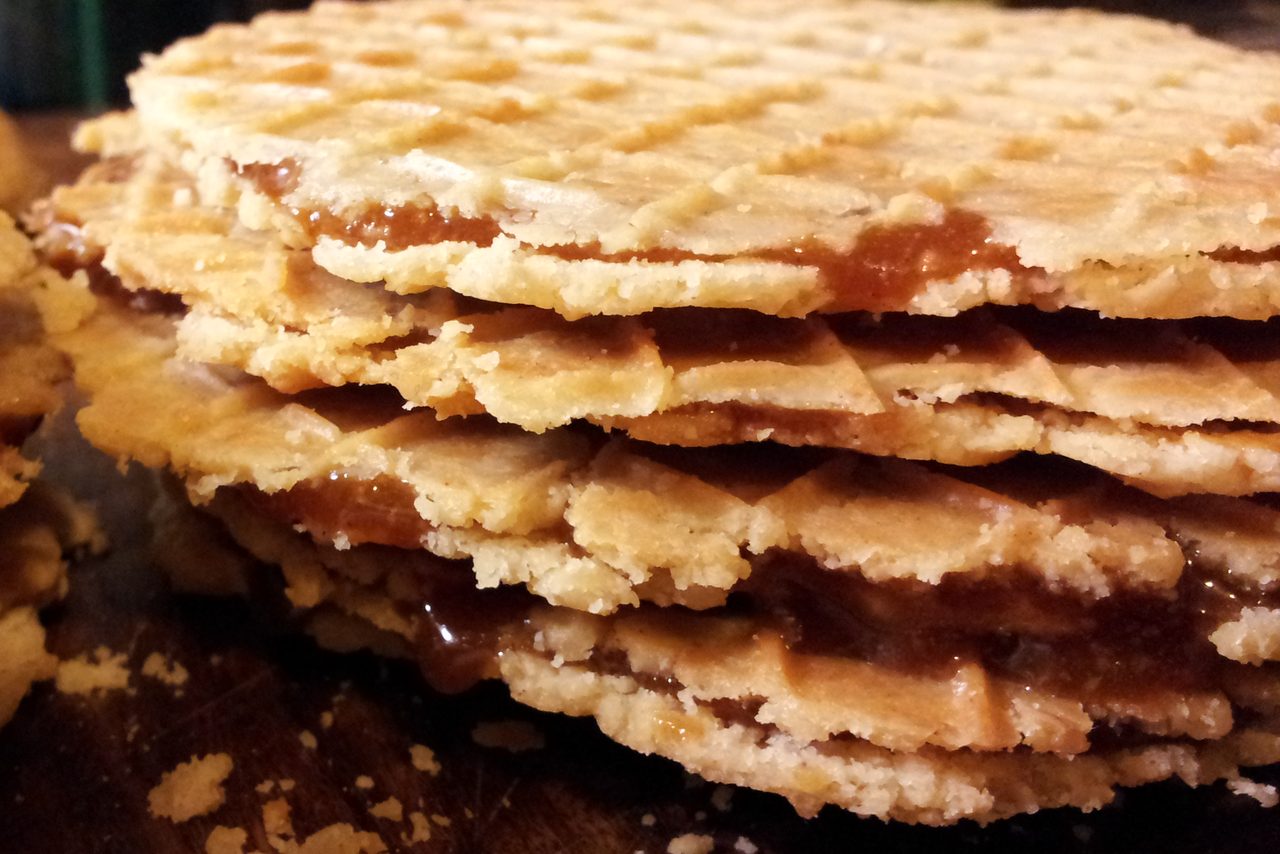
Photo: Arnstein Bjone · CC BY-SA 4.0
Brunost (Brown Whey Cheese)
The Norwegian brown cheese, made by boiling the whey left over from making an ordinary cheese until the water is gone. The cheese pages on this site set out three ways to set milk — acid, a calcium salt, rennet. Brunost is not on that list, because nothing in it is set at all. Not a drop of coagulant goes in, and it is made from the thing all three of them throw away. The colour and the sweetness are the lactose browning against the whey protein, which is why it tastes of caramel rather than of cheese.
Ingredients
- Brunost (about 350g)
- whey · left from making cheese or paneer; see the tips4 L
- double cream · Anne Hov’s 1863 addition; the reason is in the tips200 ml
- milk · optional, and effectively a little more lactose200 ml
- salt · optional2 g
- To serve
- flatbread or waffles · lefse or waffles4 portions
- butter30 g
Steps
- ⏲ 10 min
Strain the whey through a fine sieve and muslin to take out any curd. Left in, it catches on the base and you can feel it as grit in the finished block.
- ⏲ 20 min
Put the whey in a wide, heavy pan and bring it just below a boil. Do not let it boil hard: whey protein coagulates around 75-80°C, and coagulated protein sticking to the base is where the burning starts.
- ⏲ 10 min
Skim off the white foam that rises. That is the coagulated whey protein, and left in it makes the finished cheese gritty.
- ⏲ 120 min
Reduce it for two hours. It comes down to about a quarter of its volume and the colour turns a pale beige. There is very little to do at this stage.
- ⏲ 120 min
Add the cream and the milk and reduce one to two hours more. From here it needs stirring often. The colour goes from beige to light brown to caramel.
- ⏲ 15 min
It is ready when a spatula drawn across the base leaves a track that holds for a moment. It sets much firmer as it cools, so the last ten minutes are the whole judgement.
- ⏲ 15 min
Off the heat, keep stirring hard as it cools. This stirring is the difference between smooth and sandy — it is what stops the lactose growing into large crystals.
- ⏲ 15 min
While it is still thick and warm, press it into a mould, cover and refrigerate. Overnight it sets firm enough to cut. Shave it thin with a cheese plane onto flatbread or waffles.
Tips & Variations
Variations
- Geitost: made with goat whey. The photograph on this page is geitost — a shade darker and much sharper. Made from cow whey alone it is milder and softer.
- Gudbrandsdalsost: the cow-and-goat blend, and the standard most Norwegians eat today. It begins with Anne Hov, who in 1863 in the Gudbrandsdalen valley added cream to the whey.
- Prim: the older form, made without cream. Almost fat-free and much harder. As ko.wikipedia puts it, this was poor farmhouse food, made so that the whey left from butter and cheese would not be wasted.
- Left soft: potted before it sets and it is a spread rather than a block.
- At the table: shaved thin with a cheese plane (ostehøvel) onto lefse or waffles. Lefse's Nordland version, møsbrømlefse, is spread with a sauce made of this cheese.
Tips
- Nothing is set. As mozzarella sets out, there are three ways to set milk — the acid of rasgulla, the calcium salt of douhua, and mozzarella's rennet. Brunost is not on that list, and the reason is that it is not a coagulation. Not a drop of coagulant goes in; all that happens is that the water leaves. And the material is what all three of them throw away — rasgulla's own method uses "the moment the whey runs clear" as the signal that it is done.
- The colour and the sweetness are lactose. Whey is mostly water, and the rest is lactose and whey protein. Drive the water off and you are left with both of them concentrated, and over a few hours just below boiling they brown against each other (browning and Maillard). It is Maillard rather than caramel, because there is protein in it, and that is why it tastes of fudge rather than of cheese. Not a spoonful of sugar goes in.
- Read it beside barfi. That page reduces whole milk for two hours into khoya. This reduces only the whey the cheesemaker did not want. Same reaction, opposite starting point.
- Anne Hov's cream is the technique, not just the flavour. Fat gets in the way of lactose building a crystal network — the same job the butter does in nanaimo bars and the cream in Bündner Nusstorte. That is why prim is hard and brunost planes.
- The stirring at the end matters. Not stirred as it cools, the lactose grows into large crystals and the block is sandy. Stirred, you get many small ones and it is smooth — the same argument barfi makes about sugar (what sugar does).
- Do not let it boil hard. The first of the three causes dairy and heat gives applies directly. Whey protein coagulates, sticks to the base, and scorches there, and a scorched batch cannot be rescued.
- Where the whey comes from. Making mozzarella, Jāņu siers or rasgulla leaves you exactly this much of it, and so does straining Greek yoghurt. Four litres is what comes off about 20 litres of milk, so in practice this is the day-after-cheesemaking dish.
The basics behind this dish
- Heat Control: Preheating, Oil, and Reading the PanThe same ingredients become a different dish depending on pan temperature. When to add the oil, how to read heat by sound, and which dishes want low heat instead.
- Browning and the Maillard ReactionMeat fails to brown for one of three reasons: it is wet, the pan is cool, or you put too much in at once. Plus how the brown film stuck to the pan becomes your sauce.
- Stocks and Broths: Clarity, Time, and Why You Do Not Salt ThemWhat separates a clear stock from a cloudy one is temperature, not ingredients. Why you start in cold water, how long each ingredient wants, and why salt comes later.
More of the same kind



More from this country
Norwegian →


Sign in to edit.
AI-drafted, editor-reviewed · edits: 0 ·Edit history
https://cookiki.com/en/r/brunost · cookiki · User contributions are licensed under CC BY-SA 4.0.