
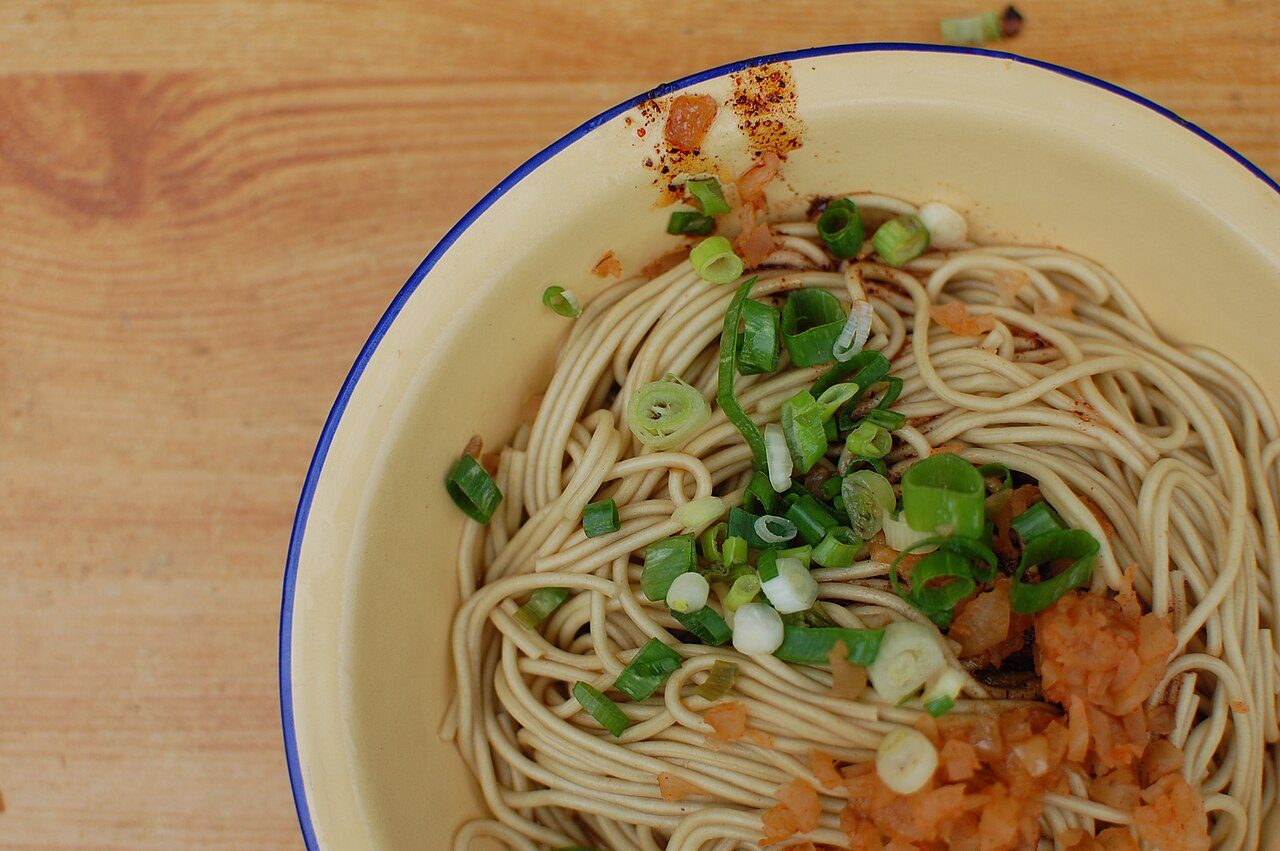
Photo: Sharon Ang · CC0
Dan Dan Noodles (Sichuan Noodles in Chilli-Sesame Sauce)
Sichuan noodles built over a spoonful of sauce — sesame paste, soy and chilli oil sitting in the bottom of the bowl — with dry-fried minced pork on top, tossed at the table. It is not a soup: the sauce goes under the noodles rather than over them, and that arrangement is the dish.
Ingredients
- Sauce (per bowl, goes in first)
- Chinese sesame paste · tahini or peanut butter will stand in1 tbsp
- soy sauce1.5 tbsp
- chilli oil · scoop the sediment from the bottom too2 tbsp
- Chinkiang vinegar · or a little balsamic1 tsp
- ground Sichuan pepper · far better toasted whole and ground yourself0.25 tsp
- sugar0.5 tsp
- garlic · very finely minced1 clove
- noodle water · from the pot, to loosen the sauce3 tbsp
- Pork topping
- minced pork · not too lean150 g
- yacai · Sichuan preserved greens; zhacai or pickled mustard works. Rinse the salt off30 g
- soy sauce1 tsp
- Shaoxing wine1 tsp
- five-spice powder · more than this takes over0.25 tsp
- Noodles and garnish
- thin wheat noodles · fresh Chinese noodles, or somen200 g
- spring onions · finely sliced3 stalks
- roasted peanuts · roughly crushed2 tbsp
- bok choy · optional; 30 seconds in the noodle water100 g
Steps
- ⏲ 5 min
Rinse the yacai (or zhacai) two or three times, squeeze it dry and chop it fine. Skip this and the topping alone over-salts the bowl.
- ⏲ 2 min
If you have whole Sichuan pepper, toast it in a dry pan over low heat for a minute until it smells, then grind it. It is noticeably better than pre-ground.
- ⏲ 6 min
Dry-fry the minced pork in an unoiled pan over medium-high heat for 5-6 minutes — it cooks in its own fat while the moisture leaves, until the grains separate and crumble.
- ⏲ 2 min
Add the yacai, soy, wine and five-spice and fry 2 minutes more, finishing dry. Set it aside.
- ⏲ 2 min
Loosen the sesame paste by adding the soy sauce a little at a time — poured in all at once it seizes and splits.
- ⏲ 3 min
Put that mixture, the chilli oil, vinegar, sugar, garlic and ground pepper in the bottom of the bowl and leave it there. The sauce waits for the noodles, not the other way round.
- ⏲ 4 min
Boil plenty of water, blanch the bok choy 30 seconds and lift it out, then cook the noodles 30 seconds short of the packet time.
- ⏲ 1 min
Stir 3 tbsp of the noodle water into the sauce. The heat slackens the sesame paste and the starch is what makes the sauce cling to the noodles.
- ⏲ 1 min
Shake the noodles completely dry and pile them on the sauce. Water carried over thins it and it pools at the bottom.
- ⏲ 1 min
Top with the pork, spring onion, peanuts and bok choy, and add one more small pinch of ground Sichuan pepper.
- ⏲ 30 sec
Toss it from the bottom right before eating. Mixed and left standing, the noodles drink the sauce and go stodgy — the tossing belongs to whoever is eating.
Tips & Variations
Variations
- The Chengdu soup version. Shops there commonly flood the bowl with stock — add 200ml of chicken stock to the sauce above. The tossed version is the original: these were noodles carried on a shoulder pole (担), and you cannot carry soup. The soupy one came later, once the noodles had a shop to sit in.
- Japanese tantanmen is a separate line. Sesame paste thinned with soy milk or stock into a rich broth, served with ramen noodles. The name travelled; the method did not.
- Vegetarian: dry-fry minced shiitake and crumbled firm tofu the same way and the texture lands close. Keep the yacai.
- Making your own chilli oil is the single biggest upgrade: heat 100ml of oil to 180°C, pour it over 3 tbsp of chilli flakes in three goes, and cool it with a star anise and a little cassia in the jar.
- Jjajangmyeon and bibim guksu belong to the same family — sauce and noodles kept apart and combined at the last moment.
Tips
- Sauce under the noodles is the format, not a shortcut. Poured over the top, the upper noodles are salty and the ones underneath are bare; underneath, tossing brings it up through everything evenly.
- Loosen the sesame paste gradually. It separates easily, and liquid added all at once makes it seize into lumps (emulsions and pan sauces).
- The three tablespoons of noodle water are the glue. Plain water will not do it — the starch is what makes the sauce cling.
- Dry-fry the pork with no oil. The goal is not to cook it but to dry it: moist mince clumps, dry mince scatters and sticks to the noodles.
- Sichuan pepper last, and freshly ground. Toasting whole and grinding it yourself is a different ingredient from the pre-ground jar (blooming spices).
- Salt arrives from three places — soy, yacai and sesame paste. That is why rinsing the yacai and holding the soy at 1.5 tbsp is what keeps it balanced (balancing flavour).
- Make the pork topping double: it keeps 3 days refrigerated, a month frozen, and turns the next bowl into a five-minute job.
The basics behind this dish
- Blooming Spices: Why Aromatics Go into Fat FirstStir ground spice into liquid and half the aroma never arrives, because most aroma compounds are fat-soluble. The thirty-second window, and the order things go in.
- Dough and Gluten: When to Build It and When to Avoid ItThe same flour and water becomes a dumpling wrapper or a tender pancake. The difference is whether you built gluten or avoided it — and kneading and resting do different jobs.
- Why Sauces Split: Emulsions and Pan SaucesA cream sauce breaking and a carbonara scrambling are the same failure. Temperature and emulsifiers — plus how to bring a split sauce back.
More of the same kind


More from this country


Sign in to edit.
AI-drafted, editor-reviewed · edits: 0 ·Edit history
https://cookiki.com/en/r/dan-dan-noodles · cookiki · User contributions are licensed under CC BY-SA 4.0.