
Photo: Jiaqian AirplaneFan · CC BY 3.0
Lanzhou Lamian (Hand-Pulled Beef Noodle Soup)
The beef noodle soup of Lanzhou, in which one lump of dough is folded and stretched over and over until it is hundreds of strands. Every fold doubles the count, so eight folds is 256. What separates it from a rolled and cut noodle is not the absence of a knife but that the dough has to be taken in the direction of stretch rather than spring. And the broth has to stay clear, which is exactly why these noodles are boiled apart from it and rinsed.
Ingredients
- Noodles
- strong white flour · 12% protein or more; plain flour will not pull500 g
- water · lukewarm250 ml
- salt5 g
- food-grade alkali · traditionally penghui; baked bicarbonate of soda works3 g
- oil · to coat the dough while it rests2 tbsp
- Broth
- beef brisket · shin mixed in is good800 g
- beef bones · if you have them500 g
- daikon · half into the broth, half sliced thin to serve300 g
- ginger30 g
- spring onion1
- star anise2
- Sichuan pepper1 tsp
- fennel seed1 tsp
- cassia bark1 piece
- black cardamom · optional1
- salt · at the end2 tsp
- Chilli oil and garnish
- chilli flakes · half coarse, half fine4 tbsp
- oil150 ml
- coriander1 handful
- garlic chives · or spring onion2
Steps
- ⏲ 60 min
Start with the broth. Soak the beef and bones in cold water for 1 hour to draw out the blood, then start them in fresh cold water, bring them up slowly and skim.
- ⏲ 180 min
Add half the daikon, the ginger, spring onion and spices and simmer 3 hours. Never let it boil — a clear broth is the first thing this dish is judged on, and a hard boil breaks fat and protein into the liquid and clouds it (stocks and broth). Salt it at the end.
- ⏲ 10 min
The dough. Dissolve the salt and alkali in the water, work it into the flour and knead 10 minutes. The flour has to be 12% protein or more (choosing flour).
- ⏲ 30 min
Cover it, rest 30 minutes, knead again — three times over. When the dough fights your hands the answer is not more force but more rest (dough and gluten). These rounds are what turn a dough that only springs back into one that stretches.
- ⏲ 120 min
Oil the surface, wrap it and leave it another 2 hours at room temperature. Overnight in the fridge is better still.
Chilli oil: put the chilli flakes in a heatproof bowl and pour over oil heated to just below smoking, in three goes. All at once and it scorches.
Pulling. Roll the dough into a thick rope, take an end in each hand and stretch, then fold in half — over and over. Every fold doubles the strands: four folds is 16, eight is 256. As you stretch, tap the middle lightly on the bench and let the weight do the work.
Dust between the strands so they do not weld, and break off the held ends. First time, fold only four or five times. Thick noodles are still noodles; snapped ones are nothing.
- ⏲ 40 sec
Boil in plenty of hard-boiling water for 40 seconds. Freshly pulled noodles cook startlingly fast (cooking noodles).
Rinse once in cold water and shake them dry. Water that has boiled alkaline noodles is yellow and slippery, and carrying it into the bowl undoes the broth you spent three hours keeping clear.
Put the noodles in a bowl and pour the hot broth over. Top with the thinly sliced daikon and the simmered beef, add a spoon of chilli oil, and finish with coriander and garlic chives. Serve at once.
Tips & Variations
Variations
- The customer picks the thickness. Maoxi (fine as a capillary), xi, erxi, sanxi, erzhuzi, jiuye (flat like a chive leaf), dakuan (wide) and pidaikuan (wide as a belt). You say which when you order and it is pulled to that gauge on the spot. All that changes is the number of folds.
- "One clear, two white, three red, four green, five yellow" (一清二白三红四绿五黄) is the scorecard: clear broth, white daikon, red chilli oil, green coriander and garlic chives, yellow noodles. That clarity comes first tells you what kind of dish this is.
- It is Hui Muslim cooking, so there is no pork in it, and the shops outside Lanzhou that trade under the name are almost all halal. It is also why the broth is built on beef and bones alone.
- The same name as Taiwanese beef noodle soup, and the opposite dish. In Lanzhou this is simply called niurou mian, beef noodle, which is what Taiwan calls its own. But the Taiwanese bowl is braised red with soy and doubanjiang and uses thick chewy cut noodles; this one is clear and the noodles are pulled to order. ko.wikipedia keeps the two articles side by side and cross-references them.
- Against kalguksu, udon and soba: those are rolled and cut. A cut noodle has a square section and edges for broth to cling to; a pulled noodle is round and smooth and holds less. A clear broth and a pulled noodle is not an accident of history.
- Against ramen: both use alkali, but ramen noodles are cut, not pulled. The same chemistry doing springiness and colour in one bowl and extensibility in the other.
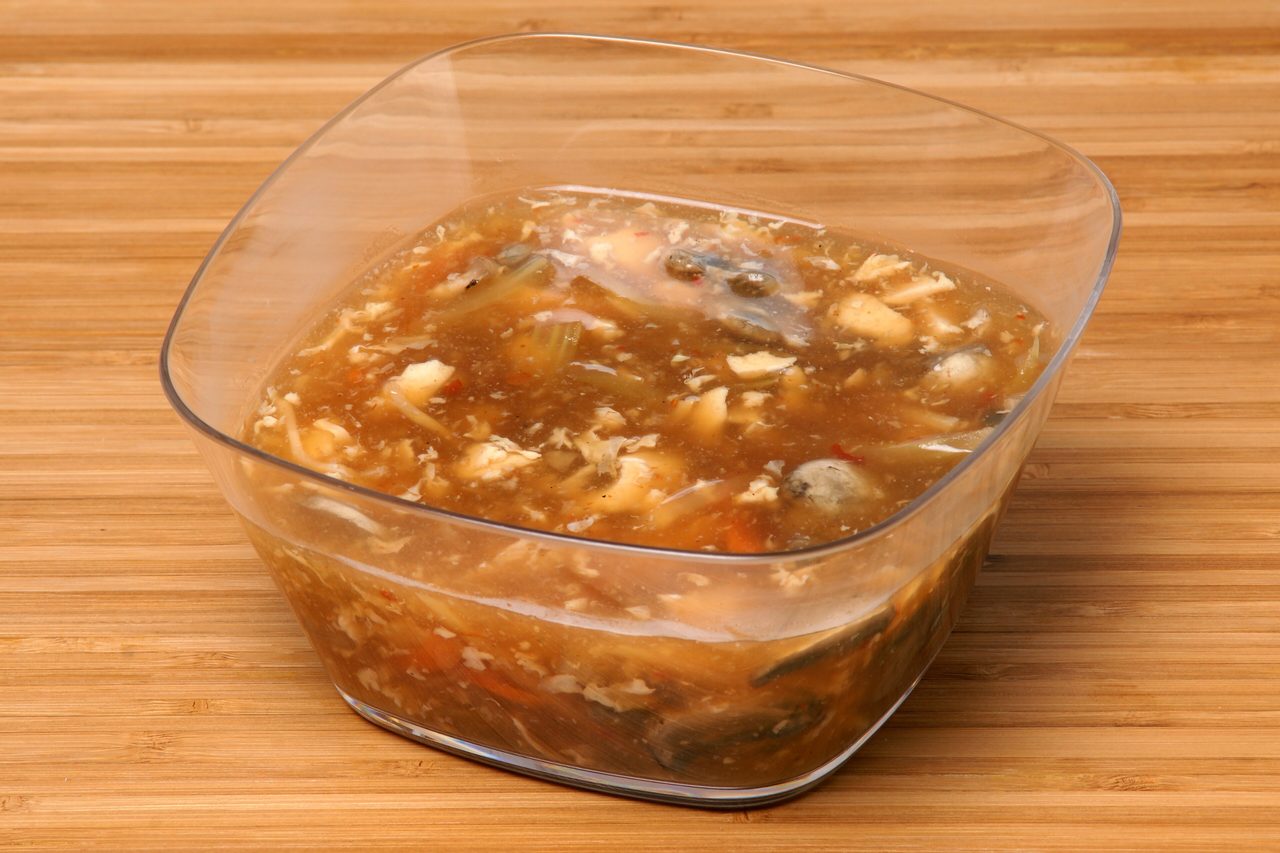
- The bowl in the photograph is the wide gauge with no chilli oil on it, so two of the five colours — the red and the white — are missing. What you get instead is an unusually honest look at how clear the broth is actually supposed to be.
- No alkali? Bake bicarbonate of soda at 120°C for an hour and it becomes a stronger alkali. With neither, the dough can still be pulled with salt alone, but it snaps far more often.
Tips
- Half of this is the flour. 12% protein or more. Plain flour tears at about the fourth fold.
- The other half is resting. Kneading builds gluten; resting lets it relax. Freshly kneaded dough springs back when you pull it; properly rested dough goes where you pull it. Skip the three half-hour rests and no amount of hand strength will pull it (dough and gluten).
- The alkali is not there for colour. Cooking noodles says alkaline noodle water clouds a broth and tells you to rinse — this is the dish that explains why the alkali is in there at all. At high pH the dough stretches far more smoothly and the thinning strands break less. The yellow is a by-product.
- Every fold doubles it. Count them and you control the gauge: four folds is 16 strands, six is 64, eight is 256. Stop at four or five the first time.
- Do not pull with your arms. Hold both ends and tap the middle on the bench; the dough's own weight stretches it. Hauling on it snaps it in the middle.
- Be generous with the dusting flour, between the strands at every fold. Strands that weld together do not come apart.
- Never boil the broth. Three hours at a bare shiver. One hard boil and it will not go clear again (stocks and broth).
- Boil the noodles apart and rinse them. Those two things are what protect the clear broth.
- Forty seconds. Fresh-pulled noodles are nothing like dried. When they float they are all but done.
- If the pulling defeats you, roll and cut instead. What you get is closer to kalguksu — a different noodle — and that difference is what this page is about.
The basics behind this dish
- Dough and Gluten: When to Build It and When to Avoid ItThe same flour and water becomes a dumpling wrapper or a tender pancake. The difference is whether you built gluten or avoided it — and kneading and resting do different jobs.
- Cooking Noodles: Salt, Starch, and Whether to RinseWhy the water is salted, why oil in it is a mistake, and the actual rule for which noodles get rinsed and which never do.
- Why Sauces Split: Emulsions and Pan SaucesA cream sauce breaking and a carbonara scrambling are the same failure. Temperature and emulsifiers — plus how to bring a split sauce back.
More of the same kind


More from this country


Sign in to edit.
AI-drafted, editor-reviewed · edits: 0 ·Edit history
https://cookiki.com/en/r/lanzhou-lamian · cookiki · User contributions are licensed under CC BY-SA 4.0.