
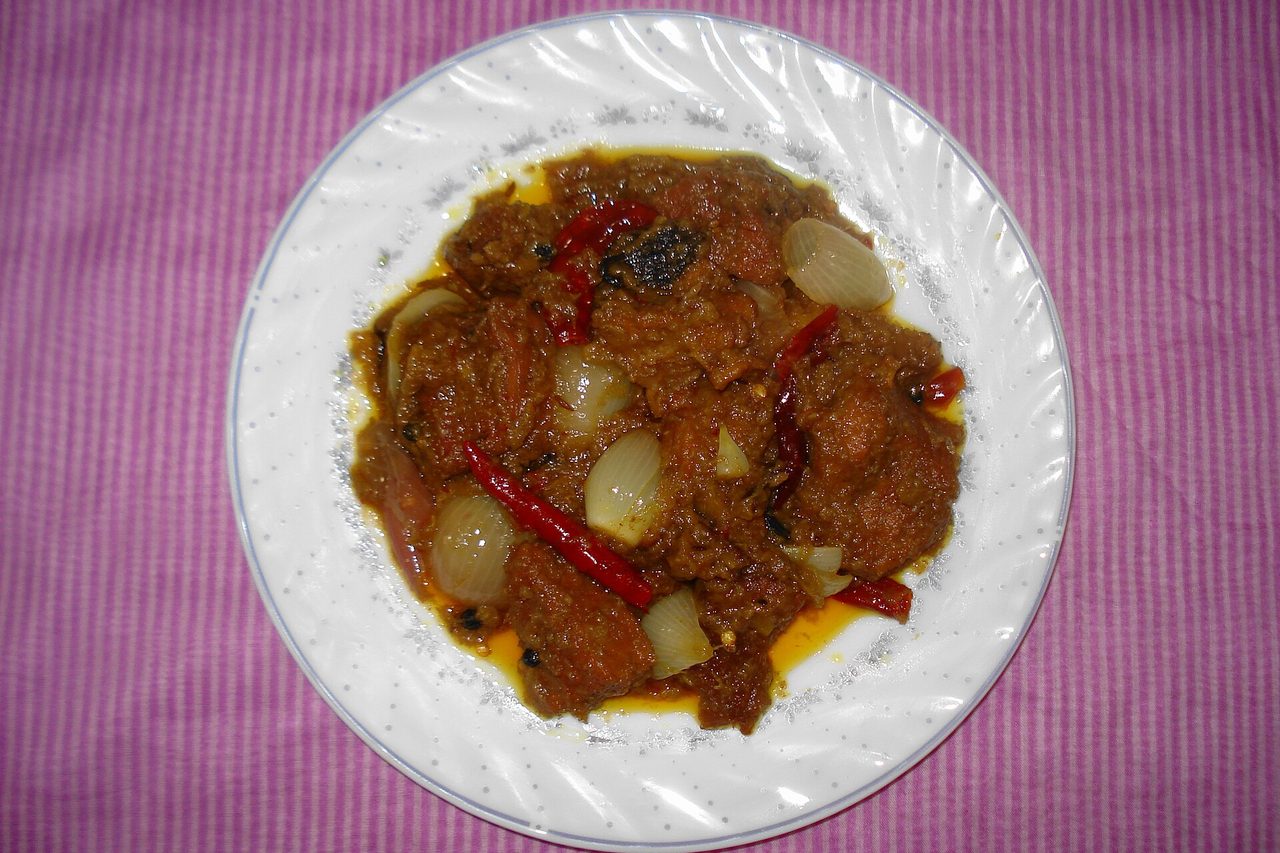
Photo: Ibrahim Rustamov · CC BY-SA 3.0
Qurutob (Torn Flatbread in Dried-Yoghurt Broth)
Tajikistan's national dish: balls of dried yoghurt soaked back into a broth, flatbread torn into it, vegetables piled on top, eaten with the hands from a shared bowl. This site dries fruit, dries vegetables, dries fish and dries bread. The one thing it never dries is the food that spoils fastest — dairy. Qurut is the answer to that: ferment it so the pH is already down, salt it, and dry it in the sun until it is as hard as a stone. It keeps for years with no refrigeration at all.
Ingredients
- The broth (serves 4, one shared bowl)
- qurut · dried yoghurt balls; Central Asian grocers120 g
- warm water · not boiling water500 ml
- If substituting
- Greek yoghurt · when qurut is not available400 g
- salt · only when substituting1 tsp
- The bread
- fatir · the layered Central Asian flatbread; naan or lavash will stand in2 pieces
- On top
- onion · sliced very thin1
- tomatoes · cut in large pieces2
- cucumber · cut in large pieces1
- coriander · coarsely chopped1 handful
- dill · coarsely chopped0.5 handful
- spring onions3
- The poured oil
- oil · or rendered mutton fat4 tbsp
- onion · sliced and fried1
- black pepper0.5 tsp
Steps
- ⏲ 40 min
Put the qurut in a bowl and pour over warm water (40–50°C). Leave 40 minutes. It is stone-hard, so crush it against the bowl with the back of a spoon as it softens. Do not pour boiling water on it and do not put it in a pan on the heat — this is acid-set protein, and heat splits it into grains (dairy and heat).
- ⏲ 10 min
Work it with a hand or a whisk until no lumps remain and it is about the consistency of thin yoghurt. If it tastes very salty, let it down with a little more water. Substituting Greek yoghurt, thin 400g with 150ml water and a teaspoon of salt.
- ⏲ 5 min
Warm the fatir briefly in a dry pan or oven and tear it into bite-sized pieces by hand. Do not cut it: a torn edge is ragged, and ragged edges hold the broth.
- ⏲ 5 min
Slice the onion very thin and soak it in cold water for 5 minutes, then drain. The raw bite goes and the crunch stays. Cut the tomato and cucumber into large pieces and chop the herbs coarsely.
- ⏲ 8 min
Fry the sliced onion in the oil for 8 minutes, until pale brown. Add the pepper and take it off. This oil is the only part of the dish that meets a flame.
- ⏲ 3 min
Lay the torn bread in a wide shallow bowl (a tabaq) and pour the qurut broth over it so the bread is half submerged. Fully submerged, it becomes porridge.
- ⏲ 3 min
Pile the onion, tomato, cucumber and herbs over the top like a blanket, then spoon the fried onion and its oil over that.
- ⏲ 5 min
Leave it 5 minutes, then serve. You want the bread to have drunk the broth and softened while still holding its shape. Eaten with the hands, several people from one bowl, is the original way.
Tips & Variations
Variations
- With meat: boiled lamb, pulled and laid over the top. Common when it is served to guests in Tajikistan, and some of the cooking liquid often goes into the qurut broth.
- If you cannot get qurut: Greek yoghurt let down with water and salt gets the shape of the dish. But qurut's taste is what fermentation, salt and drying built over months, and the deep note behind the sourness and the salt does not come back. It is more accurate to think of it as a different dish.
- Instead of fatir: naan, lavash, even stale baguette. Fatir is baked with fat worked into it in layers, so in liquid it stays in pieces rather than dissolving; with a thin bread you notice.
- As a cold summer dish: chill the broth. Nothing here is cooked, so the temperature is free.
- Osh qurutob: the regional version with rice in it.
Tips
- Dairy was the one thing this site never dried. Dried persimmon dries fruit, takuan and bugak dry vegetables, the hwangtae in hwangtaeguk dries fish, lavash dries bread. Milk was not on the list, and milk is the thing that spoils fastest. Qurut solves it by stacking three preservations: the ferment has already dropped the pH (fermentation basics), salt goes further, and drying takes away the water microbes need. That is why it keeps for years in a mountain pastoral economy with no refrigeration.
- Warm water, and never boiled. Dairy and heat gives three conditions under which yoghurt splits: boiling, acid, and salt plus prolonged heat. Qurut already has two of them — it is acid and it is salty. Only the third is left to avoid, and that is why this recipe pegs the water at 40–50°C.
- Cultured dairy is handled several ways here. Dovga stabilises it with egg and flour so it can be boiled; šaltibarščiai never applies heat at all and so the problem never arises; qurutob stops below the temperature at which it splits. Same ingredient, same risk, different ways round it.
- The bread has to be torn. A knife-cut face is smooth and the broth runs off it; a torn face is ragged and holds it. And the broth goes only half way up the bread — fully submerged this becomes something you eat with a spoon, like umm ali, and qurutob is a dish you eat with your fingers.
- Only one part of it meets a flame. Nothing is cooked except the oil that goes over the top. The cooking was finished months ago on a roof in the mountains. It belongs to the same class as dasik, which uses neither water nor heat.
- Soak the sliced onion. The sharp compounds in thin raw onion dissolve into water. Five minutes is enough and the crunch survives intact.
The basics behind this dish
- Browning and the Maillard ReactionMeat fails to brown for one of three reasons: it is wet, the pan is cool, or you put too much in at once. Plus how the brown film stuck to the pan becomes your sauce.
- Cooking Meat: Temperature, Resting, and Cutting Against the GrainDoneness is a core temperature, not a number of minutes. What resting actually does, how to handle a thick cut, and why the direction you slice changes the texture.
- Knife Skills: Grip, Cuts, and Why Size MattersHow you hold the knife matters more than how fast you cut. The pinch grip, the claw hand, and why uniform size is a cooking decision rather than a cosmetic one.
More of the same kind


Sign in to edit.
AI-drafted, editor-reviewed · edits: 0 ·Edit history
https://cookiki.com/en/r/qurutob · cookiki · User contributions are licensed under CC BY-SA 4.0.