
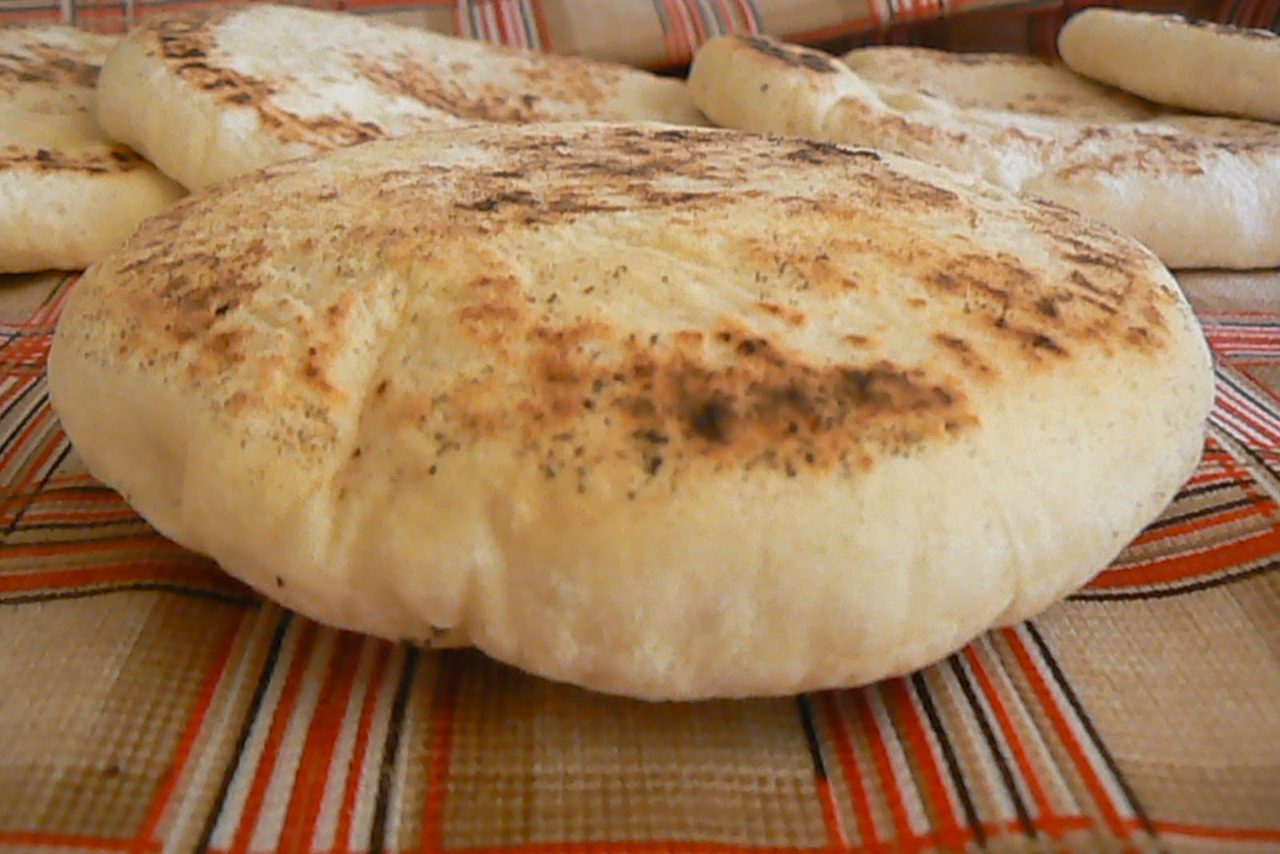
Photo: Narek75 · CC BY-SA 4.0
Lavash (Paper-Thin Flatbread Dried for Storage)
An Armenian flatbread of flour, water and salt, rolled out to paper and baked in under a minute against the wall of a clay oven. Every other bread on this site is best fresh and treats drying as the enemy. Lavash is baked in order to be dried: stacked and left until it is brittle, it has too little water for anything to live in and keeps for months. Then you sprinkle it with water, cover it with a cloth for a few minutes, and it is soft bread again. The drying is reversible, and that is the whole trick.
Ingredients
- The dough
- plain flour500 g
- water · lukewarm; 56 percent280 ml
- salt1.5 tsp
- Optional
- yeast · traditional lavash is unleavened, but leavened versions exist3 g
- sesame or nigella seeds · pressed on before baking2 tbsp
- To revive it
- water · flicked on by hand, per dried sheet3 tbsp
- To wrap in it
- brinza or feta200 g
- tarragon, basil, coriander · Armenia wraps fresh herbs in it as they are1 handful
- grilled meat · khorovats400 g
Steps
- ⏲ 10 min
Mix the salt into the flour, add the lukewarm water, bring it together and knead for ten minutes until smooth.
- ⏲ 60 min
Cover it and rest it for an hour. Dough and gluten's rule exactly: dough springing back is a time problem, not a strength problem. The thinness of lavash comes out of this hour.
- ⏲ 15 min
Divide into eight, roll into balls, and rest them covered another fifteen minutes.
- ⏲ 15 min
Roll one out to about 40 x 25cm and under a millimetre. Use as little flour as you can — excess scorches on the surface and tastes bitter. Once rolled, drape it over the back of your hands and stretch it thinner still.
- ⏲ 10 min
Get a cast-iron pan or an upturned wok very hot indeed. No oil. Traditionally it is slapped onto the wall of a tonir.
- ⏲ 1 min
Lay the sheet on for thirty to sixty seconds — big blisters rise and dark spots appear underneath — then turn it for twenty seconds more. Do not wait for an even brown; by then it has gone brittle.
- ⏲ 5 min
To eat it soft, stack the sheets under a damp cloth as they come off. They keep each other pliable with their own steam.
To store it, do the opposite: spread the sheets out singly until they are completely dry and brittle, then stack them and wrap the stack in a dry cloth. It keeps for months like that.
- ⏲ 10 min
To revive a dried sheet: flick water over it by hand and leave it between damp cloths for five to ten minutes. It comes back soft enough to fold and roll. Revive only what you are about to eat — revived lavash spoils within a day.
Tips & Variations
Variations
- Soft lavash: fresh off the pan and stacked under a damp cloth. This is the version used as a wrap.
- Dried hard: used as a plate, broken into soup, or eaten as it is like a cracker. Often seeded with sesame or nigella.
- Around the region: Iranian nān-e lavāsh, Turkish lavaş and Azerbaijani lavaş are all the same family. UNESCO inscribed Armenian lavash in 2014, and separately inscribed the flatbread culture of Azerbaijan, Iran, Kazakhstan, Kyrgyzstan and Turkey in 2016.
- Hats brnadzov: revived lavash rolled around brinza cheese with tarragon and basil — the commonest Armenian breakfast there is.
- Church bread: the Armenian Apostolic Church's communion bread is made from this same unleavened dough.
Tips
- The aim is the opposite of this site's other breads. Shokupan uses a tangzhong to hold water and slow staling; pumpernickel bakes wet for sixteen hours. For lavash, completely dry is the finished state.
- The difference from bugak is that this is reversible. Bugak is also dried for keeping, but what follows is frying, and the dry state is its final form. Put water back into lavash and it is bread again. Same water-activity logic; one is a one-way trip and the other a round one.
- One millimetre only comes off a rested dough. Without the hour it springs back however hard you roll. It is the same reason kalguksu and mandu doughs sit for half an hour — here it is twice as long.
- You do not need the oven. A tonir wall is well over 400C, but a cast-iron pan at its hottest will cook a 1mm sheet. Naan needs tandoor heat because its dough is leavened and thick; this one is too thin to need it.
- Be sparing with the flour you roll in. Loose flour scorches on the surface before the dough does, and the bitterness stays.
- Eat revived lavash the same day. The moment water goes back in, it stops being a preserved food.
- Dry the sheets singly. Stacked, steam is trapped between them, those patches never dry, and that is where mould starts.
The basics behind this dish
- Dough and Gluten: When to Build It and When to Avoid ItThe same flour and water becomes a dumpling wrapper or a tender pancake. The difference is whether you built gluten or avoided it — and kneading and resting do different jobs.
- Serving Temperature: Why Some Dishes Wait and Some CannotWhy cold dishes need heavier seasoning, why rice and rice cake go stale fastest in the fridge of all places, and the dishes where letting the steam off is the point.
- Heat Control: Preheating, Oil, and Reading the PanThe same ingredients become a different dish depending on pan temperature. When to add the oil, how to read heat by sound, and which dishes want low heat instead.
More of the same kind


Sign in to edit.
AI-drafted, editor-reviewed · edits: 0 ·Edit history
https://cookiki.com/en/r/lavash · cookiki · User contributions are licensed under CC BY-SA 4.0.