
Seolleongtang (Milky Ox Bone Soup)
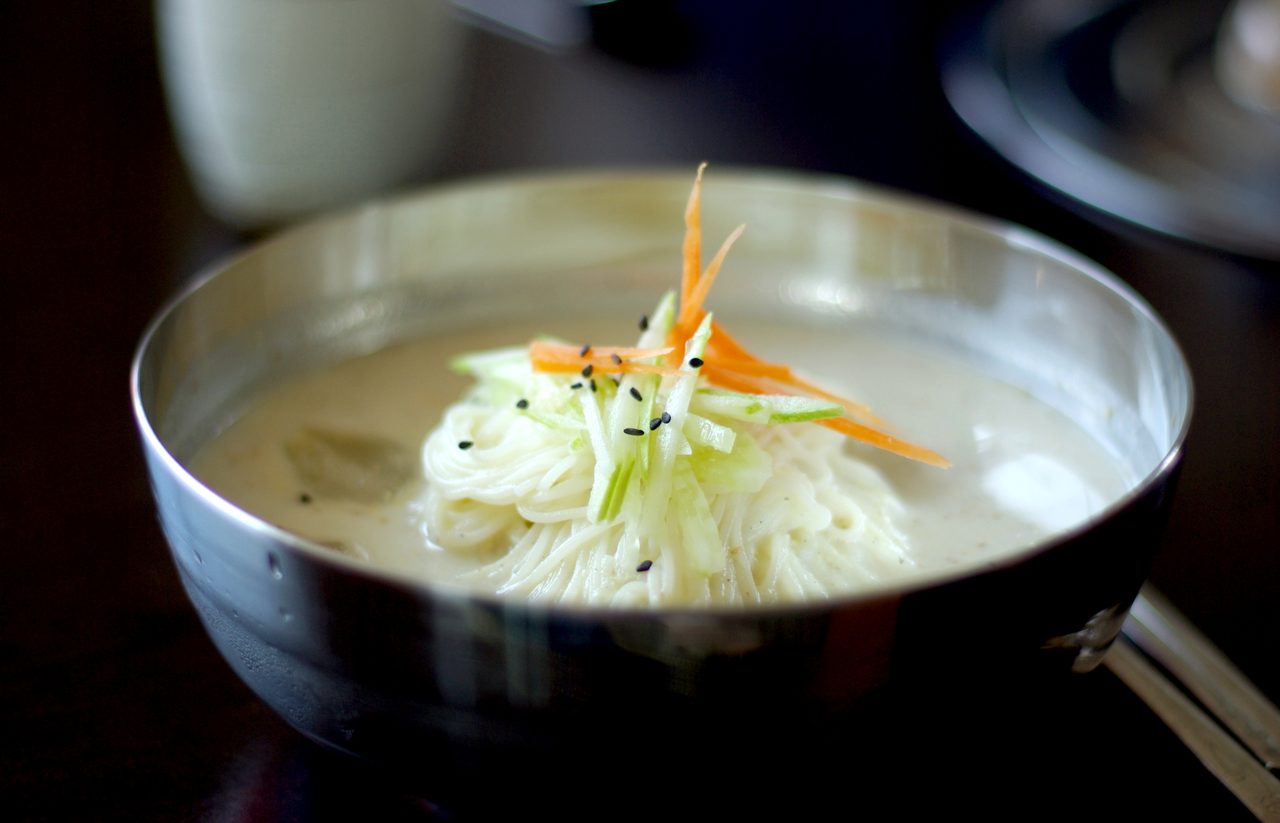
Seoul's ox bone soup, boiled until the broth turns milk-white. That whiteness is not dairy but fat and gelatin emulsified into water — which is why, unlike almost every other broth, this one wants a rolling boil. And it is seasoned at the table, not in the pot.
Ingredients
- Bones and meat
- beef leg bones · cut into lengths; you need exposed marrow for the broth to go white1.5 kg
- assorted beef bones · optional; knuckle or back bones add gelatin500 g
- beef brisket · or shank. This is the topping, not the broth600 g
- To draw the blood
- cold water · enough to cover the bones, changed several times4 L
- To simmer
- water · well over the bones; top up with hot water as it reduces5 L
- leek · for poaching the meat only — not for the bone broth1 stalk
- garlic · with the meat only5 cloves
- ginger · with the meat only15 g
- To serve
- thin wheat noodles · optional; boiled and rinsed200 g
- cooked rice · stirred into the soup is the standard way4 bowls
- At the table (not in the pot)
- salt · added by each person4 tsp
- black pepper · coarsely ground1 tsp
- spring onions · finely sliced, generously3 stalks
- kkakdugi · radish kimchi; the acid, not a side dish300 g
Steps
Soak the leg bones in cold water for at least 6 hours to draw out the blood, changing the water whenever it reddens, until the last change comes out pale pink. Cut this short and off-smells and grey scum stay in the broth to the end.
- ⏲ 15 min
Parboil the bones from cold water. As the grey foam rises, boil 10 more minutes and then throw all the water away. Rinse the bones under running water, rubbing off the dark residue clinging to them.
- ⏲ 30 min
Rinse the pot, return the bones with 5L of fresh water, and bring it to a hard boil. This broth wants a rolling boil. Only violent agitation breaks the fat released by the bones into droplets fine enough to stay suspended, and that emulsion is the milky white. A gentle simmer gives you a clear yellow broth instead.
- ⏲ 240 min
Cover and hold it at a hard boil for 3-4 hours. Top up with hot water only — cold water breaks the emulsion and the broth clears again. No leek, garlic or ginger goes into the bone pot: tasting of bones and nothing else is the character of this soup.
- ⏲ 180 min
Once it is white, lift out the bones, add fresh water and extract a second time for 3 hours. Blending the first and second extractions is how the seolleongtang houses do it — the first is dense and the second thin, and together they are rich without being heavy.
- ⏲ 90 min
Poach the brisket separately: soak 30 minutes in cold water, then simmer 90 minutes over low heat with the leek, garlic and ginger. Unlike bones, meat turns dry at a boil, so this part stays gentle.
- ⏲ 30 min
Lift the meat out, cool it completely, and slice it thinly across the grain. Sliced hot it falls apart; sliced with the grain it eats tough.
Strain the bone broth to remove fragments and sediment. Chilling it overnight makes the set fat easy to lift off. Do not remove all of it — emulsified fat is half of both the colour and the body.
- ⏲ 10 min
Bring the broth back to a hard boil before serving. Cooled broth separates into layers; boiling recombines it and the white returns.
- ⏲ 5 min
Put the sliced meat and, if using, noodles and rice into a stone bowl and pour the boiling broth over. The broth itself is not seasoned.
- ⏲ 2 min
Bring salt, pepper and plenty of sliced spring onion to the table separately, with kkakdugi alongside. This is structure rather than etiquette: unsalted broth is what lets the bones show through, and it leaves the saltiness to whoever is eating.
Tips & Variations
Variations
- Doganitang adds knuckle joints to push the gelatin to an extreme; the broth sets like jelly when cold.
- Kkori-gomtang is made from oxtail. Bone and meat come together, so the broth tastes meatier and renders far more fat.
- Against gomtang, the distinction is drawn differently from region to region, but in practice seolleongtang leads with leg bones and comes out white, while gomtang leads with meat and offal and stays somewhat clearer. Naju gomtang is the clear archetype.
- A pressure cooker cuts it to two hours but comes out less white: inside one the liquid stays at boiling temperature without any surface agitation, so far less emulsifies. Pressure-cook 90 minutes, then boil hard uncovered for 30 with the lid off and the colour returns.
- Rice rather than noodles is the standard. The broth is mild enough that rice stirred in does not thin it out.
- Gamjatang is the other bone-broth dish on this site, and it runs the opposite way: pork spine plus seasoning, where this is beef bone plus nothing.
Tips
- The whiteness is an emulsion, not dairy. Fat rendered from the bones is broken into fine droplets and dispersed through the water, and gelatin from the same bones coats those droplets so they cannot coalesce again. Advice to add milk or creamer circulates for this dish; it is unnecessary and muddies the flavour (emulsions and pan sauces).
- Which is why this one broth is boiled hard. In every other broth a rolling boil is the failure — the clear soup of beef noodle soup only comes from a bare simmer, and boiling it counts as having clouded it. Seolleongtang sets out to produce that very cloudiness, so the rule is inverted (stocks and broth).
- Never top up with cold water. It drops the temperature, breaks the emulsion, and takes a long while to recover. Keep a kettle of hot water going.
- Do both the soak and the parboil. One does not stand in for the other: six hours of soaking pulls blood out of the bone, and parboiling-then-discarding removes surface protein and scum. Between them they decide how clean it tastes.
- No aromatics in the bone pot. Leek, garlic and ginger belong only in the water the meat poaches in. Tasting of bone alone is what this soup is; add aromatics and it drifts towards samgyetang territory.
- Do not season the pot. Salt added early cannot be taken back, and rice or noodles going into the bowl shift the seasoning again. Seasoning at the table is the design of the dish (salt and seasoning).
- Cool the meat before slicing. Hot, it falls apart; thin and across the grain is what makes it tender (braising: collagen and time).
- The broth freezes well. Make a large batch and portion it: 4 days refrigerated, 3 months frozen. Always bring it back to a hard boil after thawing or the white will not return (freezing and thawing).
- The Japanese broth built on the same physics is the tonkotsu of ramen — pork bones boiled hard for hours until white, by exactly this mechanism.
The basics behind this dish
- Stocks and Broths: Clarity, Time, and Why You Do Not Salt ThemWhat separates a clear stock from a cloudy one is temperature, not ingredients. Why you start in cold water, how long each ingredient wants, and why salt comes later.
- Salt: When You Add It Matters More Than How MuchThe same amount of salt either draws water out or seasons all the way through, depending on when it goes in. Osmosis, seasoning in layers, and why salt types are not interchangeable by volume.
- Knife Skills: Grip, Cuts, and Why Size MattersHow you hold the knife matters more than how fast you cut. The pinch grip, the claw hand, and why uniform size is a cooking decision rather than a cosmetic one.
More of the same kind


More from this country


Sign in to edit.
AI-drafted, editor-reviewed · edits: 0 ·Edit history
https://cookiki.com/en/r/seolleongtang · cookiki · User contributions are licensed under CC BY-SA 4.0.